The Complete Guide to Keyword Cluster Validation for SEO

Every few months, Google rolls out a major algorithm update, and search professionals scramble to figure out why supposedly cohesive topic clusters are suddenly cannibalizing each other's traffic. Why do separate pages targeting closely related terms end up fighting for the exact same ranking spot? It happens because matching words by their literal meaning isn't the same as matching what a search engine actually rewards. Keyword cluster validation is the process of confirming that grouped search terms share the same user intent by analyzing real-time search engine results pages (SERPs). Instead of relying on guesswork or basic semantic grouping, a rigorous validation workflow ensures multiple queries can successfully rank on a single page without causing internal friction.
Relying strictly on semantic keyword grouping often misses these nuances because it looks at word roots instead of actual ranking data.
Research indicates that the prevalence of internal competition increases significantly as a website grows older. Brand new sites typically only experience overlapping queries on about 2% of their content, but mature sites active for over ten years face duplicate content conflicts on approximately 14% of their pages. You might notice two newly published articles swapping places in search results every week and splitting your traffic. This guide breaks down a comprehensive workflow for validating keyword groups using live SERP data—complete with dynamic thresholds and strategic content integration—to fix exactly that.
Quick Takeaways: Keyword Cluster Validation
- Keyword cluster validation is the essential process of confirming that grouped search terms share the exact same user intent by analyzing real-time search engine results, preventing your own pages from fighting for the same ranking spot.
- Discover why relying on basic semantic grouping or conversational AI models to bucket your keywords often leads to mismatched user intents and severely wasted content production budgets.
- Uncover the exact mathematical overlap thresholds you need to definitively prove whether two distinct search queries should share a single landing page or be split into separate assets.
- Learn how to dynamically adjust your SERP clustering parameters based on your specific domain authority to consolidate your ranking signals and build topical relevance faster.
- Find out how to automatically translate a flat spreadsheet of validated terms into a robust pillar-and-cluster site architecture where your internal linking structure practically writes itself.
- Master the consolidation playbook to identify aggressive position swapping, merge cannibalizing content, and focus your domain's historical ranking signals into a single authoritative hub.
The business impact of keyword cluster validation
The financial argument for grouping queries correctly is straightforward. Every page you publish costs money to outline, draft, edit, and maintain. When you build multiple URLs for intents that should have shared a single page, you dilute your ranking power and inflate your production budget.
Consolidating organic traffic
A meta-study analyzing content consolidation efforts at scale found that large websites—those with 10,000 to 100,000 pages—achieved an average organic traffic increase of nearly 78% after pruning and merging overlapping pages. They accomplished this growth even though they reduced their total indexable content footprint by roughly 24%. Having fewer, stronger pages usually beats maintaining a sprawling index of thin, narrowly focused articles. Grouping your targets correctly before publishing prevents the need for massive pruning projects later.
Prioritizing production by aggregate potential
Imagine looking at a backlog of content briefs for the upcoming quarter. If you score priority based on isolated search volume, you might assign top billing to a highly competitive, broad term that your domain lacks the authority to capture. By validating clusters, you shift the metric from individual keyword volume to aggregate traffic potential. A validated group of sixty long-tail variations might collectively offer more realistic traffic than one vanity short-tail phrase. Our take: this approach changes how we allocate budget. The focus is on topics where a site can actually win, not individual phrases that look impressive in a spreadsheet.
Eliminating redundant content spend
Teams consistently waste resources trying to write distinct articles for "b2b crm software" and "crm for b2b companies". If the live search results show identical ranking pages for both queries, paying a writer to craft two separate articles is throwing money away. Validation catches these overlaps early. It forces you to build one comprehensive asset that satisfies the core intent, which reduces your cost-per-acquisition for organic leads.
Why semantic-only clustering fails without SERP validation
Most standard grouping models rely on semantic similarity or morphological matching. They look at the text strings, identify common root words, and lump them together. While that creates linguistically tidy lists, it largely ignores how real users behave and how search algorithms interpret that behavior.
The intent mismatch trap
Linguistic matching treats words with similar definitions as identical targets. For example, if you use a basic AI grouper, you might find "buy running shoes" and "best running shoes" in the exact same bucket because the core noun phrase is identical. But looking at the actual search results tells a different story. The transactional query triggers e-commerce category pages and shopping carousels. The informational query triggers long-form review articles and buyer's guides. If you build one page to target both, it'll fail to rank for either because it can't satisfy two conflicting user intents simultaneously.
The opposite problem often occurs, too. A purely semantic tool might separate "affordable sneakers for jogging" from "cheap running shoes" because the vocabulary differs. Real-time validation proves that search engines treat those phrases as the exact same intent, rewarding the exact same set of URLs. Trusting the text without checking the SERP leads to missed opportunities and duplicated efforts.
Moving past one-keyword-per-page
The old model of building a dedicated landing page for every keyword variation is dead. The average top-ranking page now ranks for about 1,000 other relevant keywords. Search engines have evolved to understand topical authority and broad intent mapping.
True search intent mapping goes beyond topical relevance; it requires verifying that the algorithm wants to serve the exact same page format for those grouped queries. They reward comprehensive resources that answer a user's underlying question, regardless of the specific phrasing typed into the search bar.
Semantic grouping alone can't confidently tell you which of those 1,000 variations belong together. Only SERP-based clustering provides the empirical evidence needed to combine them safely. When you base your content architecture on actual ranking behavior instead of vocabulary overlap, you build a structure that mirrors the reality of modern search algorithms.
Methodology comparison: manual grouping versus automated SERP validation
If you've ever stared at a raw, 10,000-row export from a traditional SEO tool, you know the exact feeling of spreadsheet fatigue. Flat lists offer data without architecture. Deciding which terms belong on a pillar page versus a supporting subtopic requires a structured methodology, and the tools you choose dictate how painful that mapping process will be.
The limits of manual verification
Historically, teams verified intent by typing queries into search engines one by one and visually comparing the results. You could also cross-reference performance data in Google Search Console to see if a single URL was already earning impressions for multiple variations. Manual spot-checking works perfectly for a handful of primary targets. However, when you need to architect a resource center with hundreds of pages, manually checking tabs and cross-referencing URLs becomes a massive bottleneck. The scale of the work breaks the methodology.
Evaluating generative AI for grouping
Many strategists try to solve their spreadsheet bottleneck by pasting flat lists into conversational models like ChatGPT. The logic seems sound—ask the AI to group the list by topic. The problem is that these models group by linguistic probability, not live search data. They lack native, real-time connectivity to the current SERP landscape for your specific geographic and device targets.
While generative tools are excellent at organizing information logically, their output is an educated guess about how a search engine might interpret the terms. Relying solely on an LLM for clustering results in beautifully formatted tables that still cause cannibalization when pushed to production.
The case for automated reverse-engineering
The alternative to manual checking and AI guesswork is automated SERP validation. Using tools in this category, you can scrape the actual search results for every term on your list, compare the ranking URLs at scale, and group queries based on empirical overlap. That methodology replaces assumptions with hard data. If a platform can automatically determine that three specific queries share the exact same top-ranking competitors, you have verifiable proof that they require a single, unified page.
Keyword Cluster Validation Tools Comparison
| Platform | Clustering Approach | Key Differentiator | Starting Price |
|---|---|---|---|
| RankDots | Customizable live SERP overlap | Pre-clustering AI data cleaning | Contact for pricing |
| Keyword Insights | Live SERP data | Automated AI content briefs | $58/month |
| KeyClusters | Real-time SERP overlap | Pure-play direct CSV imports | $4.97 per 1,000 keywords |
| LowFruits | Top 100 SERP scraping | Identifies weak domain spots | $21/month |
| Keyword Cupid | Neural network processing | Interactive visual mind maps | $9.99/month |
Implementation workflow: live SERP reverse-engineering
A validated cluster requires you to shift your perspective from what you want to rank for, to what the algorithm is currently rewarding. Reverse-engineering live ranking patterns reveals structural opportunities that search volume metrics alone often obscure.
Extracting structural data from search results
The validation process begins by pulling the actual URLs that rank for your target queries. With specialized overlap tools like KeyClusters, you can group keywords purely by comparing live results. Similarly, you can use platforms like LowFruits to scrape the SERPs and identify weak domain spots and user-generated content. The shared mechanism here is data extraction: analyze the specific page types, content formats, and topical depth that currently own the first page.
If the majority of ranking pages are product categories, your informational blog post will struggle, no matter how well it's written. Gathering structural data upfront prevents you from investing heavily in the wrong content format.
Applying URL intersection analysis
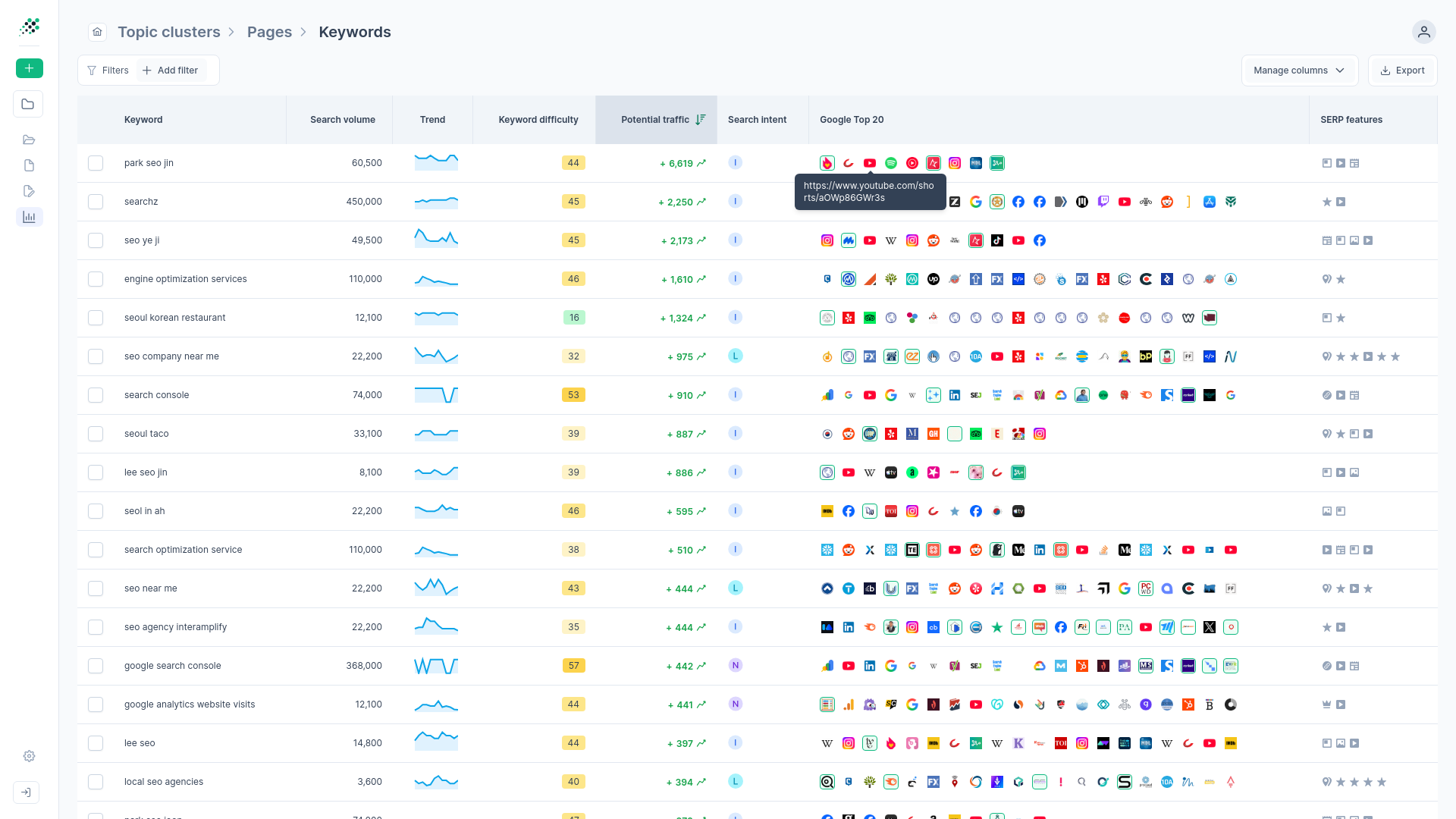
Once the SERP data is extracted, the next step is calculating the overlap. The widely accepted threshold for SERP-based keyword clustering is three to four overlapping URLs. Under that standard, if two distinct search queries share at least three or four of the same top 10 ranking pages, they share the same underlying user intent.
You validate these clusters in RankDots using its URL Intersection Analysis feature. RankDots runs an automated check across your keyword set to validate that the same pages actually rank across your newly formed clusters, which saves you from comparing lists manually. If the intersection hits the required threshold, the grouping is validated for a single page. If the intersection is too low, the system splits the terms into separate targets. Users can even customize the SERP overlap threshold, making the grouping parameters stricter or more lenient based on their specific site architecture.
Cross-referencing overlap indicators
Beyond checking URLs, advanced validation looks at where the keyword demand originates. With RankDots, you can validate the strength of individual queries using Data Source Overlap Indicators. If a keyword is discovered across multiple active environments simultaneously—such as autocomplete suggestions, related searches, and traditional volume planners—it receives a stronger validation score.
You remove the guesswork from content planning by combining URL intersection with data source validation. Instead of mapping a flat list of text strings, you build a taxonomy grounded in verified search engine behavior, organizing topics into broad pillar pages and highly specific supporting articles.
Implementation workflow: cross-referencing multi-source overlap indicators
Picture this scenario: you have a massive keyword export and a major campaign launching in two weeks. The raw list is a mess—filled with competitor brand names, bizarre misspellings, and irrelevant local modifiers. Processing search volume and keyword difficulty metrics for 50,000 unvetted rows burns through tool credits rapidly. Worse, it pollutes the strategic mapping phase with garbage data. You risk wasting the month's budget on dirty queries before the actual SEO analysis even begins.
Cleaning data before running heavy metrics
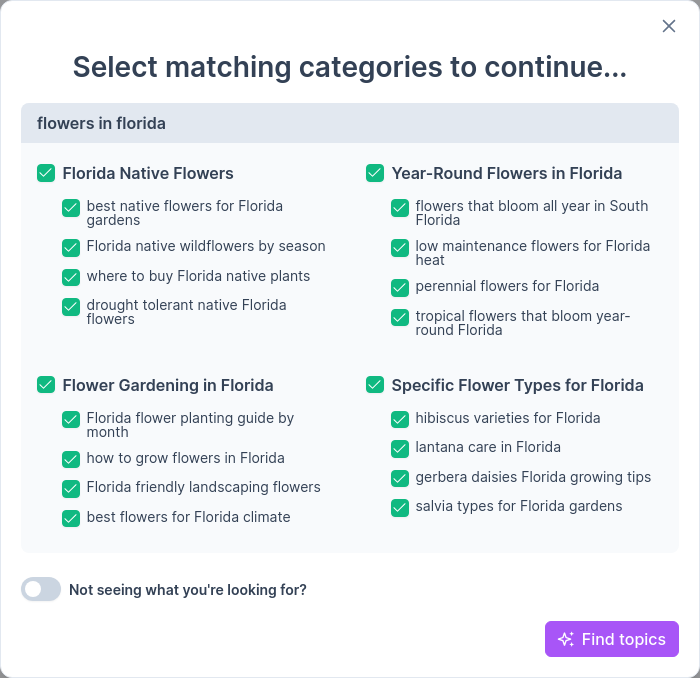
Most teams pull raw data from various discovery tools and dump it straight into a master spreadsheet. Inserting a strict filtering phase before pulling metrics is usually recommended. Filtering out noise early saves hours of manual pruning down the line. Before keywords are clustered or expensive metrics are collected, you can run an automated AI validation sequence in RankDots. You can use the platform to check every single query against multiple linguistic rules and perform semantic relevance checks that remove obvious junk.
If your seed topic is "running shoes," the system instantly filters out irrelevant tangents like "running man game" or "running boards for trucks." When you strip away formatting issues, unwanted geographic modifiers, and disconnected topics, you limit your compute costs and human attention to the queries that actually matter to your business. Data cleaning is also about intent purity. When you dump an unfiltered list into a metric tool, you pay for data you'll never use. Remove the noise early to keep the focus entirely on actionable topics.
Multi-source intent confirmation
To validate a keyword's worth, look far beyond its theoretical monthly search volume in a traditional planner. Many platforms only pull data from the Google Ads Keyword Planner. While that provides a solid baseline for paid advertising, it often misses the long-tail conversational queries real people type into the search bar. Tracking methodologies must evolve beyond historical averages.
Look for active, multi-source confirmation. If a specific query only appears in a single database, it might be a historical anomaly, a seasonal blip, or just a low-quality algorithmic extrapolation. You can validate the strength of individual queries by tracking their precise origins using Data Source Overlap Indicators in RankDots. When a keyword is discovered simultaneously across multiple live environments—like Google Ads Keyword Planner, real-time autocomplete suggestions, and bottom-of-page related searches—it receives a much stronger validation score. That multi-source presence acts as undeniable proof. It indicates the query is highly relevant, actively searched by real users right now, and genuinely worth targeting in your upcoming content cycle.
Normalizing and merging disparate lists
If you pull data from multiple distinct streams, you inevitably create massive duplication problems. You might scrape "b2b crm software" from an autocomplete API and "crm software for b2b" from a competitor analysis export. Normalizing these strings into a unified, workable format is critical for accurate clustering.
In RankDots, you can use pipeline management to automatically deduplicate, normalize, and merge these overlapping variations into a single unified list. If multiple sources find the exact same term, the system intelligently keeps the best available metrics—logging the highest search volume, retaining the most complete SERP data, and recording the lowest difficulty score.
You significantly change your baseline confidence level by taking the time to cross-reference where your queries actually originate. You stop guessing if a long-tail term is actually valuable and start trusting the aggregated demand signals.
Implementation workflow: applying dynamic overlap thresholds
Most SEO professionals treat keyword grouping parameters as a rigid, universal rule. In standard practice, the widely accepted threshold for SERP-based keyword clustering is three to four overlapping URLs. This means if two distinct search queries share at least three or four of the same top ten ranking pages on Google, they are considered to have the same underlying user intent. But treating that benchmark as an absolute law ignores the reality of differing site architectures, content goals, and domain strengths.
Setting strict versus lenient parameters
A customized overlap threshold changes the entire shape of your eventual content plan. In RankDots, you can customize the SERP overlap threshold to adjust the sensitivity of the grouping algorithm.
A strict threshold—requiring five or six shared URLs—produces highly fragmented, specific topic clusters. We typically lean toward a stricter setting when building out a bottom-of-funnel conversion hub, where user intent is incredibly precise and subtle differences in phrasing matter. Conversely, a lenient threshold—requiring just one or two shared URLs—creates massive, broad topic buckets. For top-of-funnel educational glossaries or beginner guides, a lenient threshold works perfectly to catch wide linguistic variations under one roof.
Adjusting for domain authority
Your website's current ranking power should heavily influence your clustering sensitivity. High-authority domains can afford to target incredibly nuanced query variations with separate, highly specific pages. Search engines trust them enough to rank distinct articles for "best email marketing software" and "top email marketing platforms."
Newer or lower-authority sites simply can't pull that off. They need to consolidate their ranking signals. If you manage a newer domain, dropping your threshold to group more terms together into definitive, comprehensive pillar pages almost always yields better traction. Consolidation builds topical authority much faster than fragmentation. Your overarching SEO strategy plays a massive role here as well. If your mandate is to cast a wide net and capture top-of-funnel awareness traffic rapidly, setting a lenient threshold allows you to brief out massive, ultimate-guide style articles.
Forcing a cluster split despite high overlap
Sometimes the search engine results demand a split even when the semantic meaning is nearly identical. You might analyze a cluster where informational guides and e-commerce product pages are actively fighting for dominance on page one.
In these mixed-intent scenarios, a mathematical overlap score isn't always enough. If you see a split SERP—half blog posts, half product category pages—force the cluster apart. Build one asset for the researchers and a separate asset for the buyers.
Dynamic thresholds return control to the strategist. Matching the granularity of your clusters to your actual production capacity and domain authority is what turns a theoretical keyword map into a highly practical editorial roadmap.
Translating validated clusters into content strategy
You ran the validation checks. The messy export is gone. Your content director now stares at a clean, verified list of grouped terms, feeling genuinely empowered to present a data-backed site structure to the executive team. The guesswork is eliminated, but the next major hurdle remains: translating those theoretical keyword buckets into a concrete publishing schedule and page hierarchy.
Mapping a pillar-and-cluster architecture
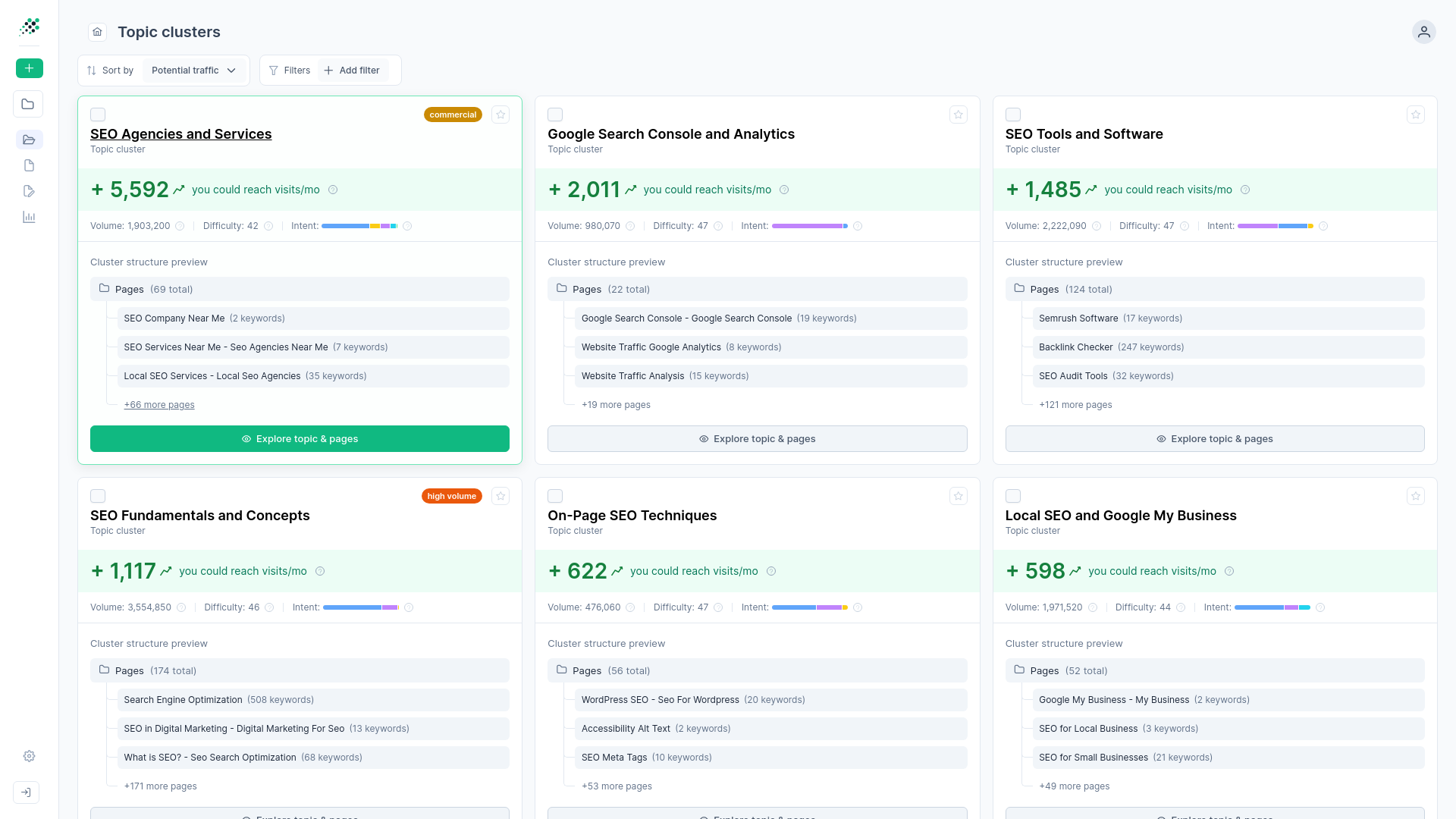
Translating keyword data into a cohesive architecture requires moving from a spreadsheet mentality to a structural one. Most teams struggle here because they still view keywords as individual checklists. A validated cluster map should dictate your exact site architecture. You can use RankDots to organize the validated keywords into a two-level hierarchical structure right away, which saves you from trying to invent a logical navigation flow from a flat list.
Broad parent topics—like "email marketing automation"—automatically become your main pillar pages. The highly specific subtopics—such as "drip campaign examples" or "B2B email sequences"—become your supporting articles. This pillar-and-cluster architecture means every new piece of content has a defined, structural place in the ecosystem before a writer even drafts the outline. The generated taxonomy naturally mirrors how search algorithms prefer to crawl and index topical authority. You build a central hub that covers the core concept broadly, surrounded by spokes that dive deep into the nuanced long-tail variations.
Assigning dominant search intents
Not every keyword cluster requires a 2,000-word educational blog post. Matching the validated grouping to the correct page type is critical for driving actual revenue. Mapping dominant search intents to specific page types prevents the most common content marketing failures. You can write the most brilliantly optimized guide on the market, but if the algorithm has decided the user wants a quick tool or a product comparison table, your guide will remain invisible.
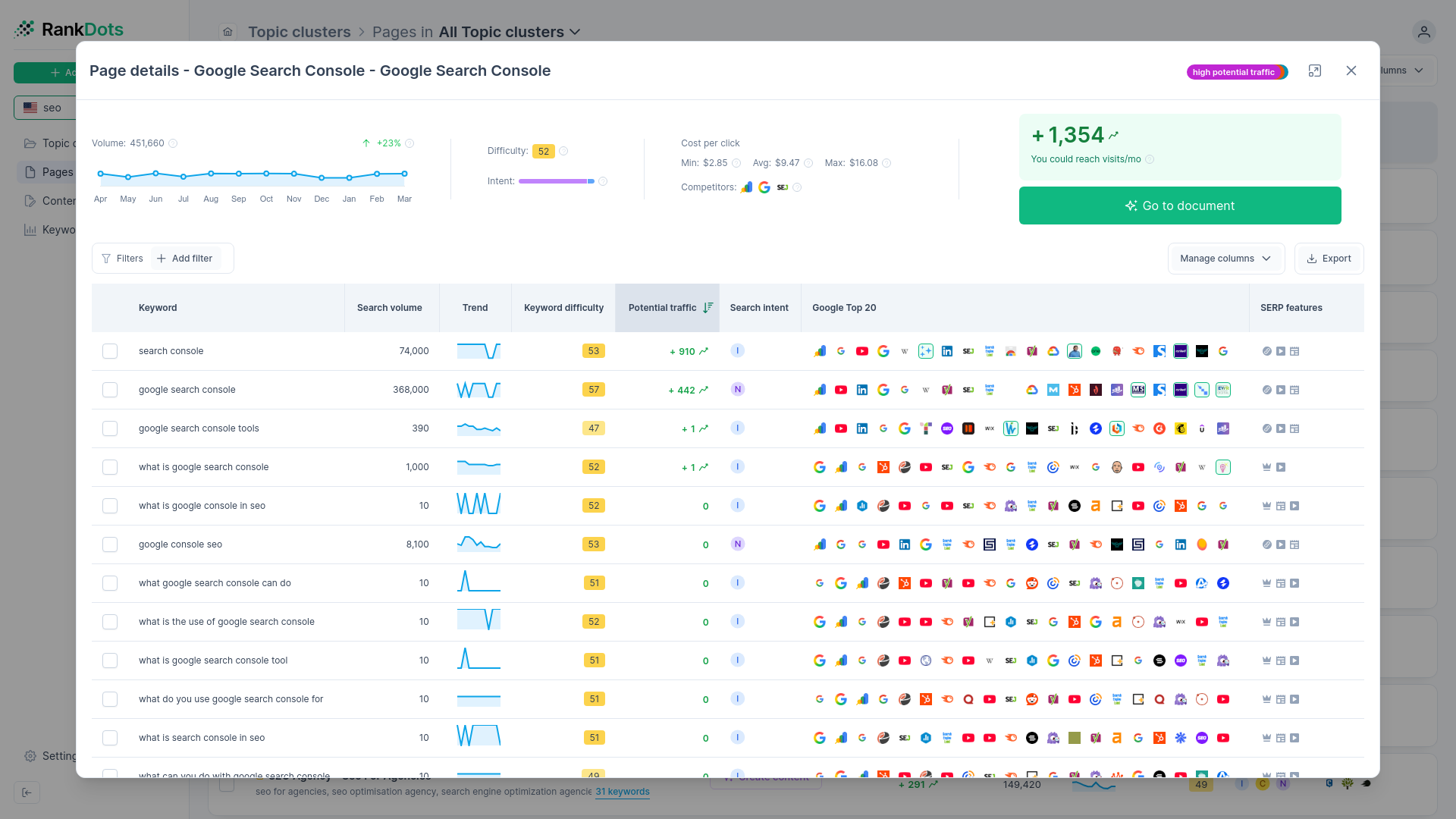
Within the validated cluster, you can further break keywords down by their dominant search intent using RankDots. Informational groupings like "how to set up email automation" map naturally to resource centers, how-to guides, and blog categories. Transactional groupings like "best email automation software" map directly to feature pages, solution landing pages, or product listings. We see teams fail constantly by trying to rank an educational blog post for a transactional cluster simply because the search volume looks tempting. Let the aggregated intent of the cluster dictate the page template you deploy.
Deriving internal linking structures
The hardest part of managing a large-scale site architecture is usually maintaining a logical internal linking strategy. When you build pages based on a hierarchical, validated keyword map, the internal linking structure essentially writes itself.
The primary pillar page links out to every supporting subtopic cluster using optimized anchor text derived from the subtopic's core term. In return, every supporting article links back up to the main pillar.
This approach helps eliminate orphaned pages. The validated overlap data already proves these topics are deeply connected in the eyes of the search engine algorithm. Manual internal links transfer maximum ranking equity throughout the entire silo. Your content strategy shifts from publishing isolated, standalone articles to deploying interconnected topical webs that capture specific industry niches.
Addressing and preventing keyword cannibalization
Even with a perfect initial architecture, websites drift over time. Multiple authors publish similar content, older pages receive conflicting updates, and suddenly you have two articles fighting for the exact same ranking spot. Keyword cannibalization splits your domain's authority across competing URLs instead of concentrating it, which lowers your total organic traffic.
Spotting internal competition
The most obvious symptom of cannibalization is aggressive position swapping. If you check your ranking tracker and see URL A ranking in position six on Tuesday, and URL B ranking in position eight on Thursday for the exact same query, the search algorithms are confused. These patterns can be found in performance reports by filtering for specific target queries and checking how many distinct pages earn impressions. If multiple pages generate significant impressions for the same term, you have a structural overlap problem that needs immediate attention.
Executing the consolidation playbook
To fix cannibalization, we recommend aggressively merging content. Identify the competing page with the strongest backlink profile and the most established organic history. That URL becomes your primary pillar. Take the competing, thinner pages and extract any unique subtopics, original data points, or helpful examples they contain. Integrate those specific sections into the primary pillar page to make it significantly more valuable. Finally, apply 301 redirects from the thin pages to the newly expanded pillar. This consolidation strategy focuses all your historical ranking signals into a single, highly authoritative asset.
Monitoring ongoing cluster performance
You can prevent future conflicts by adding a hard validation step to your editorial calendar. Before assigning a new topic to a writer, run it through your SERP overlap tool against your existing published content index. If the proposed topic shares three or more ranking URLs with an article you published last year, don't write a new post. Update the old one instead. When cluster validation acts as a mandatory editorial gatekeeper, you stop paying to compete against yourself.
Frequently Asked Questions About Cluster Validation
What is the difference between SERP-based and semantic keyword clustering?
How many keywords should be included in a single validated cluster?
Can ChatGPT or other AI tools be used to cluster keywords effectively?
Does keyword clustering work for small websites with limited content?
Scale Your Content Strategy With Verified Keyword Cluster Validation
Stop wasting budget on duplicate articles that fight each other in the search results. Upload your raw list and let automated SERP intersection analysis organize your targets instantly. You get a clean, ready-to-assign editorial roadmap.