RankDots

Group thousands of keywords by search intent in seconds with RankDots.

Stop wasting hours formatting spreadsheets. RankDots analyzes live search results to categorize queries by intent, preventing cannibalization and mapping your content architecture automatically.

AI keyword clustering tool: Build topical authority | RankDots

Manual spreadsheet grouping of thousands of search terms is a heavy time drain, which is why AI Keyword Clustering has become mandatory for scaling content strategy without guesswork or keyword cannibalization. An export of 25,000 queries from Google Keyword Planner creates an immediate operational bottleneck. The formatting required to categorize those exported terms by hand stalls production before writing even begins. Manual keyword research for a single content cluster takes eight or more hours — an unsustainable bottleneck for scaling production.

To eliminate manual sorting, automated keyword clustering groups related search terms based on live search engine results and user intent. By analyzing URL overlap, this technology structures raw keyword data into organized topic clusters, helping you build topical authority and avoid keyword cannibalization efficiently. This approach provides a complete strategic framework for transforming raw keyword lists into a structured content hierarchy using automated SERP analysis.

Search intent estimation without checking the live top 10 results causes immediate targeting errors. Words that look similar to a human often trigger entirely different search engine result pages (SERPs). Guessing these technical nuances through a spreadsheet cell often leads to poor ranking performance.

Legacy workflows force all data into one centralized sheet, creating overlap between different business units. RankDots replaces this chaos through unlimited projects with isolated data. Each product line or market maintains a distinct keyword universe. This isolation prevents cross-contamination and ensures your target terms remain tightly bound to specific campaigns.

Where does the grouping data come from? High accuracy mode clustering with MPNet is designed for large datasets of 25k+ keywords — per MPNet documentation. Instead of relying on static databases, the tool pulls active signals directly from current ranking pages.

Stop managing rows and start managing topics. Establishing a strict boundary around your data environments protects your site architecture from day one.

Map content architecture using live search intent signals.

RankDots evaluates the top 10 search results to group queries by exact URL overlap. The MPNet-powered engine processes datasets of 25,000+ terms simultaneously, bypassing static text analysis. You receive a structured topic architecture that systematically prevents internal cannibalization.
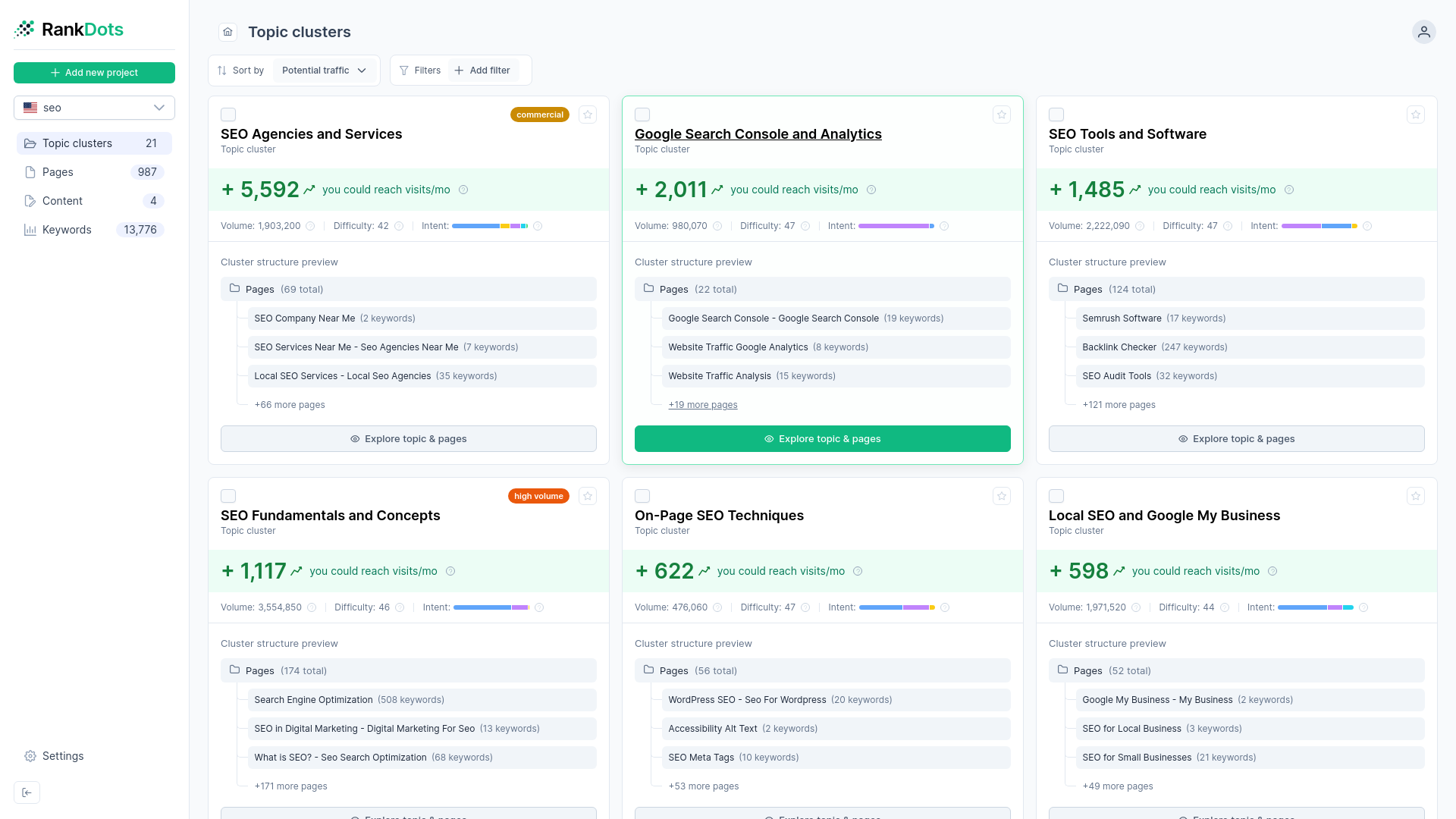
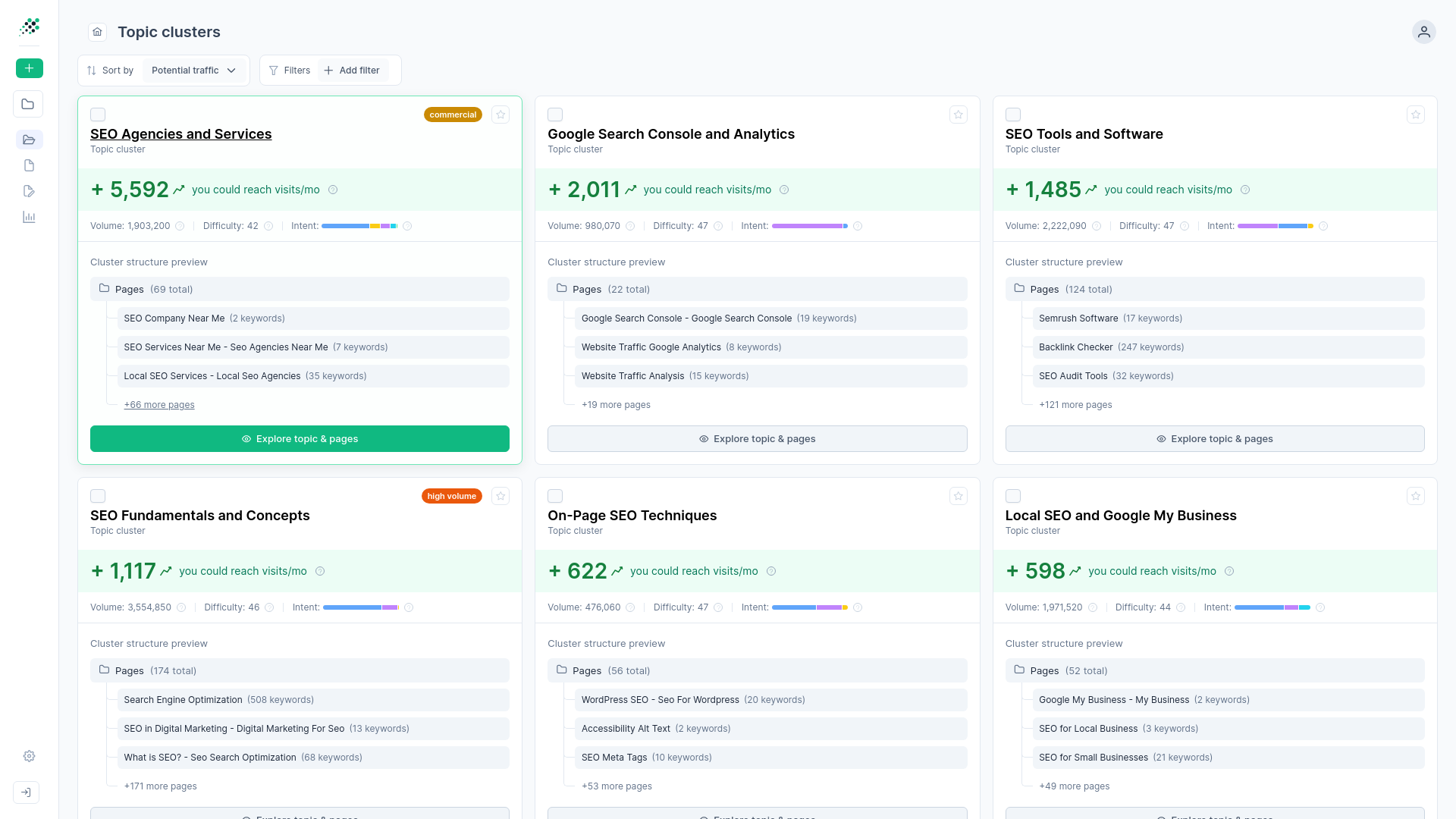
Map your topic clusters
Dashboard showing keyword clusters grouped by SERP overlap and search intent

How RankDots Keyword Clustering Works

magnifying glass over search results

Extract Live Search Results

RankDots analyzes the top 10 search results for each query to capture real-time ranking signals instead of relying on static database metrics.

intersecting circles overlapping

Calculate SERP URL Overlap

The engine compares competing pages using a 30 percent URL overlap threshold. If multiple queries trigger identical ranking pages, they share the same intent.

folder structure organization tree

Build Semantic Topic Clusters

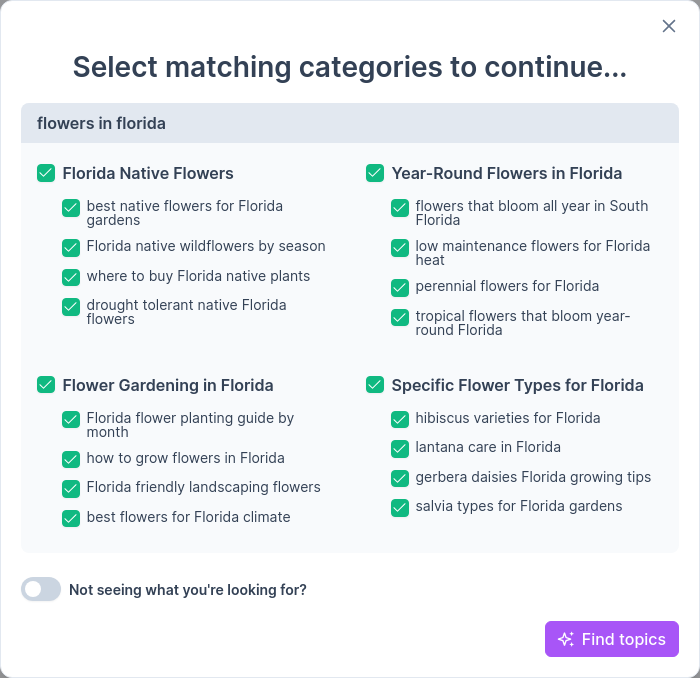
The Topicizer system groups up to 35,000 keywords into semantic page clusters and topic super-clusters to map your content architecture.

clipboard with strategic mapping

Assign Intent and Structure

Every group receives an intent classification, like informational or transactional, so you can assign topics to authors without risking keyword cannibalization.

Understanding keyword clusters and SEO strategy

Organic traffic drops when multiple older blog posts compete for the exact same query. This self-inflicted traffic loss occurs when a flat "one keyword per page" approach fractures your domain's ranking power. Without a structural grouping mechanism, your authors write redundant articles that confuse search engine crawlers.

Content directors lack data when they review an editorial draft and guess if "healthy snacks" and "healthy snacks for kids" demand separate pages. Without validating the actual user intent behind those variations, you risk wasting budget on duplicate pages. Natural language processing (NLP) might identify those two phrases as linguistically similar, but semantic closeness does not equal search intent.

RankDots solves this uncertainty through intelligent topic clustering. The software evaluates the live Google search results for every query in your list. Standard SERP-based clustering algorithms use a 30% URL overlap threshold in the top 10 search results to determine keyword synonymy — a benchmark that proves whether two terms share the same search intent. If three or more of the same URLs rank for both "healthy snacks" and "healthy snacks for kids", the engine groups them into a single target page.

Related query organization surfaces hidden subtopics that strengthen your domain's topical hub. You move beyond targeting a primary term and begin answering the specific sequential questions users ask. As research from Keyword Insights demonstrates, organizing keywords into clusters helps map out content strategies and build targeted topical hubs.

Basic language processing models look at words; advanced clustering engines look at active URLs. Understanding this distinction changes how you map your website.

Legacy word-matching groups "apple fruit" and "apple computer" together simply because the characters match. Conversely, modern intent-matching separates the two terms because the ranking URLs share zero overlap.

A successful topic cluster requires identifying the central pillar and the supporting spoke pages. When you rely on real URL overlap thresholds, you stop guessing what users want. You structure the exact content hierarchy the search engine already rewards.

Advanced Agglomerative Clustering Capabilities

target with arrows pointing center

Search Intent Categorization

RankDots segments keywords into informational, commercial, navigational, and transactional buckets. You align your content architecture directly with user behavior to improve engagement.

overlapping web pages

Live SERP Overlap Analysis

The algorithm evaluates the top 10 search results to calculate a 30% URL overlap threshold. This prevents keyword cannibalization by forcing each page to target unique intent.

server stack with lightning bolt

Industrial-Scale Data Processing

Enterprise accounts process up to 35,000 keywords per project. Upload a raw list and RankDots maps a complete topic hierarchy in seconds.

line chart trending upwards

Search Momentum Detection

RankDots flags specific queries exhibiting upward search volume trajectories. Early detection lets you invest resources into rising topics before competitor saturation occurs.

Core features of the AI clustering engine

A raw export from Ahrefs or Semrush transforms from unstructured text into a rigorous content plan in seconds when processed through an automated engine. The relief of watching software handle the heavy lifting replaces the anxiety of manual sorting. You need a platform built for industrial-scale data processing without system crashes or cross-departmental data leaks.

Advanced AI clustering tools process approximately 200,000 keywords at a time. This capacity allows enterprise teams to map entire market sectors in a single session. The engine parses the data, identifies the overarching categories, and filters the results down to individual page assignments.

The specific architectural flow moves from broad topic categories down to precise page-level keywords. The highest level of categorization forms topic super-clusters, which define the core business pillar. Beneath this sit the page clusters, representing the specific articles or landing pages required to cover the pillar. Finally, the system makes exact keyword assignments, mapping the primary and secondary search terms to each specific page.

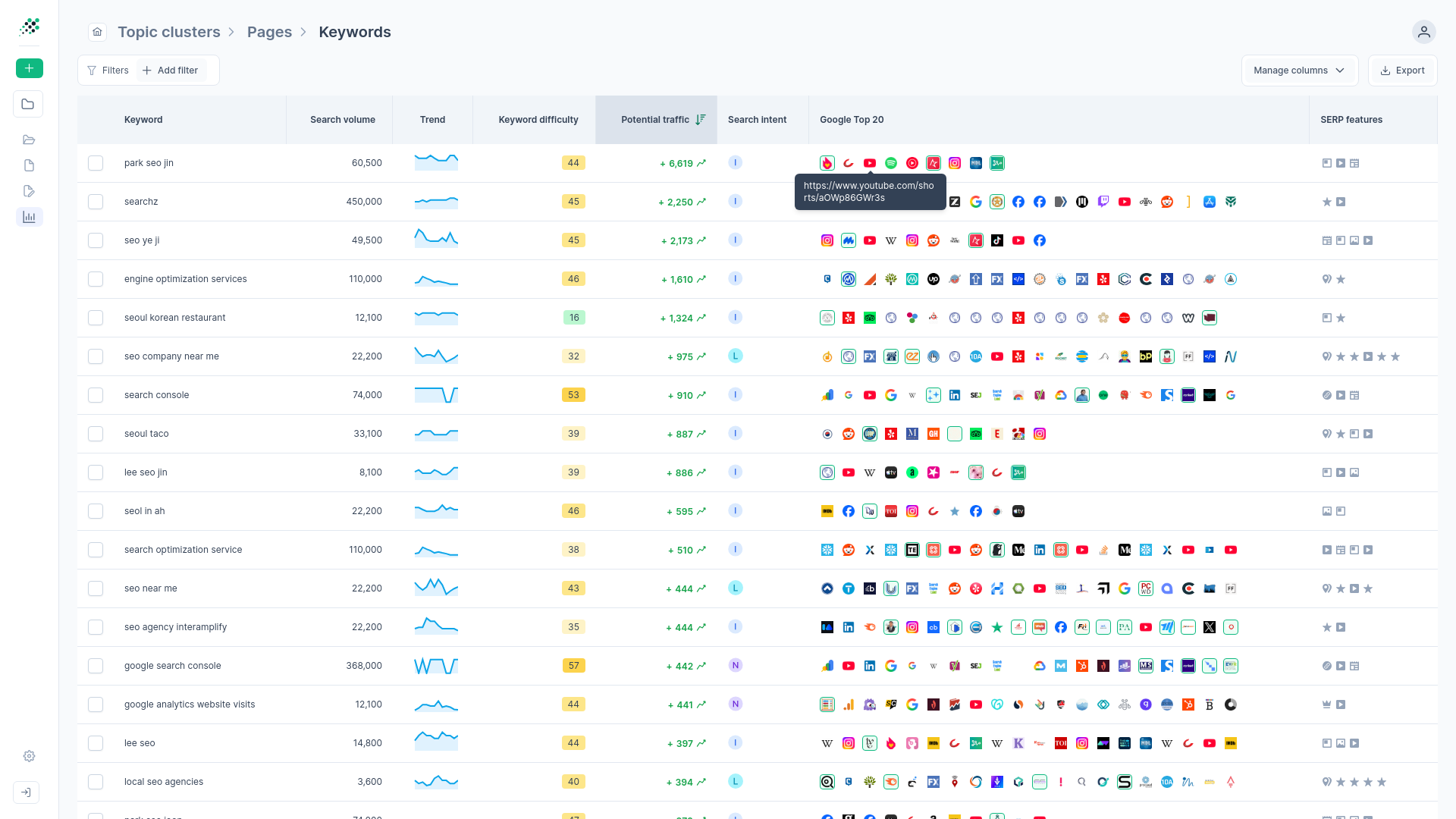
This Topics → Pages → Keywords hierarchy replaces flat, disjointed lists. RankDots executes this transition through smart keyword discovery that combines artificial intelligence with live search data. Every imported term receives an intent classification (informational, commercial, navigational) and pairs with live search metrics.

SERP-Based Keyword Grouping is more accurate than relying solely on NLP to group keywords. Static rules fail because search intent shifts based on current events or algorithm updates. Modeling current live search results ensures your blueprint matches what actually ranks today.

Automated clustering prevents keyword cannibalization by ensuring each article targets unique search intent. When the URL overlap dictates the grouping, you never assign the same user intent to two different URLs. Integrating this clean architecture with Google Search Console isolated properties allows you to track the performance of specific hubs without noise from unrelated site sections.

Stop relying on basic alphabetical sorting. Architect your site based on verifiable search engine behaviors.

When mapping large keyword lists for enterprise clients, the clustering engine identifies core pillars rather than disconnected spreadsheet rows. Each pillar receives a dedicated hub page surrounded by specific technical spoke articles. This tight architecture signals deep expertise to search crawlers, establishing a structured path to ranking for highly competitive commercial terms.

Turning clusters into content plans and briefs

Stakeholders require more than a list of interesting ideas when reviewing the next quarter's editorial calendar. Executives need to see how grouped articles will collectively build topical authority over time. You must justify topic choices with concrete data and demonstrate a clear path to return on investment.

Search volume aggregation at the pillar level provides the business case you need. Instead of pitching a single article with 500 searches a month, you pitch a comprehensive cluster with a total addressable search volume of 50,000. RankDots bridges this gap through topic-level content creation. The platform takes the verified cluster map and generates detailed content briefs and AI-assisted drafts that target the entire intent group.

A structured keyword map translates into an actionable monthly editorial calendar through a strict workflow. First, prioritize your targets by momentum, selecting clusters that show upward search volume trends. Next, assign the pillar by drafting the comprehensive overview page that defines the core concept. Then, deploy the spokes by scheduling the supporting articles that answer specific long-tail questions. Finally, link the hub by connecting the spoke pages back to the pillar using exact-match anchor text from your cluster data.

Standard operating procedures require mandatory updates to account for AI search features. Content must be optimized for both traditional search and AI overviews (Generative Engine Optimization). Engines like Perplexity or ChatGPT synthesize answers from multiple sources. Structuring your articles with clear semantic groupings increases the likelihood of inclusion in these synthesized responses.

A good blog post length for SEO is 1,500+ words in most cases, though some queries demand shorter, highly targeted answers instead. The cluster data dictates the necessary depth. If a cluster contains 40 informational questions, a long-form definitive guide is required. If the cluster centers on a single transactional comparison, a concise landing page performs better.

Strict execution of cluster recommendations creates a dense network of topical relevance that drives sustained organic traffic growth. This growth happens because you stop fighting yourself in the search results and start capturing the full spectrum of user queries. Turn your data into a production schedule and execute the blueprint.

Effective execution also requires consistent monitoring. Tracking the entire cluster rather than single queries reveals the true health of your topical authority. When an entire group of related pages rises in the SERPs simultaneously, it proves the search engine recognizes your domain as an authoritative source on that subject.

See why RankDots is #1

Ryan K
“I don’t have time to dig through keywords all day. RankDots showed me what to write about, and it actually worked. Simple as that.”
Ryan K.,
Founder of Hollow Creek Supply
Melissa J
I’m not an SEO expert, but RankDots made it easy to find the right topics and publish fast. It’s like having an in-house SEO team—without the overhead.
Melissa J.,
Founder of Oak & Bloom Interiors
David M
“As an agency, we’ve tried dozens of tools — RankDots is the first that gets keyword clustering and AI content generation right.”
Danielle M.,
Founder of an SEO Agency
Tanya R
“It’s like having an SEO strategist built into our workflow. The topic clusters are spot-on, and the content drafts give us a huge head start.”
Tanya R.,
Content Marketing Manager

Pick your plan

Plans for individuals, teams, and agencies. Cancel anytime.
Monthly Annually Save 40%
Starter
$
49
/mo
Order now
Features
3 projects per month
8,000 keywords per project
10 AI articles per month
Smart keyword discovery (AI + search data)
Intelligent topic clustering
Potential growth analysis
Topic-level content creation
Best offer
Business
$
99
/mo
Order now
Features
8 projects per month
12,000 keywords per project
20 AI articles per month
Smart keyword discovery (AI + search data)
Intelligent topic clustering
Potential growth analysis
Topic-level content creation
Keyword export
Agency
$
169
/mo
Order now
Features
15 projects per month
20,000 keywords per project
40 AI articles per month
Smart keyword discovery (AI + search data)
Intelligent topic clustering
Potential growth analysis
Topic-level content creation
Keyword export
Enterprise
$
299
/mo
Order now
Features
20 projects per month
35,000 keywords per project
60 AI articles per month
Smart keyword discovery (AI + search data)
Intelligent topic clustering
Potential growth analysis
Topic-level content creation
Keyword export
Starter
$
29
/mo
Order now
Features
3 projects per month
8,000 keywords per project
10 AI articles per month
Smart keyword discovery (AI + search data)
Intelligent topic clustering
Potential growth analysis
Topic-level content creation
Best offer
Business
$
58
/mo
Order now
Features
8 projects per month
12,000 keywords per project
20 AI articles per month
Smart keyword discovery (AI + search data)
Intelligent topic clustering
Potential growth analysis
Topic-level content creation
Keyword export
Agency
$
99
/mo
Order now
Features
15 projects per month
20,000 keywords per project
40 AI articles per month
Smart keyword discovery (AI + search data)
Intelligent topic clustering
Potential growth analysis
Topic-level content creation
Keyword export
Enterprise
$
169
/mo
Order now
Features
20 projects per month
35,000 keywords per project
60 AI articles per month
Smart keyword discovery (AI + search data)
Intelligent topic clustering
Potential growth analysis
Topic-level content creation
Keyword export

Frequently Asked Questions

Who is RankDots designed for?

RankDots is built for SEO professionals, content directors, and agency teams scaling organic traffic. If you manage large editorial calendars or enterprise site architectures, it automates your manual research bottleneck. Marketing teams use isolated project environments to map distinct keyword universes without cross-contamination.

What are the differences between the free and paid versions of RankDots?

The free trial lets you test core keyword discovery, SERP-based clustering, and AI drafting capabilities before committing. Paid subscriptions provide industrial-scale processing limits, letting you analyze up to 35,000 keywords per project on the Enterprise tier. Premium plans also include isolated data environments and topic-level search volume aggregation.

Start Grouping Keywords with RankDots

Stop managing spreadsheet rows and start building topical authority. RankDots processes your raw keyword lists into strict content hierarchies based on live search intent. Execute a data-backed ranking strategy in seconds.