RankDots

Structure Your Keyword Lists With RankDots AI Topic Cluster Generator

Stop guessing search intent from raw CSV exports. RankDots groups related keywords using live SERP data to build structured content hubs that prevent cannibalization.

AI topic cluster generator | Build structured content hubs

Without a topic cluster generator, a raw CSV export of keyword variations causes budget waste and keyword cannibalization when you guess which terms share search intent. An automated keyword clustering tool bypasses this guesswork by grouping related keywords based on actual search intent and semantic similarity. By analyzing live SERP data, it organizes thousands of keywords into distinct parent and subtopic pages to build structured topical authority and prevent keyword cannibalization.

The inefficiency of sorting keywords manually causes immediate project bottlenecks. Subjective grouping often forces different pages to target overlapping intents, which splits your link equity across redundant URLs. Automated systems process this data efficiently, grouping large keyword sets without human bias. Using a Topical Clusters Generator replaces endless spreadsheet hours with exact, data-backed architecture.

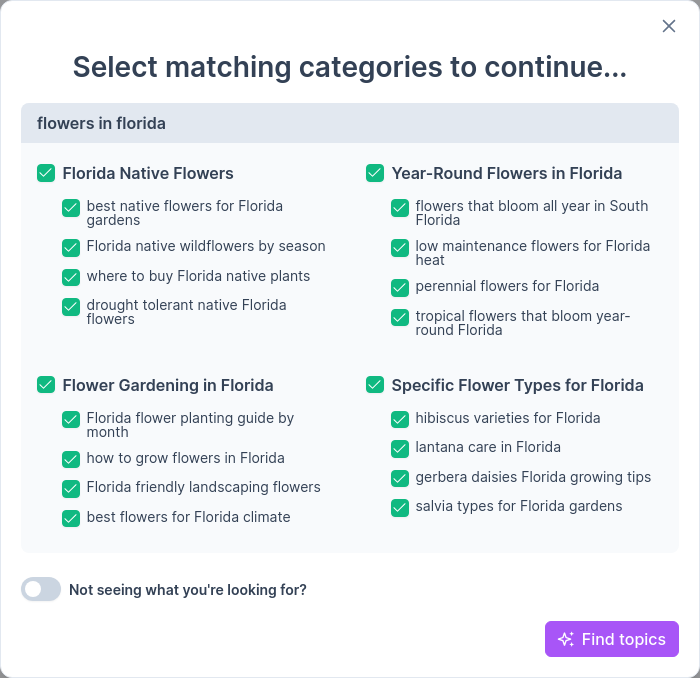
RankDots topic refinement interface displaying automated keyword grouping and cluster architecture

4-step flowchart showing Keyword Export → Live SERP Analysis → Intent Grouping → Cluster Visualization with arrows connecting each step

SERP-driven agglomerative clustering eliminates manual spreadsheet labor and builds structured topical authority.

How RankDots Clustering Workflow Operates

funnel with multiple data inputs

Multi-Source Keyword Extraction

Pull search terms from five simultaneous collector sources. This ensures complete vocabulary coverage across exact matches, related questions, and competitor rankings.

magnifying glass over search results

Reverse Engineer Search Intelligence

RankDots analyzes live Google algorithmic behavior and SERP structures. It deciphers actual ranking signals to understand why specific pages capture top positions in your niche.

nodes connecting into organized clusters

Agglomerative Intent Clustering

Group keywords based on live SERP overlap rather than basic text similarity. This prevents cannibalization by aligning phrases with actual user search intent.

hierarchical site map structure

Map Topical Hub Architecture

The mapping engine translates raw keyword groups into a hierarchical content structure. Prioritize hubs based on aggregate difficulty scores and projected monthly traffic potential.

Actionable SERP-Driven Capabilities

four converging arrows

Complete Keyword Coverage

Run five collection sources simultaneously during one research session. RankDots captures exact matches, question phrases, and competitor terms to build a comprehensive vocabulary map.

user dashboard interface layout

Role-Specific Customization

Configure workspaces to fit your operational structure. RankDots tailors dashboards for bloggers, eCommerce operators, and enterprise agencies to prioritize relevant SEO metrics.

rising line chart graph

Cluster Traffic Forecasting

Translate search volume into projected monthly visits for entire topic groups. This aggregate data provides specific traffic estimates to justify strategy investments.

target with center arrow

Macro Difficulty Scoring

Assess competition across whole topic groups. RankDots assigns an aggregate difficulty score relative to your specific domain authority, preventing wasted effort.

Why live SERP-based agglomerative clustering beats basic NLP

Software options for automated clustering often force a critical choice. You require a cost-effective solution that uses mathematically sound analysis to group keywords, rather than just matching text strings. Relying solely on natural language processing creates structural blind spots. Basic NLP groups keywords based on semantic text similarity and misses the contextual relationships that define actual user intent.

Consider the operational difference when targeting "best CRM" versus "CRM software". An NLP model might place these in the exact same bucket because the character strings look nearly identical. Google evaluates these specific queries differently and returns informational listicles for the former and transactional landing pages for the latter. Live search analysis pulls the actual top 10 results for both queries and calculates the precise URL overlap.

Side-by-side comparison matrix showing Basic NLP matching text strings vs SERP Analysis matching top 10 URL overlap

This method groups keywords directly using live search engine data. SERP-based keyword grouping prevents keyword cannibalization better than text similarity by matching actual Google search intent. It removes the arbitrary guesswork from deciding whether two variations require separate pages or can be safely consolidated into one asset. RankDots scrapes live engine results to decode algorithmic behavior in real time, which replaces assumed relevance with exact data on winning formats.

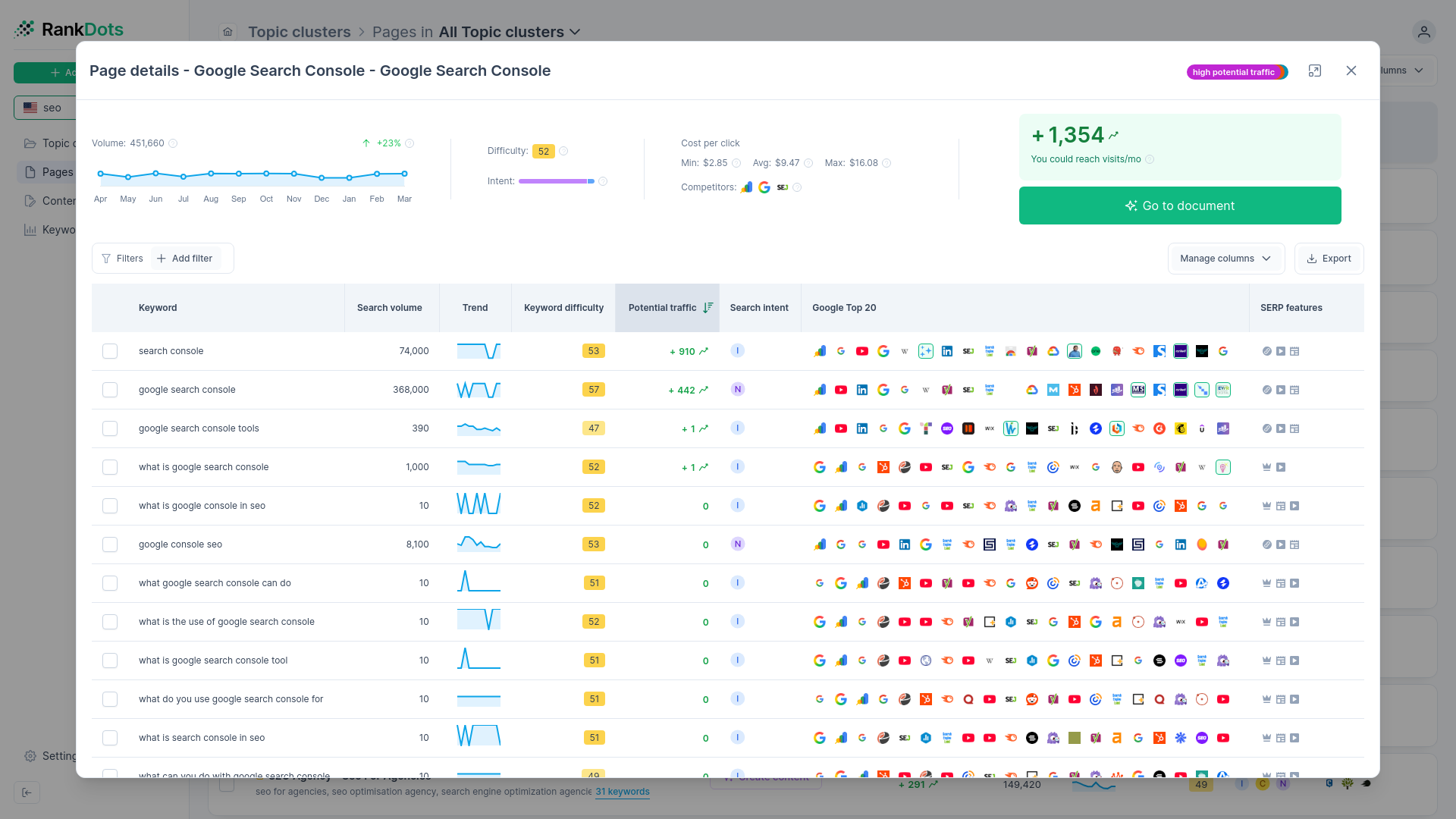
RankDots competition insights showing live SERP analysis and top 10 URL overlap

Scale topical authority while preventing cannibalization

Rankings often fluctuate in Google Search Console after you publish several related blog posts. This erratic performance occurs when multiple pages compete for the exact same search intent. Keyword cannibalization limits your ability to rank for high-value terms by diluting link equity across too many redundant URLs.

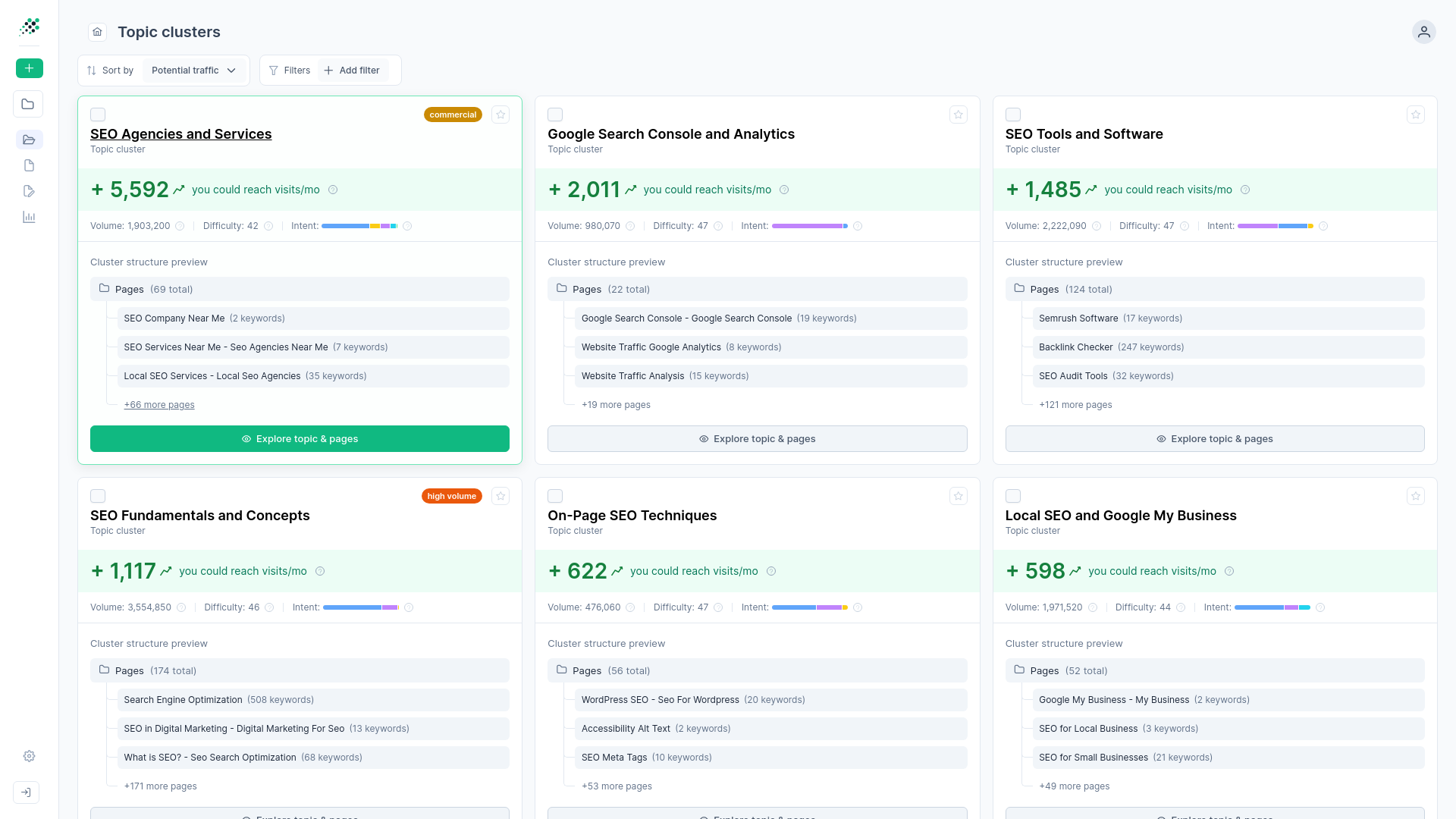
A clear hub-and-spoke model distributes link equity efficiently. Keyword clustering improves SEO by organizing related topics around a central theme to build topical authority. RankDots prevents this structural overlap by assigning each distinct user intent to a single, dedicated URL.

RankDots topics dashboard displaying structured topic clusters organized around a central theme

Generated clusters and ready drafts must connect to pass authority effectively to the pillar page. The newly generated cluster remains isolated and fails to build necessary topical weight without a structured internal linking strategy. Automating internal linking improves the efficiency of topic clusters — a proven methodology for scaling large sites.

Map every subtopic back to your primary pillar page using targeted, exact-match anchor text. This network signals hierarchical importance directly to search engine crawlers. For outward credibility, RyRob suggests you include ideally 3 to 5 external links in your content pointing to non-competing authoritative sources. Consolidate competing assets immediately by redirecting weaker pages to the strongest URL targeting that specific SERP footprint.

With your clusters successfully organized and internally linked to prevent cannibalization, the next priority is proving their business value to secure necessary resources.

Explore Hub and Spoke Topic Maps With Intent Data

RankDots maps parent topics alongside supporting keywords to visualize your exact content hierarchy. For each cluster, it indicates the specific format Google prefers — whether that is a long-form guide, listicle, or product comparison. This SERP-driven recommendation prevents you from targeting keywords with the wrong page type.
Build Your Topic Map
RankDots dashboard displaying hub and spoke topic maps with SERP-based content type recommendations

Predicting traffic potential and cluster difficulty

Strategy pitches require concrete metrics to secure budget for major initiatives, like a new pillar page supported by a comprehensive cluster of articles. Stakeholders rarely approve content budgets without a concrete projection of the aggregate traffic and authority those specific clusters will bring. Abstract keyword lists fail to demonstrate actual business value.

Generic, domain-agnostic difficulty metrics mislead low-authority sites constantly. A keyword deemed "easy" by tools like SEO Scout for a DR 60 domain remains out of reach for a DR 15 site. RankDots solves this through its proprietary Cluster Difficulty Score. RankDots evaluates SERP competition explicitly relative to your site's exact domain authority and page-level backlinks to calculate a custom difficulty per project.

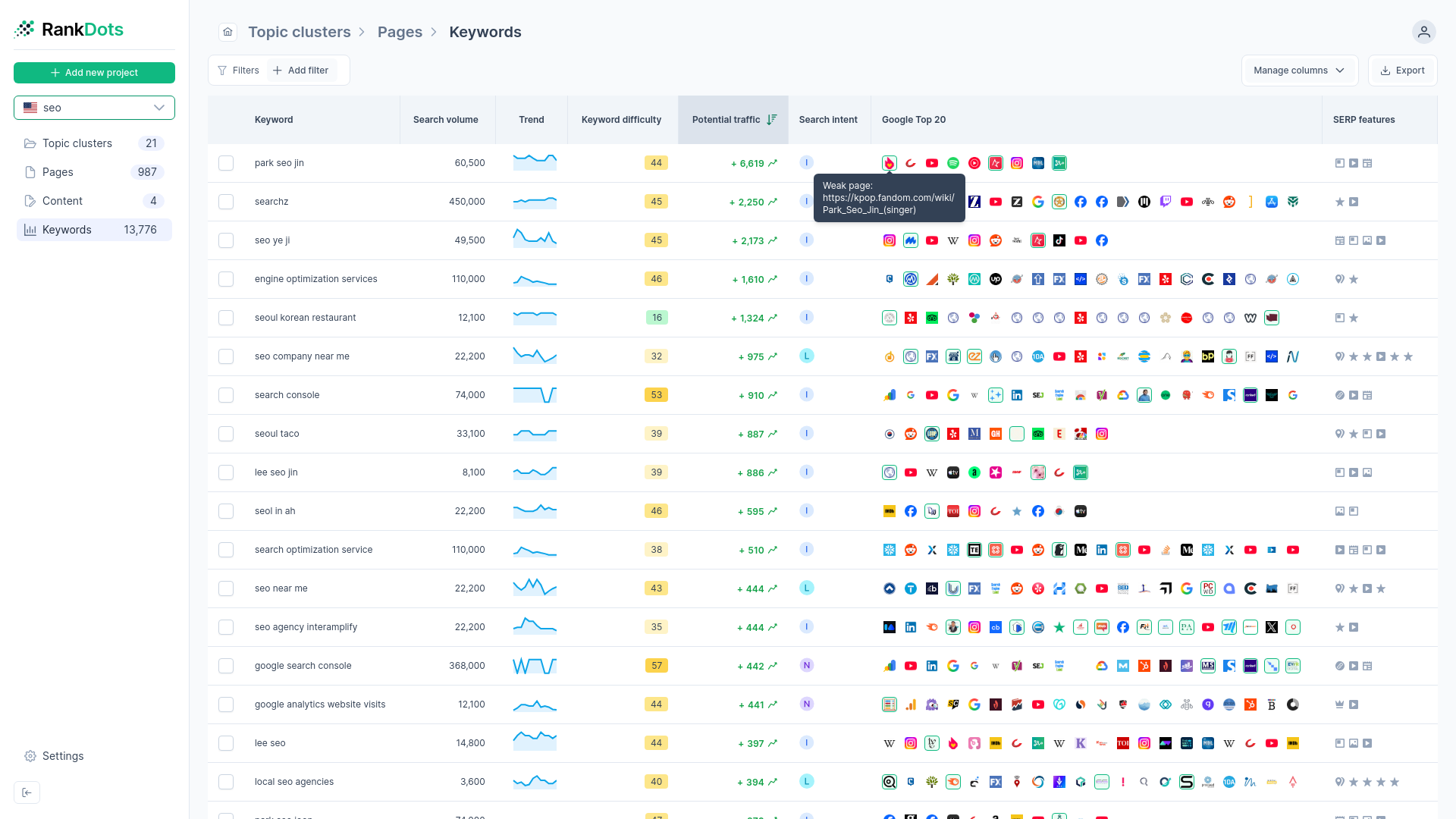
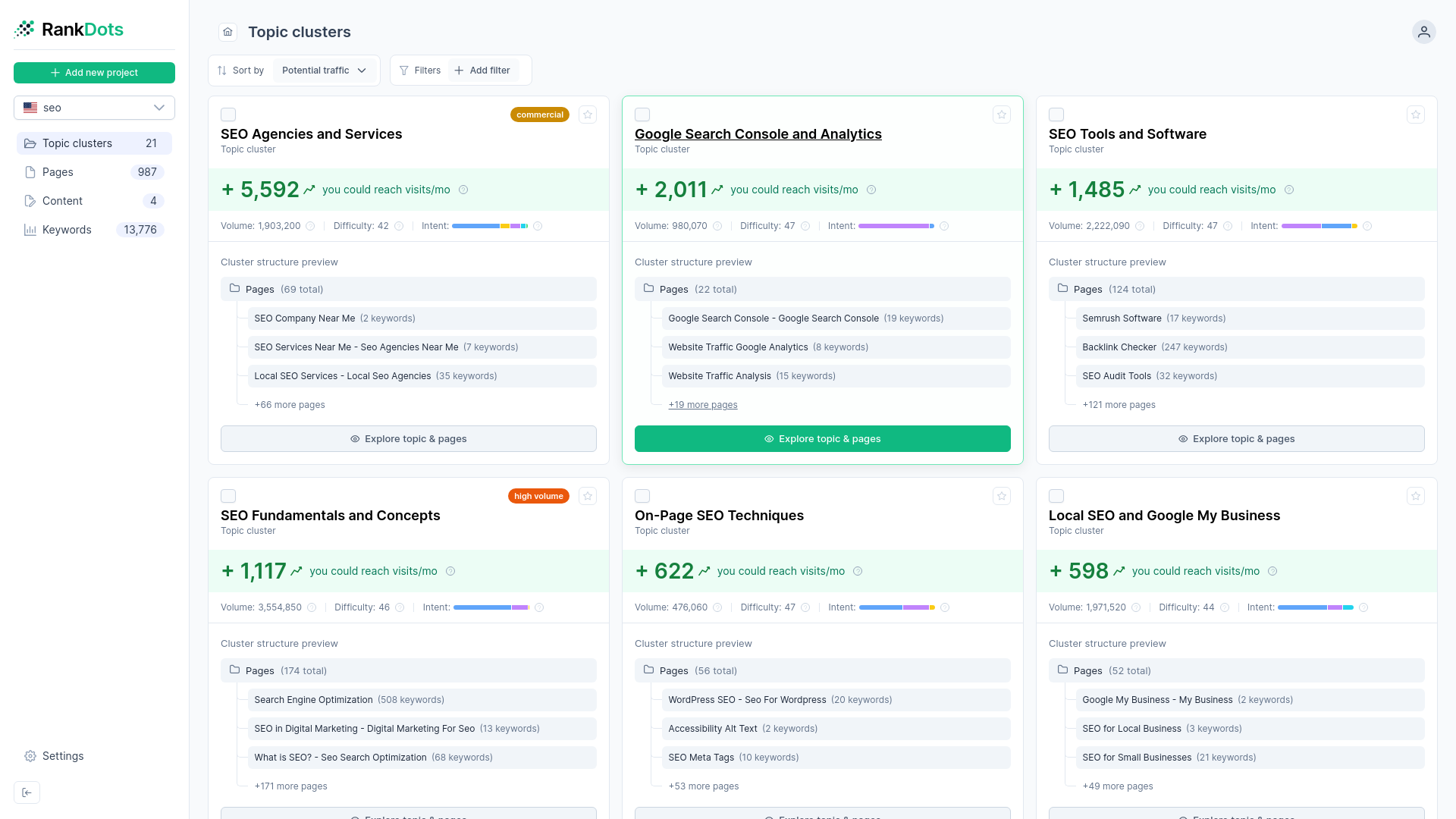
Aggregate cluster traffic projections justify these investments by converting raw keyword lists into specific monthly visit forecasts. RankDots combines the search volume of all keywords within a cluster into a single opportunity metric. Prioritize low-competition clusters that align perfectly with your exact authority tier. This secures faster ranking traction for newer domains.

RankDots dashboard showing generated pages sorted by potential traffic and cluster opportunity metrics

Comprehensive assets anchor these specific campaigns. Execution requires depth; according to RyRob, you should make blog posts 1,500+ words in most cases to satisfy the extensive coverage required by high-value hubs. RankDots highlights these emerging areas before competition intensifies. This early detection lets you prioritize high-yield topics.

See why RankDots is #1

Ryan K
“I don’t have time to dig through keywords all day. RankDots showed me what to write about, and it actually worked. Simple as that.”
Ryan K.,
Founder of Hollow Creek Supply
Melissa J
I’m not an SEO expert, but RankDots made it easy to find the right topics and publish fast. It’s like having an in-house SEO team—without the overhead.
Melissa J.,
Founder of Oak & Bloom Interiors
David M
“As an agency, we’ve tried dozens of tools — RankDots is the first that gets keyword clustering and AI content generation right.”
Danielle M.,
Founder of an SEO Agency
Tanya R
“It’s like having an SEO strategist built into our workflow. The topic clusters are spot-on, and the content drafts give us a huge head start.”
Tanya R.,
Content Marketing Manager

Frequently Asked Questions

How does a topic cluster generator handle different keyword intents?

It evaluates Google search results to map intent rather than relying on text similarity. RankDots analyzes top-ranking pages to understand algorithmic behavior and groups keywords based on SERP overlap. This approach helps you target informational and transactional terms on separate URLs.

Can this tool identify content gaps within my existing website architecture?

Yes, it compares your current pages against top-ranking competitors to pinpoint missing subtopics. RankDots identifies keyword opportunities your domain lacks so you can build topical coverage. Closing these gaps strengthens your site structure and improves relevance signals for your future search rankings.

What happens after I generate a keyword cluster map?

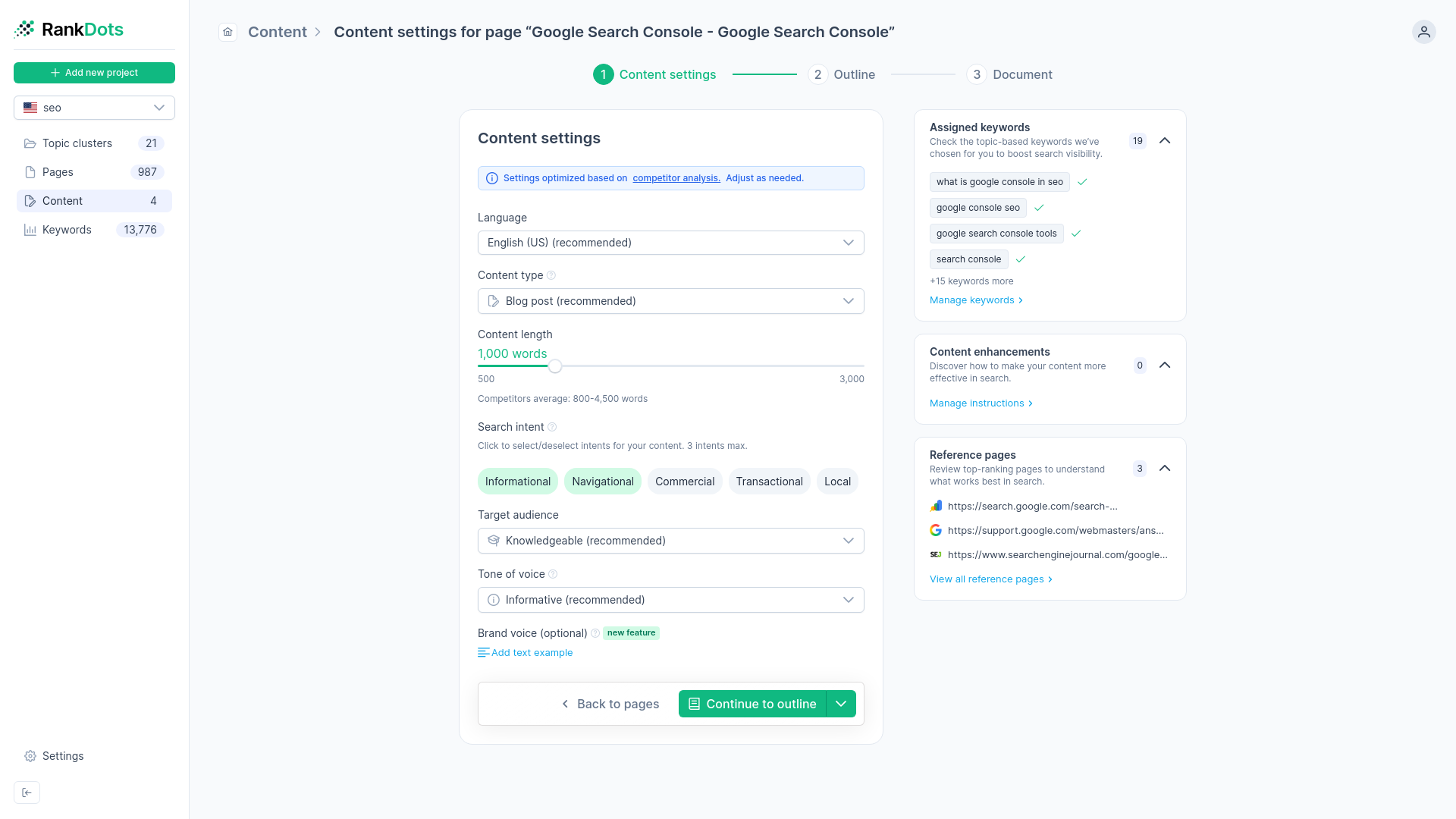
You transition immediately from strategy to production without leaving RankDots. It integrates an AI writing tool that generates structured drafts, schema-ready outlines, and semantic term recommendations directly from your new clusters. This workflow eliminates the need to export CSV files to your writers.

Start Grouping Your Keywords Into Search-Driven Clusters

Transition directly from raw keyword lists to published content. RankDots maps your terms by actual SERP intent and generates structured drafts within one unified platform. Stop switching between spreadsheets and separate writing tools.