Automate Keyword Clustering With Real-Time SERP Intent Data
Paste your keyword list to generate topic clusters within seconds based on search behavior. Eliminate spreadsheet formatting and map your content strategy using Google's ranking patterns.
Transform Raw Keyword Lists Into Topic Clusters

Free keyword clustering tool: SERP-intent analysis | RankDots
You export a raw list of over 5,000 queries from a standard SEO platform, open the CSV, and immediately realize you need a Keyword Clustering Tool. Without one, you hit a raw wall of data. Total paralysis. Staring at rows of text instead of executing strategy drains resources.
Manual sorting forces you to guess search intent and filter by raw search volume. This tedious process could easily consume days of spreadsheet manipulation. Limits on legacy platforms compound the bottleneck; per Semrush's guidelines, keyword lists are restricted to 2,000 entries with a strict account cap of 10,000.
A programmatic tool automatically groups thousands of related search terms based on semantic similarity and active search engine results page (SERP) overlaps. This technology eliminates manual spreadsheet analysis. It builds topic clusters and maps search intent. You stop cannibalizing your own pages.
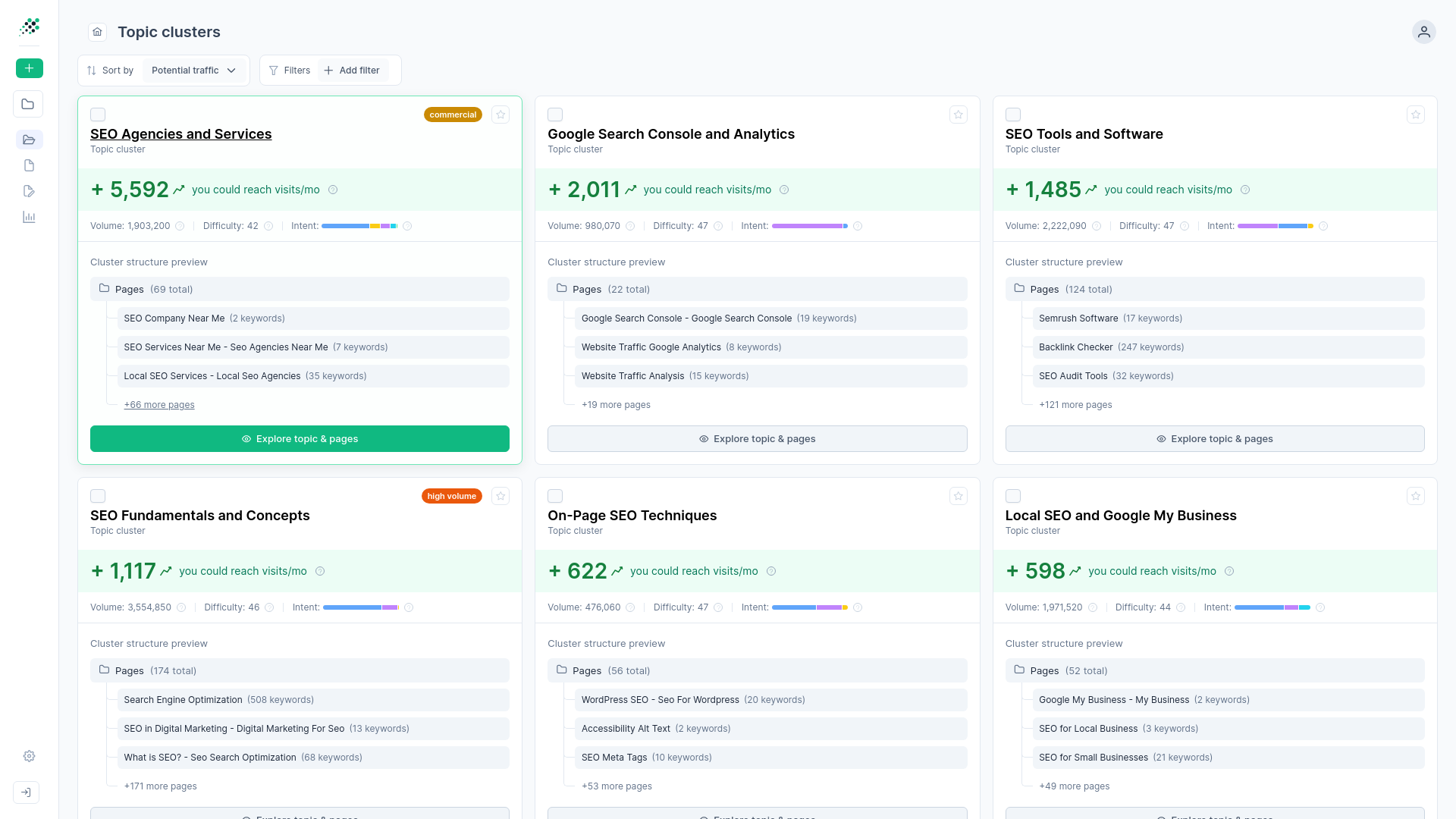
Instead of evaluating isolated metrics, RankDots shifts your focus to content architecture. RankDots displays exact keyword counts for each generated cluster. Seeing the precise number of nested terms lets you gauge the required scope and breadth for complete coverage.

This guide breaks down programmatic topic clustering across 4 stages. It automates content architecture and validates traffic potential.
The business impact of programmatic topic clusters
Your quarterly content calendar requires more than a list of disconnected terms to secure stakeholder approval. Reviewing grouped concepts containing five to 15 closely related phrases builds immediate authority. The next strict requirement involves justifying the actual return on investment for those specific assets. You must demonstrate combined search volume and intent-driven structure to secure leadership approval.
Single-keyword targeting is obsolete. Here is why. Modern search engines prefer topic clusters over isolated terms. Building authority across an entire search concept captures a wider net of user intent compared to chasing single, high-competition phrases. Organized grouping maps out a complete roadmap to rank for all relevant niche queries. Analyzing user journeys within Google Analytics proves that visitors frequently search for multiple variations of a problem before converting.
This programmatic architecture also translates directly into paid acquisition efficiency. Digital marketers managing both organic search and paid channels frequently struggle with broad ad groups that lower ad relevance. Structuring campaigns around tightly mapped, intent-specific groups increases Quality Score and decreases overall acquisition costs. Tight semantic grouping ensures the landing page matches the exact query intent perfectly.
RankDots validates your entire content pipeline before a single draft enters production. RankDots estimates the total monthly organic traffic that could be captured by fully addressing a cluster. It combines the volume of all nested phrases into a single opportunity metric. Evaluating entire topic silos replaces the guesswork of manual volume addition.

ROI validation requires looking at this aggregate traffic potential rather than isolated metrics. Forecasting the cumulative reach of a fully saturated content cluster shows exactly what a dominant position on Google actually delivers to the bottom line. Leadership teams respond to projected aggregate revenue, not individual query volume.
RankDots Workflow and Instructions
Import Raw Keyword Lists
Upload your raw search terms. RankDots processes your data within seconds, avoiding the unpredictable outputs of standard chatbots.
Analyze Top SERP Overlaps
RankDots identifies groups requiring at least three overlapping pages in the top ten results to form a structurally sound cluster.
Evaluate Aggregate Traffic Potential
It calculates the overarching difficulty score and cumulative search volume. Evaluating entire topic silos prevents isolated metric fixation.
Transition Directly to Drafting
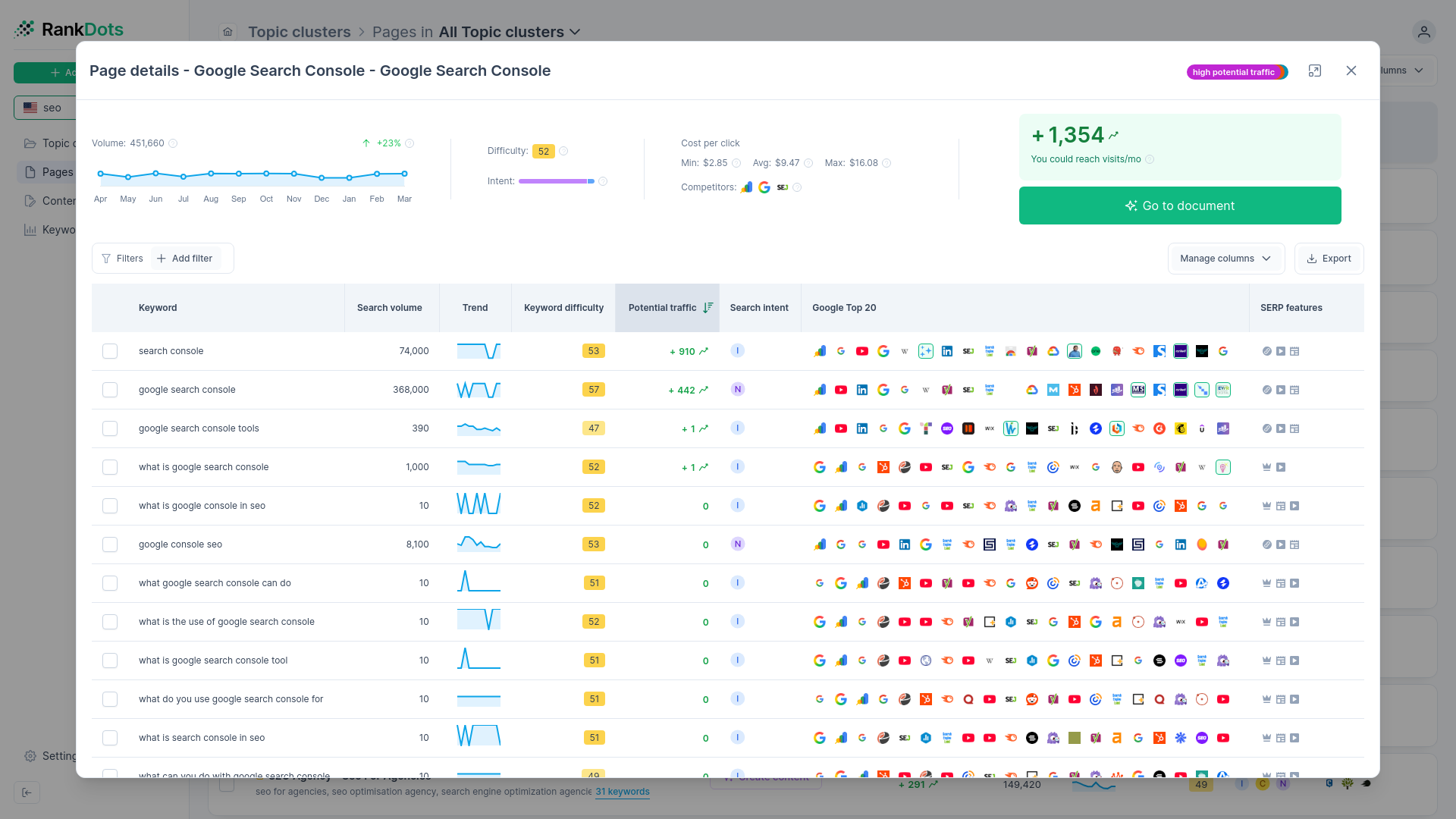
The document button moves your workflow from research to production. RankDots creates tailored copy optimized for the specific intent breakdown.
Technical capabilities: SERP overlap vs. NLP algorithms
To achieve this high-ROI content architecture, you need the right underlying technology. Standard AI chatbots often create entirely new problems when you paste a large list of queries into them to speed up workflows. The expected structural help rarely materializes. The output consists of groupings based purely on word similarity rather than actual search intent. These tools fail to deliver reliable structural data. The result? Wasted hours.
Large language models like ChatGPT are stochastic. They lack the reliability needed for quantitative search tasks. If prompted poorly, they might group unrelated concepts simply because they share a common noun. Similarly, traditional NLP algorithms running in Python environments use frameworks like TF-IDF or word2vec to sort terms. These older models match keywords based on semantic meaning and root word stems. They ignore how search engines rank those phrases today.
True intent matching requires analyzing live search engine behavior rather than relying on static dictionaries. RankDots calculates overlaps in the active top 10 search results to form definitive groups. This active alignment proves which terms search engines treat as identical topics. It bypasses the logic of simple semantic matching. Real search data dictates the taxonomy.
To establish a valid programmatic group, a strict mathematical baseline is required. Grouping generally requires a minimum of three overlapping pages ranking in the top 10 results across distinct queries. Search engines frequently indicate these contextual relationships visually by emboldening synonyms and related terms directly within the meta descriptions of results pages. Tracking these visual cues programmatically yields high-accuracy topic mapping.
Once the mathematical overlap is established, the format of the resulting page must match searcher expectations exactly. RankDots provides a specific content type recommendation per cluster. It indicates whether Google prefers a long-form guide, listicle, FAQ page, or product comparison based on the current SERP for those exact keywords. You stop guessing what format to produce and start building the exact architecture the algorithm already rewards.

Advanced Content Architecture Features
Content Type Recommendations
RankDots specifies the format Google rewards for each cluster. Stop guessing and deploy the specific guides, listicles, or product comparisons searchers expect.
Traffic Opportunity Forecasting
Evaluate the aggregate search demand for an entire topic group. RankDots calculates the total monthly organic traffic you capture by addressing the complete cluster.
Low-Competition Topic Targeting
Identify weak spots in the search results where high-authority domains ignore specific topics. Build your topical relevance quickly by capturing these accessible keyword groups.
Search Demand Trend Analysis
Track whether a topic's aggregate search volume is rising or falling. Invest your editorial resources into emerging subjects before your competitors notice the momentum shift.
Granular Intent Categorization
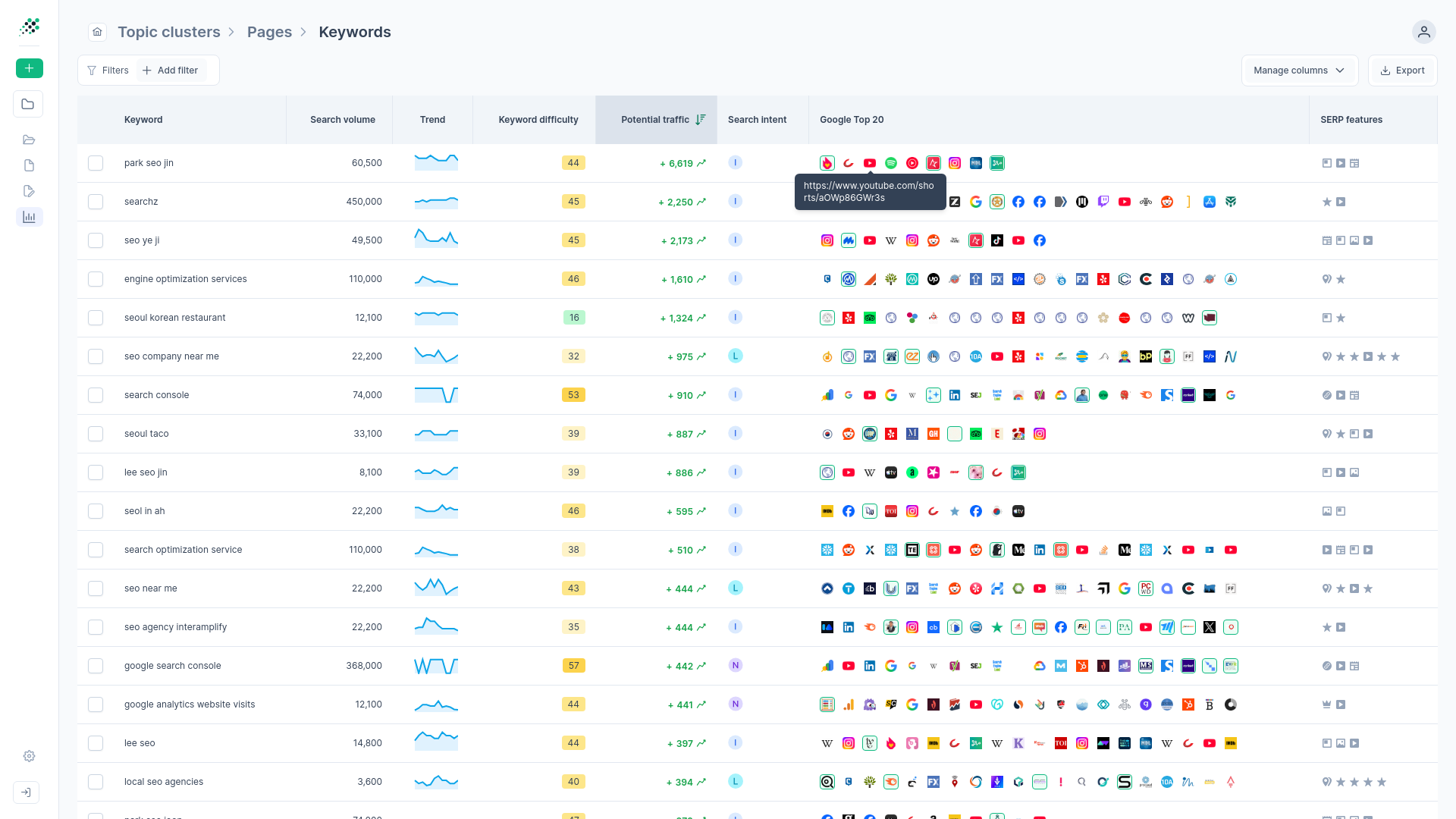
Every keyword receives a strict Informational, Commercial, or Navigational tag. Align your exact writing angle with user behavior to improve engagement and click-through rates.
Aggregate Difficulty Scoring
RankDots assigns a composite difficulty metric to every topic group. Prioritize your content pipeline by tackling the most accessible semantic clusters first.
SEO strategy benefits: Preventing cannibalization and building authority
Deploying this technologically backed format directly improves your site's health and competitive positioning. Distinct articles targeting minor variations of the same query inevitably damage organic traffic. You start seeing multiple URLs from your domain competing for identical search intent within Google Search Console. Diluting your domain authority across self-competing pages wastes budget and editorial effort. Organic traffic stagnates.
RankDots prevents this keyword cannibalization across your entire domain. Consolidating overlapping intents ensures each newly published page targets a strictly distinct concept. Grouping similar queries establishes strong boundaries between your internal assets. This forces search engines to recognize one primary pillar page per topic.
A structurally sound keyword cluster typically encompasses five to 15 closely related terms. This specific size maintains strict topical focus without stretching the overall page authority across too many divergent ideas. Maintaining this structural discipline prevents authors from wandering off-topic during the drafting phase.
You must recognize hidden semantic overlaps to map long-tail variations and build centralized authority. Grouping "produce delivery service" and "organic meat and vegetable delivery" together under a single "vegetable delivery box" cluster creates one definitive resource. Consolidating these variations into one guide ranks higher than maintaining three separate pages.
Your domain's current competitive strength dictates which consolidated topic you should tackle first. RankDots assigns an aggregate cluster difficulty score to each topic grouping. This metric maps how competitive the entire category is. This macro-level prioritization helps you target content silos where ranking is actually achievable, rather than checking individual metrics in tools like Ahrefs and blindly guessing the overall required effort. Focusing on aggregate difficulty keeps your strategy grounded in mathematical reality.
Integrating content architecture into your workflow
A validated topic map is only the initial phase of the content lifecycle. You must execute a methodical sequence to translate that raw architectural data into an active editorial calendar. Moving from overarching planning to individual page drafting requires strict editorial processes to maintain momentum.
The immediate next step after securing a map from RankDots involves batch-processing the data. Strict constraints are necessary to keep content teams focused; industry platforms define an optimal preference of 50 keyword clusters per grouping task (Contadu). This limitation keeps editorial calendars organized. It prevents content bottlenecks. Smaller batches allow for rigorous quality control during the initial drafting phase.
These validated groupings apply equally to historical optimization. A comparison of existing assets against a newly generated cluster map reveals exact gaps where aging articles lack comprehensive coverage. Updates to older pages with newly discovered subtopics deliver faster ranking improvements than constant production of net-new guides from scratch. This targeted refresh strategy reclaims lost organic traffic while maintaining structural integrity.
Sufficient depth and precise execution are necessary to address a fully saturated search concept. RankDots bridges this gap by feeding your validated cluster data straight into an AI content drafting pipeline. Instead of handing a writer a blank page and a list of keywords, RankDots uses its built-in AI writer to generate drafts containing the exact H2 and H3 subtopics required to satisfy the SERP. This direct integration turns structural analysis into ready-to-publish drafts. It accelerates production and maintains strict topical relevance.

Assign your highest-value clusters to the AI pipeline first. Filter your RankDots dashboard for groups with the highest aggregate traffic potential. Generate those articles directly within RankDots' built-in AI writer. This prioritization ensures your initial automation efforts target the most lucrative organic gaps.
See why RankDots is #1
Pick your plan
Frequently Asked Questions
How many keywords can I analyze or cluster at once?
Is the keyword clustering tool free, and what are the limitations of the free version?
Where does RankDots source its keyword clustering data?
Can I export or share my keyword cluster results?
Generate Your First Topic Cluster With Real Search Data
Stop wasting hours on manual spreadsheet sorting. RankDots groups thousands of related terms using active search engine overlaps. Build structured content architectures and validate your organic traffic potential immediately.