RankDots

Automate your discovery pipeline to find new keywords with RankDots

Stop wasting hours deduplicating CSVs. Enter a seed term, and RankDots instantly merges data from eight live sources into validated topic clusters mapped by search intent.

You just downloaded CSV files from three different keyword tools, and now you're staring at a spreadsheet trying to deduplicate thousands of rows. Your actual content planning stalls. To find new keywords effectively, stop relying on single-source databases that miss emerging trends. Instead, use an automated discovery pipeline that pulls real-time data from multiple platforms to instantly build validated, high-intent topic clusters.

We got tired of watching teams waste days sorting metrics by hand. Relying on just one index creates strategic blind spots, particularly when 15% of daily search queries have never been searched before.

RankDots replaces those endless CSV exports with an automated pipeline that normalizes the data for you. Paste your seed term. The tool merges live metrics, strips out the junk, and groups the remaining terms by shared search intent. You get a clean topic map in minutes, not a spreadsheet you still need to sort.
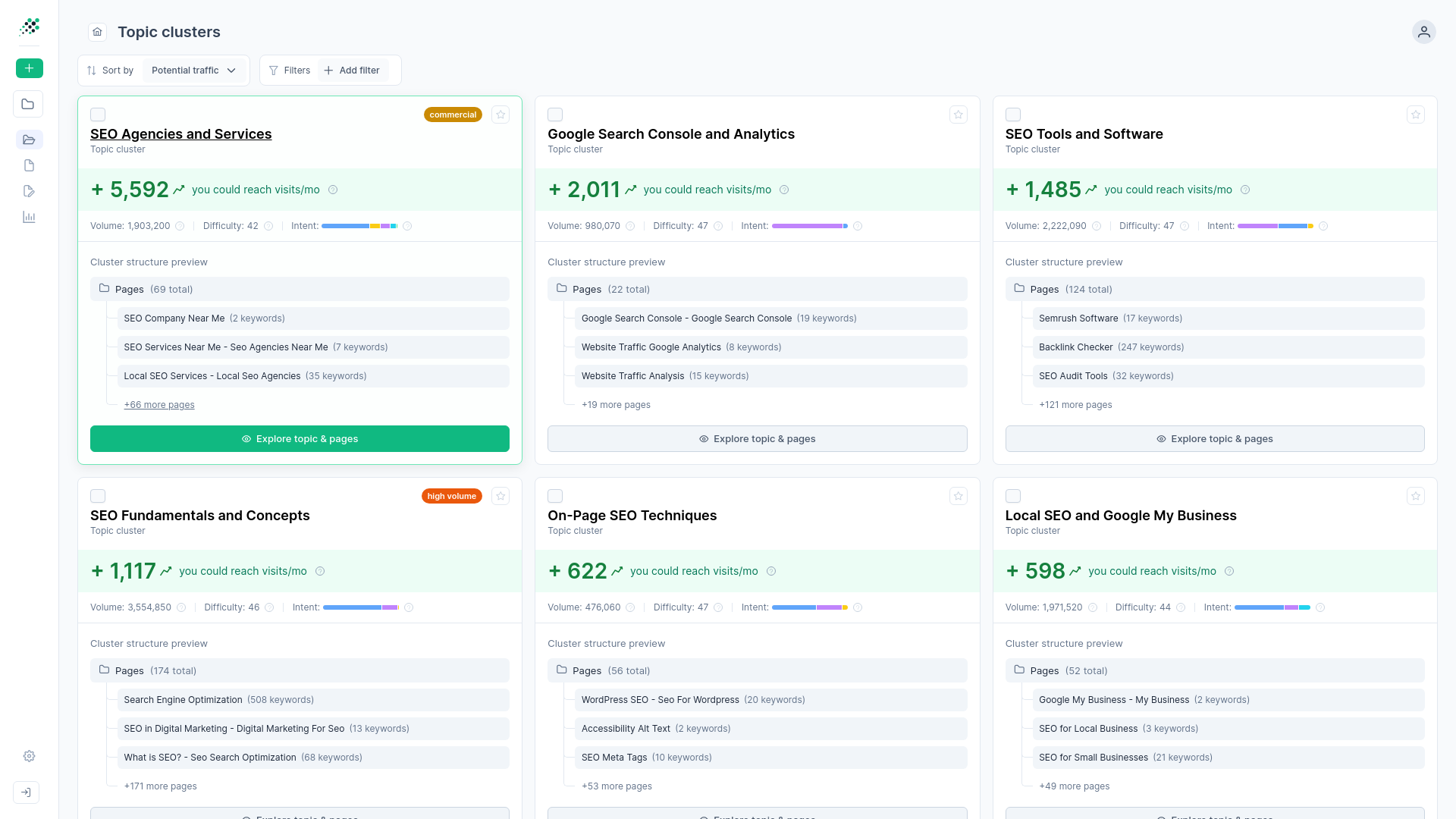
Clean data prevents skewed clusters
Junk data skews metric averages when merging lists manually. RankDots prevents this by automatically validating every keyword against 13 distinct linguistic rules, stripping out irrelevant terms before they ever reach your topic map.
RankDots Topic clusters dashboard showing organized topic cards with SEO metrics

A proper keyword research tool handles this data normalization instantly. Here's how to automate your keyword discovery pipeline and build ready-to-execute topic clusters.

Move beyond raw keyword lists

Layers

Topic-First Architecture

Manual phrase mapping is obsolete. RankDots groups terms by shared intent to build a ready-to-execute cluster structure.

Layout

SERP Feature Analysis

It analyzes 18 distinct result types to show exactly what content formats Google rewards. Target queries with available organic real estate before writing.

Target

Relative Keyword Difficulty

Ditch generic difficulty metrics. Evaluate competition against your specific site authority to pinpoint exactly which ranking positions are vulnerable.

How to automate your keyword pipeline

Search

Enter your starting seed

Type a seed term, URL, or domain to initiate discovery. It instantly generates preliminary content categories to preview available topics.

Database

Watch the pipeline expand

It simultaneously pulls live data from eight distinct sources to find new keywords. This eliminates the blind spots common in single-index tools.

Filter

Review the cleaned dataset

An automated quality check applies linguistic validation rules to instantly strip out junk terms and URL fragments. This leaves you with reliable metrics.

Layers

Prioritize your content clusters

It groups terms by shared intent. You then sort these ready-to-execute clusters using strategic lenses like Traffic Growth or Commercial value.

Eliminating single-source keyword bias

Most standard tools query just one primary database. When you rely exclusively on platforms like Semrush or Ahrefs, you hit a ceiling. You might discover a competitor capturing traffic from long-tail variations, only to realize your single-source tool completely missed those emerging trends. Missing these highly specific phrases costs you visibility.

RankDots bypasses this limit. Enter a single seed term, and the automated pipeline simultaneously queries 8 distinct sources. It pulls live data from Google Keyword Planner, Autocomplete, Related Searches, People Also Ask, and your own Search Console. The automated pipeline gathers, deduplicates, and normalizes the keyword list instantly. No more manual merging.

Run a competitor keyword gap analysis with this pipeline. You immediately uncover the exact long-tail terms driving their traffic that single-source databases completely overlook.

Baseline metrics from third-party approximations often fall short when evaluating content gaps. That's why RankDots pulls data directly from Google. You get real-time search volume and CPC metrics straight from the source. This live connection captures accurate data for newly emerged queries.

These live metrics pair directly with keyword difficulty scoring. RankDots evaluates SERP competition relative to your specific domain authority. You see exactly which ranking positions are vulnerable, not just a generic difficulty number.
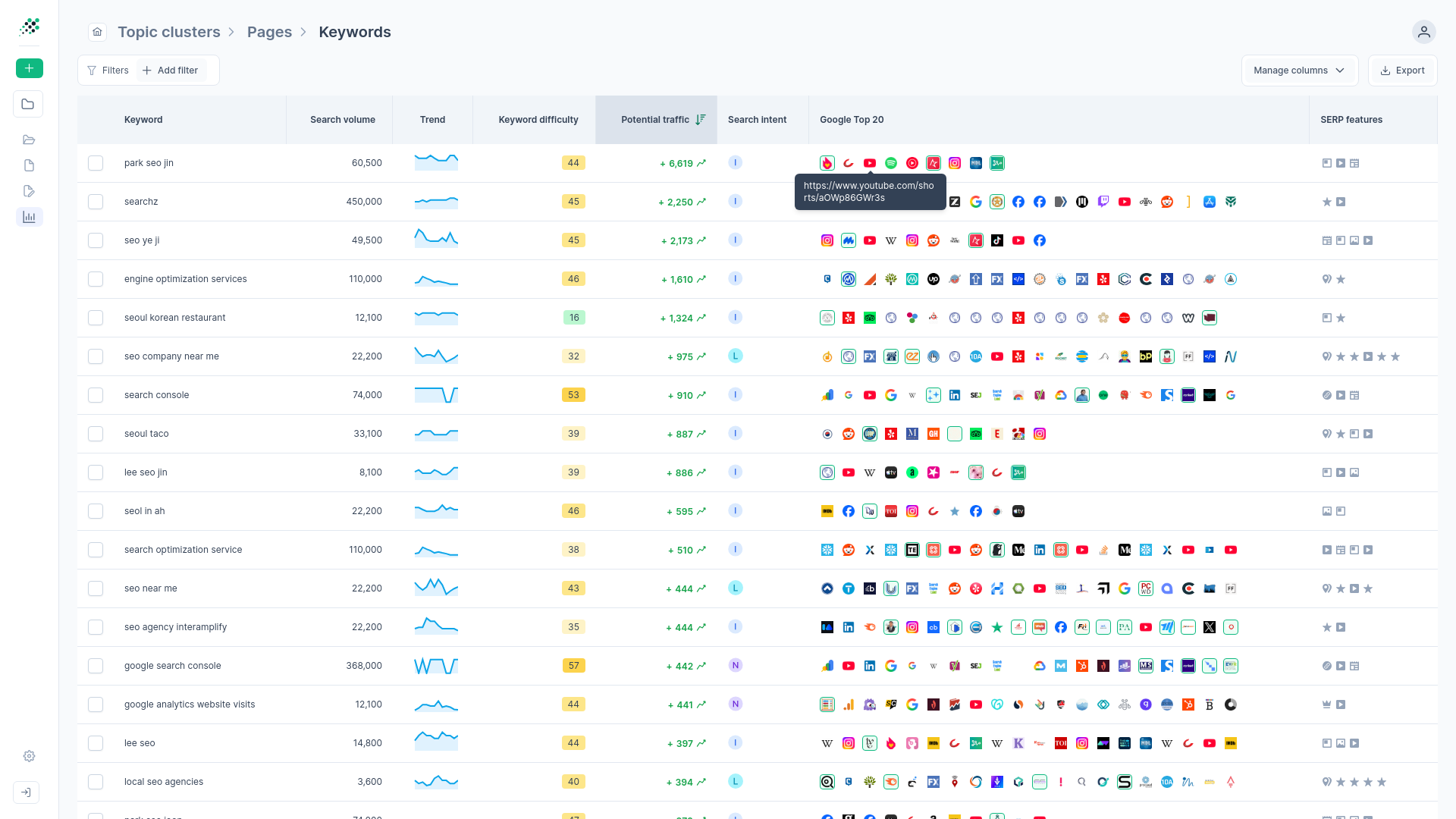
RankDots Keyword research table displaying search volume, trends, keyword difficulty, and Google Top 20 competitor metrics

A list of thousands of terms only helps if you know how to group them. URL Intersection Validation verifies your cluster accuracy. After grouping terms, the system checks live search results. If the same URLs rank for multiple queries, the cluster is validated. You get a list of targeted page topics backed by actual Google ranking patterns — no more generic lists sorted by shared words.
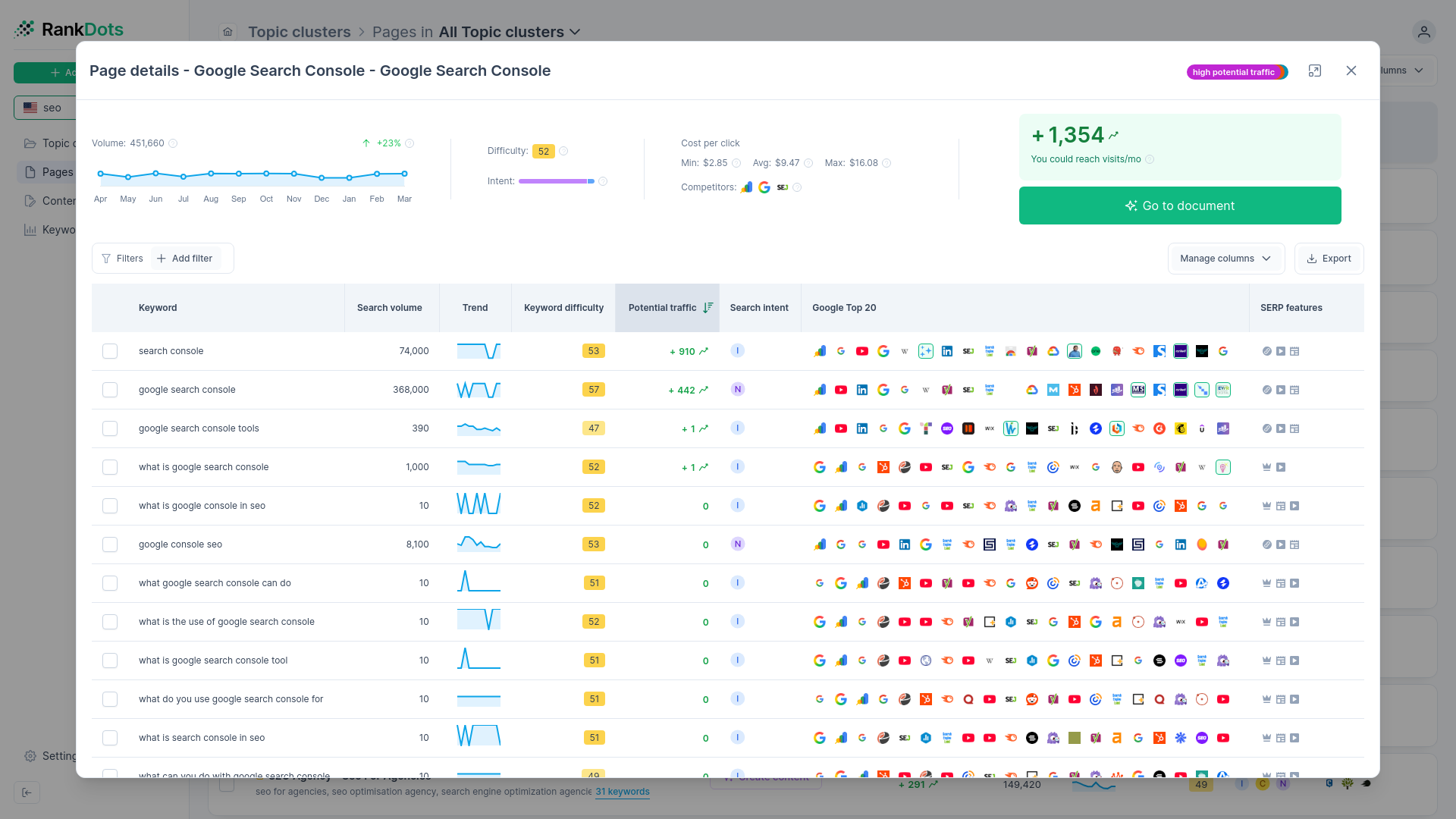
RankDots page details modal showing related keywords and Google Top 20 competitor icons for validation

See why RankDots is #1

Ryan K
“I don’t have time to dig through keywords all day. RankDots showed me what to write about, and it actually worked. Simple as that.”
Ryan K.,
Founder of Hollow Creek Supply
Melissa J
I’m not an SEO expert, but RankDots made it easy to find the right topics and publish fast. It’s like having an in-house SEO team—without the overhead.
Melissa J.,
Founder of Oak & Bloom Interiors
David M
“As an agency, we’ve tried dozens of tools — RankDots is the first that gets keyword clustering and AI content generation right.”
Danielle M.,
Founder of an SEO Agency
Tanya R
“It’s like having an SEO strategist built into our workflow. The topic clusters are spot-on, and the content drafts give us a huge head start.”
Tanya R.,
Content Marketing Manager

Frequently asked questions

What is the keyword research tool and how does it work?

RankDots is an automated discovery pipeline designed to help you find new keywords without manual spreadsheet work. Enter a single seed term, URL, or domain, and it instantly pulls data from eight distinct live sources to uncover emerging trends. It then cleans the dataset using linguistic validation rules and groups the results into actionable content silos based on shared search intent.

Which platforms and search engines does the tool support?

It integrates directly with the Google ecosystem to pull real-time metrics from Keyword Planner, Autocomplete, Related Searches, and live search results. You can also connect your own Google Search Console to bring in actual performance metrics like impressions and click-through rates. Beyond Google, it gathers alternative search data from Bing, Yahoo, and backlink API providers so you won't miss hidden opportunities.

How does this keyword tool compare to Google Keyword Planner?

While Google Keyword Planner focuses heavily on paid competition metrics and obscures exact search volumes behind broad ranges for accounts without active ad spend, RankDots provides complete organic context. It extracts precise volume data directly from Google while simultaneously evaluating 18 organic SERP features. This gives you a clear picture of actual ranking difficulty, not just advertiser bidding competition.

How can I use discovered keywords for SEO and content marketing?

You'll apply the discovered terms directly to a pillar-and-cluster site architecture. You won't map individual phrases to random pages. RankDots automatically ranks your topics using five different strategic lenses so you can prioritize execution based on immediate goals like commercial intent or traffic growth. The highly specific, low-volume queries surfaced by RankDots often yield better conversion rates than broad, competitive terms.

Can I export my keyword research results?

You won't have to deal with the messy raw data exports typical of standard platforms. Before you finalize your content plan, RankDots automatically filters the dataset against 13 linguistic validation rules to remove gibberish and URL fragments. You get a clean, validated topic map that directly informs your content calendar without the need to manually sort rows.

Watch the automated discovery pipeline operate

Preview topic categories instantly
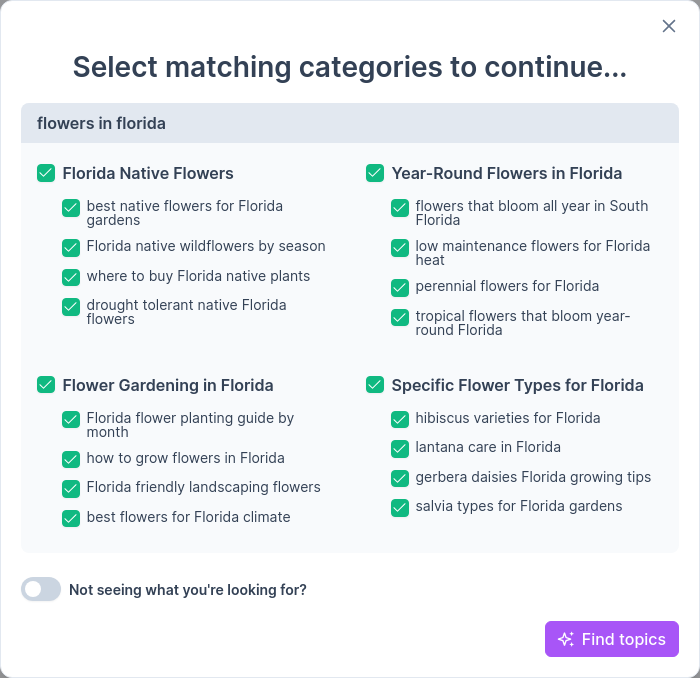
The setup screen displays initial AI-generated content categories seconds after you enter a starting term. You see a structured breakdown of potential subtopics before the full data extraction begins. This lets you refine your focus before processing.
Dashboard showing initial AI generated topic categories from a single seed term

Clean data without the spreadsheet

A unified metrics table displays exact search volumes and CPC data merged from the entire source list. The interface shows a clean dataset where linguistic validation rules stripped out irrelevant terms, which gives you a clear path to find new keywords.
Unified metrics table displaying deduplicated search volumes and cleaned query data

Verify clusters with live ranking data

The cluster detail view reveals exactly which live URLs rank for multiple queries within your group. This visual confirmation proves that search engines treat the grouped terms as the same topic. This ensures your proposed page targets a validated intent.
Cluster detail screen highlighting overlapping competitor URLs across multiple search queries

Prioritize clusters by strategic value

A sorting interface lets you apply five distinct recommendation algorithms to your clustered topics. The dashboard immediately rearranges your content plan based on your selected metric to push high-value commercial or high-traffic targets to the top.
Interface dropdown menu sorting topic clusters by Traffic Growth and Commercial intent

Start building ready-to-rank topic clusters today.

Stop wasting time deduplicating spreadsheet rows. Let RankDots automate your discovery process so you can easily find new keywords backed by live search metrics. Map your first content cluster in minutes and target vulnerable ranking positions.