Locate vulnerable search rankings with the RankDots SEO Competitors Finder
Stop fighting unwinnable battles against legacy domains. Compare live search results against your specific site authority to pinpoint the exact content gaps you can realistically capture today.
You're optimizing every meta tag and publishing consistently, but you're still losing search traffic to competitors relying on outdated content and legacy domain authority. Barely 1.7% of newly published web pages rank in the top 10 search results within their first year. You need an SEO Competitors Finder to identify competing websites, reveal semantic gaps, and pinpoint exactly where they have weak authority.
When you need to deliver quick wins for a new client, exporting thousands of raw keywords into flat CSV files only creates more confusion.
Here's how RankDots evaluates SERP competition relative to your specific domain to identify the precise "Easy-to-Rank Spots" your site can realistically win.
Reverse-engineer winning search strategies
Match Winning Formats
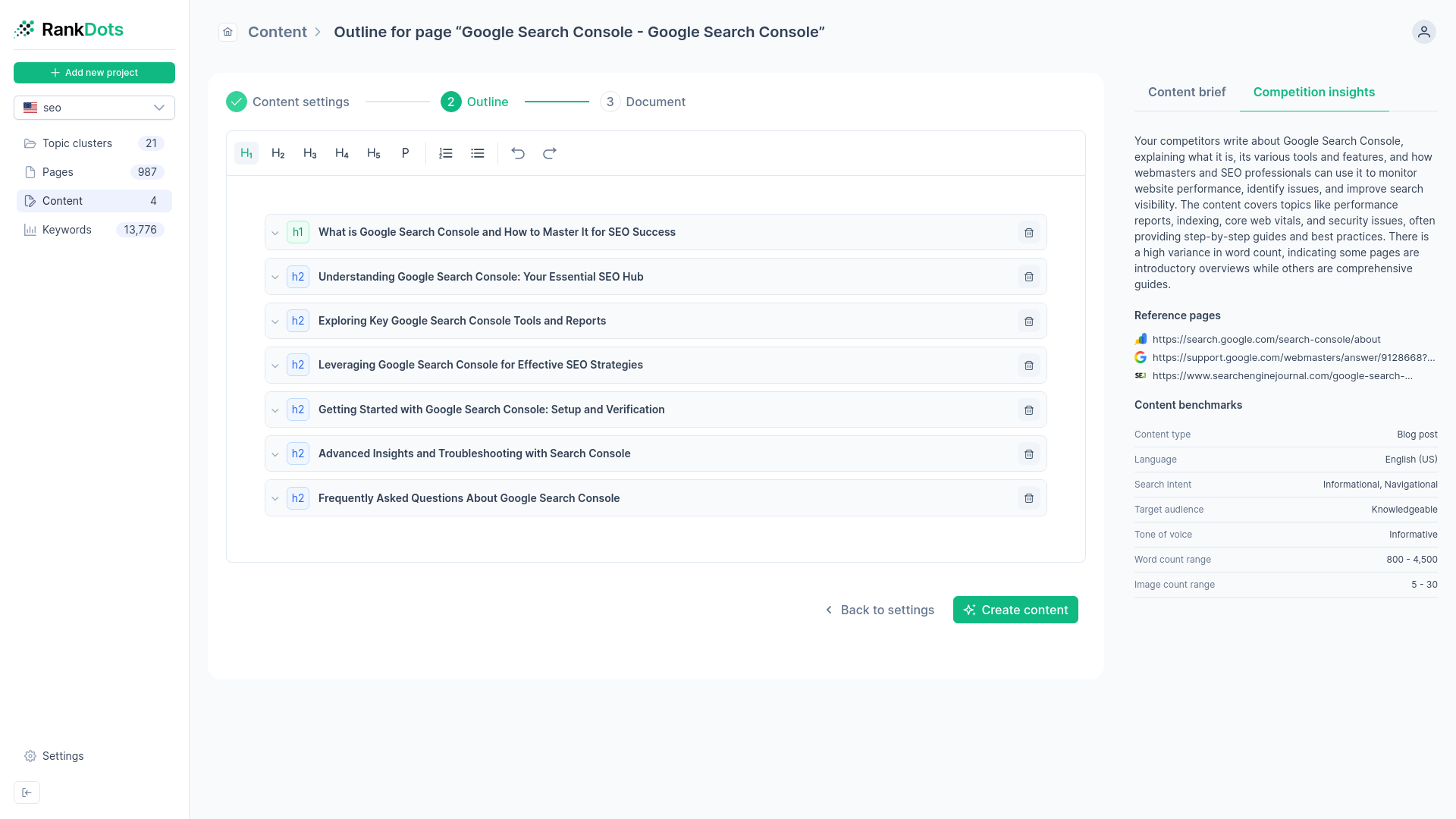
RankDots classifies competitor pages into formats like category or comparison pages. You'll build the exact page structure Google already rewards for that search intent.
Target Weak Positions
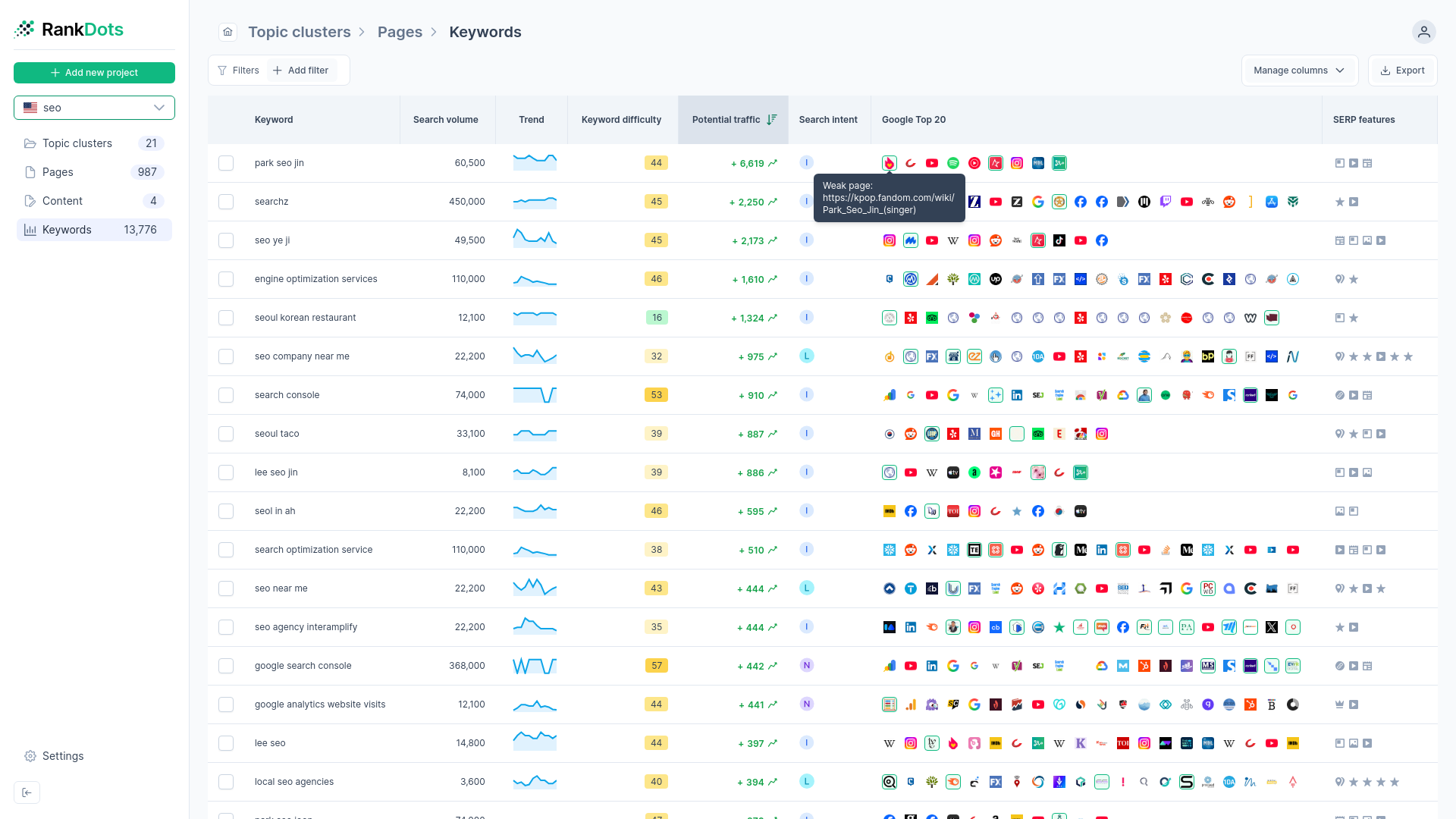
We evaluate search results against your domain authority. The algorithm highlights weak spots where legacy competitors have few backlinks so you can displace them.
Query Eight Data Sources
The RankDots SEO Competitors Finder simultaneously pulls from eight distinct sources. You'll capture semantic terms and trending variations your rivals completely miss.
Pinpoint Local Intent
Standard tools force keywords into four basic categories. We use five intent classifications. Percentage confidence scores reveal mixed-intent queries and dedicated local opportunities.
Filter Out Junk
Our AI validates every keyword against multiple linguistic rules to remove gibberish and URL fragments. Your metrics stay accurate without manual spreadsheet cleaning.
Forecast Concrete Traffic
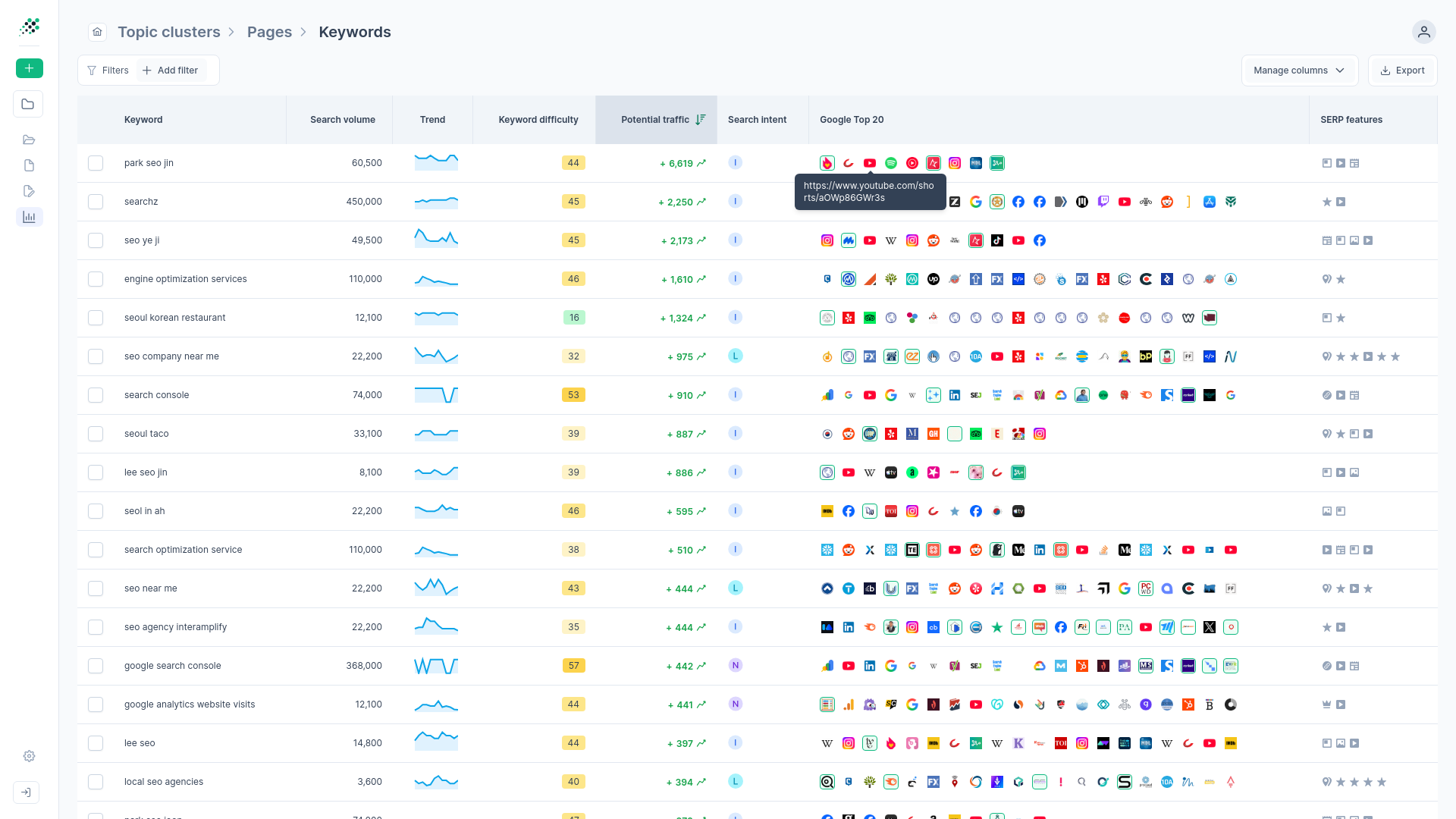
Translate abstract keyword opportunities into projected monthly traffic numbers per page. You'll present clear ROI forecasts to stakeholders before writing a single word.
How SEO Competitors Finder reverse-engineers rankings
Enter the target domain
Input a rival's URL to extract their exact ranking footprint. RankDots pulls live data from eight distinct sources and immediately strips out irrelevant search queries.
Locate vulnerable search positions
RankDots evaluates the extracted terms against your specific domain authority. It isolates the exact SERP positions where competitors survive on weak profiles you can displace.
Build the topical hierarchy
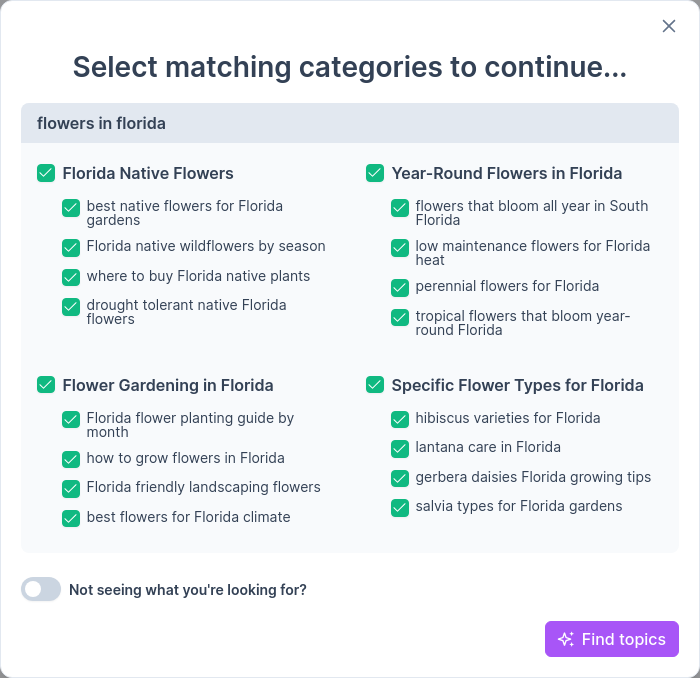
Skip the manual spreadsheet sorting. AI automatically groups your validated keyword gaps into a two-level architecture. It maps primary pillar pages directly to their supporting subtopics.
Generate the structured content
Move straight from your newly mapped architecture into production. You'll follow the plan to write targeted pages that capture the specific semantic gaps your rivals left open.
Inside the SEO Competitors Finder
Pinpoint Vulnerable Competitor Rankings
Uncover True Traffic Potential
Reverse-Engineer Winning Page Formats
Map Your Topical Strategy
Eliminate manual spreadsheet work and reverse-engineer winning content
Stop chasing phantom traffic projections
You export raw keyword data from Google Keyword Planner, build a quarterly traffic forecast, and present it to stakeholders. Months later, the actual traffic doesn't even come close to the projections. That's because the native platform groups distinct variations into identical search volume buckets. Data suggests this overestimates true search volume over 90% of the time, often drastically. RankDots detects these grouped keywords by matching their metric fingerprints. It accurately distributes the search volume across the group members, protecting your credibility and preventing you from wasting budget on inflated opportunities.
The platform's search volume correction ensures you build content strategies based on realistic traffic estimates.
Reverse-engineer exact page structures
Targeting the right keyword won't help if your page format is wrong. RankDots analyzes what ranks for specific queries. Its AI classifies competitor content into formats like comparison posts, category pages, or product pages. You see the minimum, maximum, and average word counts of competing articles immediately. It tracks the number of images and embedded videos competitors use. If the top pages are highly visual, the platform signals that your content needs multimedia to compete.
You use these specific page requirements to reverse-engineer content. Your new pages match the exact format search engines reward.
Automate the hierarchical clustering workflow
RankDots handles the transition from raw keyword extraction directly into a structured plan, stopping keyword cannibalization before it starts. It uses AI to create a two-level hierarchy of parent topics for your pillar pages and subtopics for supporting blog posts. You bypass the spreadsheet entirely and move straight into content creation with a clear, mapped architecture.
The tool generates a precise keyword gap analysis from this data. You see exactly which topical clusters your competitors dominate and where they lack coverage.
See why RankDots is #1




Pick your plan
Frequently asked questions
What constitutes a true SEO competitor?
How does the tool identify and find my website competitors?
How do you determine Easy-to-Rank spots?
Does the platform correct Google Keyword Planner search volume data?
What specific metrics and insights are included in the competitor finder report?
Turn vulnerable competitor rankings into measurable search traffic
Build your automated content plan in minutes instead of days. The RankDots SEO Competitors Finder translates raw keyword gaps into a prioritized, topic-first architecture so you'll execute your content strategy faster.