RankDots

Build a Topic-First Strategy With the RankDots Blog Content Planner

Abandon static spreadsheets and disconnected keyword metrics. RankDots uses live SERP data and automated semantic clustering to build a prioritized editorial calendar focused on validated search intent.

Keyword metrics rarely map directly to your workflow. Manual data entry takes over as you move rows from an SEO database into project management tools. You spend hours formatting spreadsheets instead of planning your content strategy. That stalls your content production. A smarter blog content planner doesn't stop at date management. It uses live SERP data and automated semantic clustering to build structured topic pillars and target verified search intent. This guide provides a clear workflow for transitioning from manual tracking to automated clustering and intent-driven prioritization.

When you export keyword lists into a standard Notion or Trello board, your volume and difficulty metrics typically become static. You guess which keywords belong together based on shared text, which risks cannibalization before a writer drafts an outline. We built RankDots to replace that guesswork. It uses a topic-first methodology to reverse the traditional keyword workflow. Paste a broad seed keyword. The agglomerative clustering algorithm instantly groups related terms based on overlapping URLs in live Google SERPs.

You see a structured site architecture appear directly within your workflow queue. RankDots automatically builds semantic topic clusters. You get ready-made page structures sorted by shared search intent. Stop dragging generic text groups into a rigid calendar. RankDots builds your content pipeline on actual Google ranking patterns.
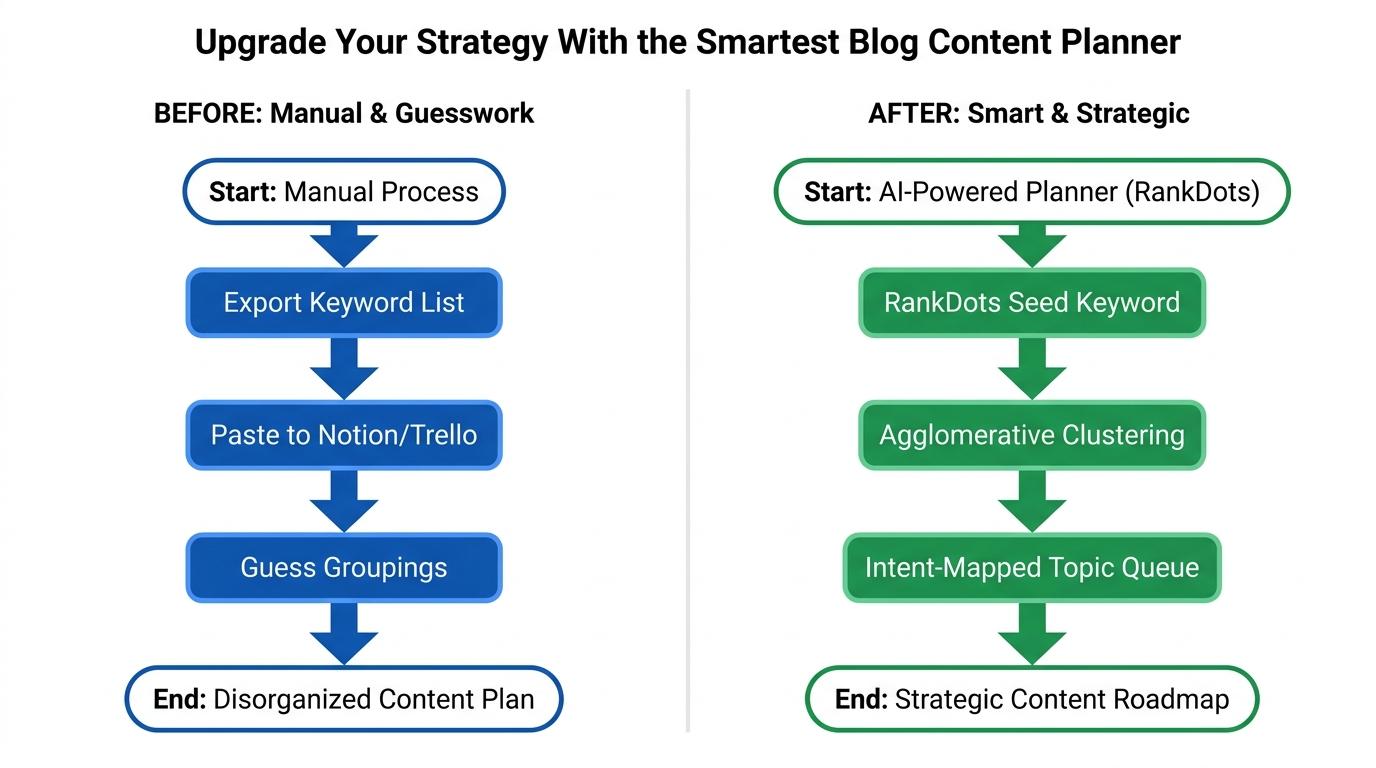
2-part workflow comparison showing Before: Export Keyword List → Paste to Notion/Trello → Guess Groupings and After: RankDots Seed Keyword → Agglomerative Clustering → Intent-Mapped Topic Queue

A Smarter Blog Content Planner

target

Verifiable Intent Scoring

RankDots calculates percentage distributions for query intent. It doesn't rely on binary tags. You know exactly when to blend informational formats with commercial guides.

trending-up

12-Month Trend Sparklines

Visualize whether search interest in a specific cluster is growing or declining. Commit topics to your calendar only when the data supports a positive trajectory.

bar-chart-2

Color-Coded Difficulty Metrics

Assess how hard it is to rank for targeted clusters instantly. A straightforward 0–100 scale helps you prioritize quick wins for your quarterly backlog.

eye

Live Competitor Insights

View the exact domains dominating the top search results. Analyze competing page structures to ensure your brief covers essential topical gaps.

zap

Search Console Integration

Connect your account to overlay real website performance data directly onto your research queue. Compare existing clicks against net-new opportunities without swapping tabs.

edit

3-Step Content Wizard

Transition directly from verified topics to actionable briefs. A structured workflow guides you through setting parameters and editing the final document outline.

The Topic-First Workflow

keyboard

Define Your Seed Topic

Enter a broad industry term and use the clarification dialog to select exact subtopics. This calibrates the engine to your specific target audience.

git-merge

Review the Cluster Map

Evaluate the auto-generated site architecture. Check page structures and search volume estimates before committing resources to a new content silo.

sliders-horizontal

Prioritize Your Backlog

Filter your blog content planner by trend sparklines and search intent labels. Identify high-value commercial gaps to schedule for the upcoming quarter.

file-edit

Launch the Content Wizard

Transition validated topics into active drafts. A guided three-step workflow helps you set parameters and finalize the document outline immediately.

See why RankDots is #1

Ryan K
“I don’t have time to dig through keywords all day. RankDots showed me what to write about, and it actually worked. Simple as that.”
Ryan K.,
Founder of Hollow Creek Supply
Melissa J
I’m not an SEO expert, but RankDots made it easy to find the right topics and publish fast. It’s like having an in-house SEO team—without the overhead.
Melissa J.,
Founder of Oak & Bloom Interiors
David M
“As an agency, we’ve tried dozens of tools — RankDots is the first that gets keyword clustering and AI content generation right.”
Danielle M.,
Founder of an SEO Agency
Tanya R
“It’s like having an SEO strategist built into our workflow. The topic clusters are spot-on, and the content drafts give us a huge head start.”
Tanya R.,
Content Marketing Manager

Pick your plan

Plans for individuals, teams, and agencies. Cancel anytime.
Monthly Annually Save 40%
Starter
$
49
/mo
Order now
Features
3 projects per month
8,000 keywords per project
10 AI articles per month
Smart keyword discovery (AI + search data)
Intelligent topic clustering
Potential growth analysis
Topic-level content creation
Best offer
Business
$
99
/mo
Order now
Features
8 projects per month
12,000 keywords per project
20 AI articles per month
Smart keyword discovery (AI + search data)
Intelligent topic clustering
Potential growth analysis
Topic-level content creation
Keyword export
Agency
$
169
/mo
Order now
Features
15 projects per month
20,000 keywords per project
40 AI articles per month
Smart keyword discovery (AI + search data)
Intelligent topic clustering
Potential growth analysis
Topic-level content creation
Keyword export
Enterprise
$
299
/mo
Order now
Features
20 projects per month
35,000 keywords per project
60 AI articles per month
Smart keyword discovery (AI + search data)
Intelligent topic clustering
Potential growth analysis
Topic-level content creation
Keyword export
Starter
$
29
/mo
Order now
Features
3 projects per month
8,000 keywords per project
10 AI articles per month
Smart keyword discovery (AI + search data)
Intelligent topic clustering
Potential growth analysis
Topic-level content creation
Best offer
Business
$
58
/mo
Order now
Features
8 projects per month
12,000 keywords per project
20 AI articles per month
Smart keyword discovery (AI + search data)
Intelligent topic clustering
Potential growth analysis
Topic-level content creation
Keyword export
Agency
$
99
/mo
Order now
Features
15 projects per month
20,000 keywords per project
40 AI articles per month
Smart keyword discovery (AI + search data)
Intelligent topic clustering
Potential growth analysis
Topic-level content creation
Keyword export
Enterprise
$
169
/mo
Order now
Features
20 projects per month
35,000 keywords per project
60 AI articles per month
Smart keyword discovery (AI + search data)
Intelligent topic clustering
Potential growth analysis
Topic-level content creation
Keyword export

Frequently Asked Questions

What is included in a blog content planner?

Stop guessing what your audience wants to read. A blog content planner maps your editorial calendar directly to verified search intent. Modern systems like RankDots include live SERP data integrations, automated semantic clustering, and specific intent labels for every page. They specify exactly where each piece of content will live. Curata notes this requirement helps map your production queue directly to your website architecture.

How do dedicated content templates compare to standard spreadsheets or documents?

Without real-time search performance insights, standard documents quickly become unmanageable data dumps. When you rely on basic tools, you'll face strict constraints—for example, Vendr notes that Notion imposes a 1,000-block limit for collaborative teams on free plans. A dedicated platform continuously updates your keyword difficulty and trend data. This automation eliminates hours of manual formatting.

What is the difference between this planner and other similar tools or templates?

RankDots breaks search intent down into precise percentages. It doesn't force a single tag onto a keyword. Most alternative templates strictly group terms by shared text, which misses how live Google ranking patterns actually work. You'll get specific metrics showing exactly when a query requires a blended format. This clarity prevents internal keyword cannibalization.

How does a content planner improve content creation and strategy execution?

When you centralize your planning, your focus shifts toward audience value and away from random keyword stuffing. Global Web Index reports that 80% of your social media content should focus on providing value, while 20% should be explicitly promotional. Use an automated queue to apply this ratio to your blog strategy. This approach keeps your informational guides and commercial pages balanced.

How do I create a content strategy using this planner?

Start by entering a broad seed keyword into the topic clarification dialog to pinpoint your exact audience angle. RankDots generates a visual map of topic clusters. From there, you can filter the backlog by 12-month trend sparklines and search volume. Finally, you'll run the three-step content wizard to transition a validated cluster directly into an actionable brief.

Launch Your Topic-First Strategy With RankDots

Stop wrestling with disconnected keyword metrics. Use the RankDots blog content planner to build a proactive content pipeline based on live Google ranking patterns. Structure your editorial calendar around validated search intent to prevent keyword cannibalization before drafting begins.