Topical Map Prioritization: The Data-Driven Execution Guide

If you just exported a large-scale spreadsheet of clustered keywords for your niche, staring at those thousands of rows often leaves you with zero idea which topics to actually write first. Topical map prioritization evaluates and sequences these content clusters based on business value, traffic potential, and semantic relevance.
Instead of randomly publishing pages, this strategy applies search volume correction, URL intersection validation, and specific scoring algorithms to build topical authority systematically. We've found that breaking this down into a 6-step framework is the fastest way to transition from raw keyword data to a prioritized content execution pipeline.
Quick Takeaways
- Topical map prioritization is the process of evaluating and mathematically sequencing content clusters based on business value, true traffic potential, and semantic relevance to systematically build domain authority.
- Balance immediate organic traffic gains with long-term architectural builds by pushing strategic updates for existing page-two URLs to the very front of your execution queue.
- Protect your site architecture from keyword cannibalization by using live search result overlap—or URL intersection validation—to mathematically prove whether related queries require distinct pages.
- Stop allocating content budgets based on flawed data by mathematically correcting the artificially inflated, bucketed search volumes consistently found in standard keyword database exports.
- Abandon superficial text-match filtering and rely on semantic AI clustering to group queries by their underlying commercial intent, even when those terms share zero overlapping vocabulary.
- Ruthlessly filter hundreds of potential topics into a realistic quarterly sprint by grading clusters against a four-tier scoring system that prioritizes direct revenue drivers over broad exploration.
The business case for data-driven topical map prioritization
The most successful content pipelines split their resources between immediate traffic recovery and long-term architectural builds. Balancing these two distinct objectives requires a mathematical approach to content sequencing, not editorial intuition.
Balancing long-term pillars with immediate traffic recovery
When stakeholders demand immediate organic traffic improvements, executing a comprehensive, months-long topical map can feel completely disconnected from business reality. Content teams face intense pressure to demonstrate fast returns to justify ongoing SEO investments. A purely architectural approach fails here because it delays traffic acquisition until the entire cluster matures. The strategic compromise involves identifying existing pages that already rank on page two or low page one. Updating these specific URLs delivers measurable organic growth within weeks. Push these quick-win updates to the front of the execution queue to satisfy leadership as the larger, time-intensive pillar structure takes shape in the background.
Allocating resources through mathematical sequencing
An unstructured subtopic list easily generates hundreds of potential entries. Handing that raw list to a writing team guarantees that production resources will stretch too thin across disjointed topics. Websites deploying a structured topic cluster strategy often see a significant increase in organic search traffic compared to sites relying on isolated keyword targeting. That accelerated growth happens because writing resources converge on specific semantic entities, forcing search engines to recognize deep expertise faster. Mathematical sequencing ensures your writers focus strictly on clusters that hold direct commercial relevance and support your primary conversion pathways. Expanding into broader informational categories only makes sense after you secure the core commercial pillars. Execution order matters.
Aligning stakeholders with auditable metrics
Subjective content choices inevitably lead to internal friction when different departments compete for writing resources. The sales team wants product comparisons, while the brand team wants thought leadership. A priority score based on search demand, brand relevance, and traffic potential segments the planned content into objective, actionable tiers. Documenting these exact prioritization metrics creates a transparent, auditable trail for the entire organization. Non-SEO stakeholders can look at the data and see exactly why a specific commercial hub takes precedence over a general glossary section. The execution roadmap transitions from a highly debated editorial wish list into a mathematically defensible business strategy that everyone can support.
Foundational concepts: Topic cannibalization and URL intersection validation
In our analysis of intent mapping failures, superficial grouping almost always causes stalled content performance.
The mechanics of topic cannibalization
Manual keyword grouping frequently causes overlapping pages because it relies on superficial word matches. A strategist attempting to group thousands of terms manually will inevitably assign variations of the same intent to different writers. The isolated-target approach to search queries structurally fails because search engines now prioritize semantic understanding. When multiple internal pages compete for the exact same user intent, crawlers struggle to assign relevance to a single canonical source. Affected keyword clusters often experience a substantial drop in organic traffic due to ranking authority splitting across competing internal pages. The architecture essentially fights itself in the search results.
Superficial keyword overlap versus true semantic intent
Topical authority requires distinguishing between words that look similar and words that mean the same thing to a search algorithm. A high E-E-A-T signal can't save a page if the underlying semantic mapping overlaps with another core asset on the domain. Group terms by their actual search intent, not identical phrasing, to resolve this structural flaw. If someone searching for "b2b crm software" and "enterprise client management system" wants the exact same software solution page, those terms belong in the same cluster regardless of the vocabulary differences.
URL intersection validation as a structural safeguard
Live search results provide a definitive answer on intent mapping. URL intersection validation analyzes whether search engines rank the exact same URLs for multiple keywords within a proposed cluster. If the live ranking URLs diverge significantly, the search engine views those queries as distinct intents requiring separate pages. If the same competitors rank for both terms, the intent is identical. This validation provides the ultimate reality check against overly broad, cannibalizing topic clusters.
How to execute data-driven topical map prioritization
-
Define your initial topical map scope
Enter your core seed keyword or competitor domain into the setup interface. Select specific subtopic categories that match your commercial niche so you don't pull in broad tangents. The system outputs a focused baseline keyword list tied to your selections.
-
Apply the search volume correction algorithm
Run the correction tool across your keyword list to identify identical metrics fingerprints. The platform automatically divides aggregated search volumes across grouped terms. You get realistic baseline traffic metrics that protect your production budget from inflated data.
-
Run URL intersection validation on clusters
Trigger the intersection check to analyze live search results for your grouped queries. The system checks if the exact same URLs rank in Google for multiple keywords within a cluster. Keywords with low overlap split into separate, validated topic pages.
-
Filter clusters by traffic growth potential
Apply the Traffic Growth recommendation algorithm to evaluate your validated clusters. This specific filter analyzes corrected search volume, competitive difficulty, and existing ranking positions. Your dashboard displays a prioritized execution sequence with quick-win updates at the top.
Step 1: Export baseline keyword and topic data
We've noticed the initial data gathering phase dictates the accuracy of the entire prioritization model. Setting strict boundaries early prevents the topic map from expanding into irrelevant categories that dilute your domain authority.
Define the initial topical scope
Every prioritization framework requires a clearly defined starting boundary. Establish your initial scope by entering core seed keywords or mapping the existing content footprint of established competitor domains. A broad exploration often pulls in hundreds of tangential subjects that drain your production budget without driving qualified conversions. For example, mapping out "project management software" could easily bleed into general "time management tips" if you fail to constrain the parameters. Narrow the focus at the very beginning so the subsequent data exports remain tightly aligned with your specific commercial niche and target buyer personas.
Extract baseline metrics from traditional databases
Scoring requires raw search metrics as a baseline input. Export standard keyword lists from established databases like Ahrefs or SEMrush. These platforms provide the necessary raw materials—search volume estimates, keyword difficulty scores, and basic parent topic categorizations. Treat this initial large-scale spreadsheet strictly as a rough inventory rather than a finalized structural blueprint. The thousands of rows you export here represent the total addressable market of search queries, but they lack the semantic refinement necessary for actual execution. They give you the scale of the landscape, not the map itself.
Integrate first-party performance data
Third-party metrics lack critical context about your specific domain authority. A keyword with a high difficulty score might seem out of reach globally, but your site might already rank on page two for a close variant. Connect Google Search Console to pull in your actual impressions, clicks, and average ranking positions. Merge this proprietary performance data with the broad market export to establish your current ranking baselines. You immediately see where you already have a strong structural foothold and where you're starting entirely from zero. This integration transforms theoretical topic research into an actionable content roadmap grounded in your website's actual historical performance, which helps you flag immediate quick-win opportunities.
Step 2: Run search volume correction and AI clustering
The raw data exported in the previous step contains a hidden flaw that skews prioritization models if left unaddressed. Teams consistently misallocate their entire quarterly budget chasing inflated numbers because they trust the default metrics without running a correction protocol.
Identify the metric inflation flaw
If you prioritize content based on flawed data, you'll misallocate writing resources and miss revenue expectations. Stakeholders reviewing potential topic clusters frequently notice inflated volume numbers that feel highly unrealistic for a narrow commercial niche. That initial skepticism is justified. The primary data source most platforms rely on aggregates closely related keyword variants together, but then it reports the exact same combined total search volume for every single individual term in that bucket.
If "agile project management," "agile project management tool," and "agile software for projects" get grouped internally by the search engine's planner tool, the interface displays the combined volume of all three across each individual line item. This specific mechanism severely inflates search impressions for top-ranking terms. These raw, duplicated metrics guarantee a mathematically broken prioritization model. You end up building expensive, comprehensive pillar pages for topics that actually possess a fraction of the demand your exported spreadsheet claims.
Apply a search volume correction algorithm
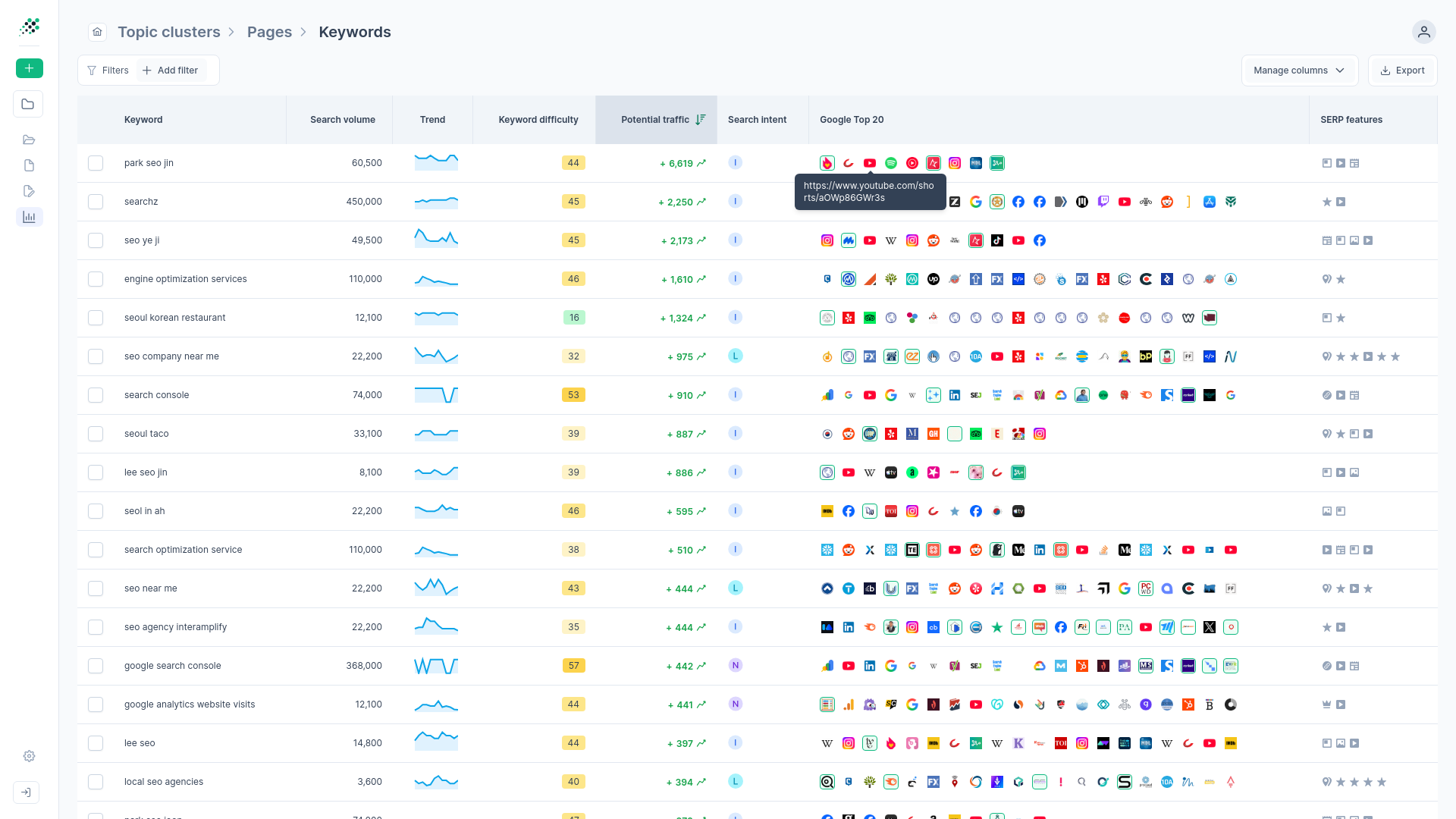
Isolate those bucketed numbers to reveal the true, uninflated traffic potential behind each query. RankDots applies a dedicated Search Volume Correction algorithm to fix these inflated metrics automatically before any prioritization scoring occurs. The correction mechanism works by identifying keywords that share an identical, highly specific metrics fingerprint.
The system looks for terms sharing the exact same monthly search volume, the exact same historical trend pattern across a twelve-month period, and the exact same paid competition level. When the platform detects these perfectly matching fingerprints across multiple rows, it knows the search engine has bucketed them. The tool then automatically distributes the total reported volume accurately across the grouped keywords, which stops the duplicated numbers from stacking. A bucket of 10,000 monthly searches gets divided realistically across its components. You secure realistic baseline data for accurate traffic potential scoring, protecting your content team from chasing inaccurate metrics and building strategy on a foundation of inflated data.
Group terms via semantic AI clustering
Once the search volumes reflect reality, those corrected terms require proper grouping to form actionable pages. The traditional method of grouping keywords based on shared text strings—filtering a spreadsheet for every phrase containing the word "software"—consistently fails to capture modern search behavior. Two phrases can share zero overlapping words but still require the exact same landing page to satisfy the underlying user intent.
Do not rely on basic text match filters. AI clustering groups keywords by their actual semantic meaning. RankDots evaluates the underlying intent relationship behind the queries. This means the resulting clusters map directly to what a user wants to achieve or purchase. A query for "affordable auto coverage" automatically clusters with "cheap car insurance" despite sharing no common vocabulary. You transition from a chaotic, inflated spreadsheet into a pristine, structured set of validated parent topics and subtopics. This final semantic clustering step converts thousands of isolated keywords into a strictly defined hierarchy, yielding a finite list of manageable page assignments ready for execution sequencing.
Step 3: Perform URL intersection validation
You just clustered your keywords semantically, and the spreadsheet looks clean. But before assigning these mapped topics to the freelance writing team, you need a way to confidently validate that the planned clusters aren't too broad. If you don't check how search engines treat specific queries, you'll likely try to rank for distinct intents with a single pillar page. Unvalidated briefs waste budget and force writers to create disjointed content for conflicting audiences.
The reality check against live search results
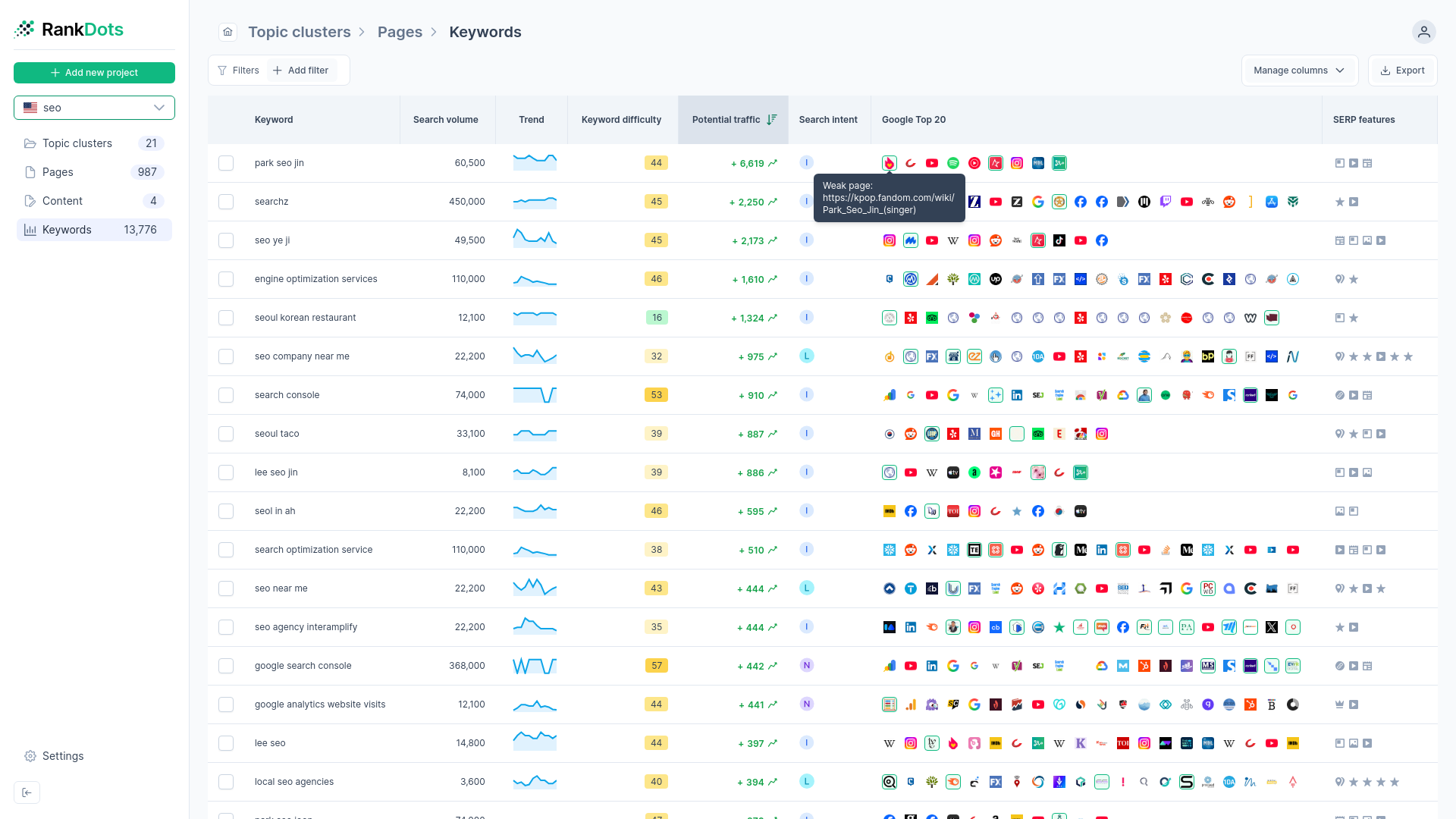
URL intersection validation is the reality check here. Stop guessing if two related concepts belong on the same page and analyze the live search engine results instead. RankDots performs a unique quality check by scraping the current Google rankings for multiple keywords within your proposed cluster. It looks specifically for URL overlap. If the exact same URLs rank for both terms, Google considers the intent identical. If the URLs completely diverge, the search engine views those queries as distinct intents requiring separate pages.
This validation process entirely removes human bias from the site architecture. You might think "CRM for enterprise" and "CRM for large business" belong on the same page. The live search results provide a definitive, mathematical answer. If the overlap is high, they stay clustered. If the overlap is non-existent, combining them will suppress the page's ability to rank for either term.
Establishing thresholds for topic separation
Cluster validation requires strict mathematical boundaries. The standard process involves calculating the percentage of identical URLs appearing across the top ten results for different queries. If six out of ten results match perfectly, the semantic relationship is undeniable. The algorithm recognizes that the searcher wants the exact same page format and information for both queries.
A 30% intersection threshold is the usual baseline for topic separation. If fewer than three URLs overlap across the top results for two given keywords, split them into distinct subtopics. A 10% or 20% overlap often indicates a mixed SERP, where the search engine is testing different intents. If you force low-overlap terms onto the same page, you'll underperform by fighting the established ranking pattern. When in doubt, separate the topics. Narrower pages targeted at specific intents almost always outperform broad pages trying to satisfy contradictory search behaviors.
Executing the intersection workflow
Manual checks take hours, but understanding the mechanics helps you interpret automated data correctly. Here is the step-by-step workflow for executing a URL intersection check on proposed clusters:
- Select a primary parent keyword that represents the core theme of your proposed cluster.
- Run a live query for that primary keyword to establish the baseline set of ranking URLs.
- Query the secondary keywords within the cluster and cross-reference their top ten results against your baseline.
- Calculate the precise percentage of identical URLs appearing in both sets.
- Split the secondary keyword into a completely new topic cluster if the overlap falls below your established threshold.
Step 4: Apply traffic potential and business impact scores
After validating the clusters, the raw subtopic list frequently swells into the hundreds. A content lead looking at over 300 potential articles with budget for only 20 this quarter has to filter ruthlessly. You must move past generic search volume metrics to identify what moves the needle for the business.
Moving beyond generic volume metrics
Teams can become completely paralyzed by choice when every validated cluster looks moderately valuable on a spreadsheet. Effective prioritization requires scores based on actual business potential and realistic traffic acquisition. High volume means absolutely nothing if the competitive difficulty puts the keyword entirely out of reach for your current domain strength.
RankDots addresses this paralysis by assigning a specific Topical Authority Score to each cluster. The platform calculates how effectively a group of pages will build authority by factoring in search demand, competitive density, and the required subtopic coverage depth. A cluster demanding fifty articles to achieve authority requires a vastly different resource commitment than a cluster requiring only five.
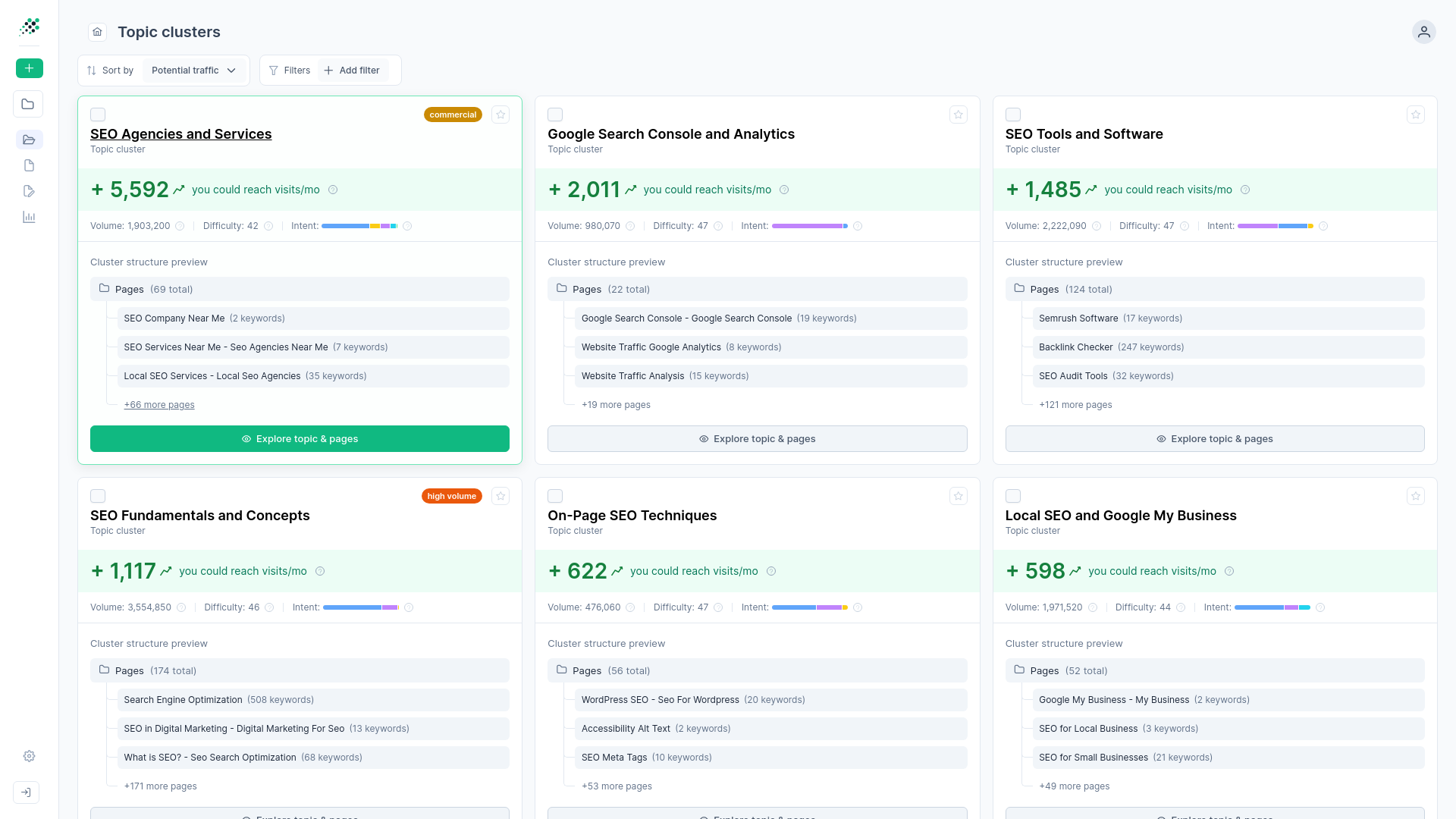
The specific topic cluster size dictates whether a project fits into a single quarterly sprint or requires a long-term roadmap. Scoring normalizes these variables so you can compare massive pillar structures against narrow niche topics objectively.
Applying strategic recommendation lenses
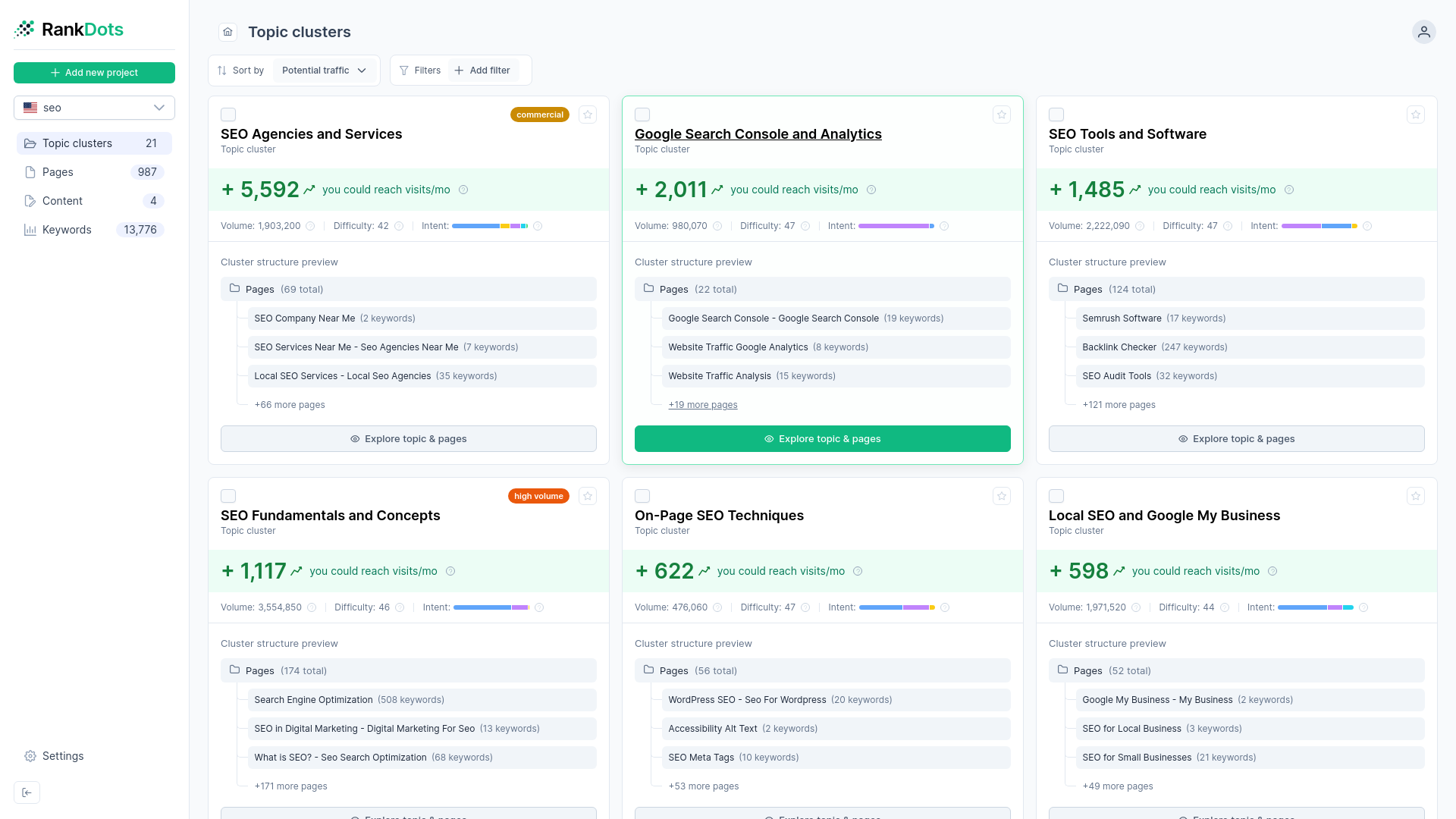
Don't sort a flat list by a single arbitrary metric; evaluate the data through multiple recommendation algorithms instead. RankDots automatically ranks your mapped topics using five different strategic lenses to match your current business goals. The Traffic Growth algorithm specifically prioritizes clusters with the highest potential traffic gain. It triangulates corrected search volume, keyword difficulty, and your existing ranking positions pulled from first-party performance data.
Updates to quick-win pages that already sit on page two or low page one should jump to the front of the queue. These strategic updates deliver measurable organic growth within weeks, generating the immediate return on investment required to fund longer-term pillar builds. Every topic card also displays a plain-language traffic estimate and visual search intent badges, so you can instantly gauge the commercial value before committing brief-writing resources.
Filtering for the quarterly production sprint
You need rigid filtering criteria to transition from a broad map to a specific execution timeline. Use this prioritization scoring rubric to narrow hundreds of subtopics down to a manageable quarterly sprint:
- Tier 1 - Immediate Growth: Existing pages ranking in positions 11 through 20 that require minimal updates to break onto page one. High business impact, low effort.
- Tier 2 - Core Commercial Pillars: High-intent product or service clusters directly tied to primary revenue drivers. High business impact, moderate effort.
- Tier 3 - Supporting Subtopics: Informational pieces that link back to existing commercial pillars to fill immediate topical gaps. Moderate business impact, low effort.
- Tier 4 - Broad Exploration: High-volume, top-of-funnel topics requiring extensive new cluster builds. Low immediate business impact, high effort.
Ruthlessly discard anything falling into Tier 4 until the first three tiers are fully saturated. Execution order determines how quickly the architecture generates revenue.
Step 5: Sequence your content execution pipeline
Topic selection is only half the battle; the connections between individual pieces dictate the actual site architecture. An SEO manager evaluating a niche needs to quickly identify high-opportunity gaps in their existing footprint. Visual maps that highlight covered and empty sections empower the team to sequence production logically.
Defining the hub-and-spoke architecture
Most platforms start with a flat keyword list and try to shoehorn them onto distinct pages. A topic-first approach works significantly better for building authority. You start by structuring the clusters and derive the optimal page hierarchy from them. Prioritize the creation of the most impactful central pages before systematically expanding into narrower supporting subtopics.
RankDots automatically designates which clusters are comprehensive pillar pages and which are supporting blog posts. It maps out the exact hub-and-spoke internal linking structure, explicitly detailing which subtopics must link back to which parent pillars. This structural clarity prevents writers from randomly hyperlinking across the site and diluting the semantic relevance of the core hubs.
Identifying content gaps visually
When you translate a spreadsheet into a production pipeline, architectural gaps often remain invisible until after publication. Visual overlays solve this translation failure. RankDots provides a Completeness Indicator and a Content Gap Overlay to show exactly how thoroughly you have covered a specific niche. The interface highlights uncovered topic areas directly on the visual map.
You know exactly what to prioritize next because the blank spaces point directly to missing semantic coverage. If your main product pillar lacks the necessary supporting comparisons, the overlay flags the omission. This visual proof is invaluable for aligning non-technical stakeholders. When leadership asks why the team is writing a seemingly obscure subtopic, you can point directly to the gap in the visual map that must be filled to support the primary revenue page.
Structuring the final execution workflow
You must set clear boundaries and rigid instructions when handing a sequenced map to a writing team. Use this structured content execution checklist to enforce the architecture during production:
- Assign the central pillar page to your most experienced writer to establish the core narrative and structural format.
- Distribute the supporting subtopic briefs concurrently to the rest of the team to build out the required spokes.
- Mandate strict internal linking requirements in every single brief, forcing the spokes to point directly back to the primary pillar.
- Validate that the visual search intent badges align perfectly with the assigned page template before writing begins.
Step 6: Audit and maintain your topical map over time
Search behavior shifts constantly, and a topical map degrades if left static. Search intent evolves, competitors launch aggressive new pillar structures, and your own business objectives pivot. To maintain authority, treat the map as a living, adaptable document instead of a one-time architectural project.
Triggers for map recalibration
Your core topical structures should be reviewed at least quarterly. Routine cadence maintains baseline health, but specific external events should trigger immediate recalibration. If a major algorithm update shifts the dominant intent of your primary keyword from informational guides to commercial directories, the underlying map must adapt instantly.
Similarly, if you launch a net-new product category or acquire a competitor, you must map an entirely new branch of the taxonomy. An annual review leaves gaping holes in your semantic coverage while competitors capture the emerging search demand. Treat the map as a reflection of the current market reality, adjusting the priorities as the business environment changes.
Measuring topical authority accumulation
Success tracking for a cluster strategy goes far beyond monitoring single-page rankings. Authority accumulation should be measured across the entire published structure. The most reliable indicator is monitoring the aggregate impression growth of the hub-and-spoke structure as a single entity.
Proper topical authority measurement relies on these aggregate signals rather than isolated keyword wins.
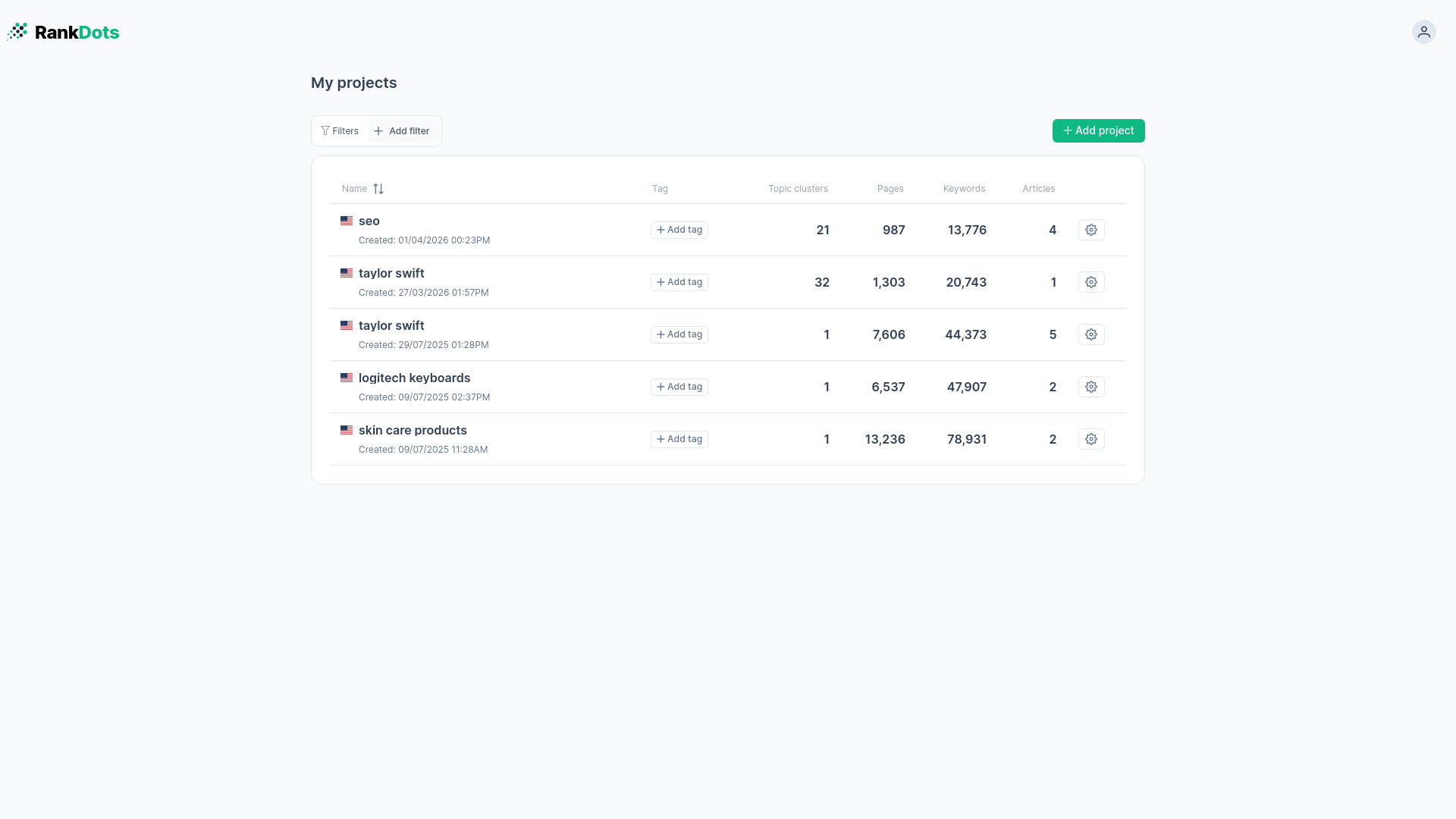
When a newly published subtopic immediately ranks on page one without any external backlinks, the parent cluster has achieved genuine topical authority. That unassisted ranking momentum signals that the search engine fully trusts your domain for that specific category. Once you hit that threshold, you can safely pause production in that category and reallocate writing resources to a different, underperforming pillar.
Pruning and merging post-publication
Over time, previously distinct intents sometimes merge in the search engine's understanding. Pages that operated perfectly well as separate subtopics for years might begin to cannibalize each other post-publication. Active maintenance involves routinely identifying these overlapping pages and consolidating them.
Redirect a decaying subtopic into a stronger, closely related pillar page to consolidate ranking signals and clean up the site architecture. Active pruning removes obsolete, low-value content that dilutes your overall domain relevance. Keep the topical map strictly aligned with current search reality so every page serves a distinct, validated purpose within the broader hierarchy.
Essential tools for automating topical map prioritization
A manual topical mapping process eventually breaks down when scaled across thousands of keywords. You need software that handles semantic analysis without exhausting your quarterly budget to move from theoretical site architecture to a sequenced production pipeline.
All-in-one SEO platforms versus specialized mapping tools
Most teams in this space start with broad legacy databases. Traditional platforms like Ahrefs and SEMrush provide essential raw materials. They offer extensive backlink and keyword databases that help establish your baseline domain authority. But they generally fall short when you need to group those thousands of exported rows semantically.
This capability gap created a dedicated market for specialized clustering software. MarketMuse, for instance, evaluates topical depth across entire content inventories. It uses patented topic modeling algorithms to score content depth and identify semantic gaps instead of relying on generic keyword volume. The primary trade-off is a steep learning curve for new users navigating the interface. Use legacy platforms strictly for your initial baseline data export, then port those CSVs into a specialized semantic tool for the actual architectural mapping.
Using live SERP data for intent grouping
Static keyword databases guess at search intent. Live search results prove it. Platforms that scrape real-time search engine result pages provide a vastly safer foundation for structuring your site architecture.
Keyword Insights transforms large keyword lists into intent-based clusters using live SERP keyword clustering to build authority. Current ranking data prevents you from accidentally combining distinct search intents onto a single pillar page. RankDots integrates a similar philosophy through its URL intersection validation feature. It mathematically checks if the exact same URLs rank for multiple queries within your proposed cluster. If the live competitor overlap is low, the platform flags the cluster as too broad. That automated reality check prevents cannibalization before a writer ever receives a brief.
Navigating tool limitations and pricing trade-offs
The shift to specialized AI clustering introduces new operational constraints. Almost every platform in this category monetizes through strict query restrictions or credit-based output limits.
Topical Map AI generates large-scale topical clusters in under 60 seconds and supports direct export to Claude Projects. However, the platform has an unpolished user interface and lacks comprehensive on-page optimization tools. Keyword Insights provides public API access and AI content briefs, but it entirely misses the technical audits found in legacy platforms.
You have to balance automation speed against recurring costs. MarketMuse imposes strict query limits on free and basic plans. When evaluating these credit-based pricing models, calculate your exact quarterly publishing velocity first. An enterprise API bucket makes zero sense if your freelance writing team can only produce ten pillar pages a month. Match the software's query limits directly to your actual execution capacity.
Frequently asked questions
How often should you update a topical map?
How do you prevent keyword cannibalization?
How long until you see results from a topical map?
Who should own and maintain a topical map?
Can topical maps reveal untapped content opportunities?
Build a profitable content pipeline with topical map prioritization
Stop guessing which clusters to write first. Sequence your upcoming content sprints based on actual semantic intent and immediate traffic potential. Start building authority systematically without wasting your production budget.