Replace messy spreadsheets with smarter Free Keyword Research Tools
RankDots cross-references eight search data streams to build hierarchical content maps automatically. You get clear intent scores and validated variations without manually sorting a single CSV.
- Filter out junk terms using AI linguistic validation
- Uncover long-tail variations from eight distinct search sources
- Group terms into ready-to-use hierarchical topic clusters automatically
Most free keyword tools just dump a messy, ungrouped list of broad terms onto your lap and leave you to figure out the rest. When evaluating free keyword research tools, the most effective options move beyond basic search volume to provide accurate intent scoring and topical clustering. Manual CSV exports slow you down. Modern platforms cross-reference multiple data sources to uncover hidden long-tail variations automatically.
You waste hours deduplicating spreadsheets when you juggle multiple freemium apps to bypass tight daily search limits. You've likely lost entire afternoons just wrestling with manual data collection. And if you rely on Google Keyword Planner for your quarterly content calendar, exact search volumes are hidden behind uselessly broad ranges—making stakeholder reporting and concrete traffic forecasting nearly impossible.
Automated hierarchical clusters replace the standard raw keyword dump so you can map out content immediately. With RankDots, you skip the spreadsheet phase. The platform's Hierarchical Topic Clustering groups keywords into a two-level architecture of parent topics and subtopics. You get an immediate, ready-to-use content map, not a flat bucket of unrelated terms.
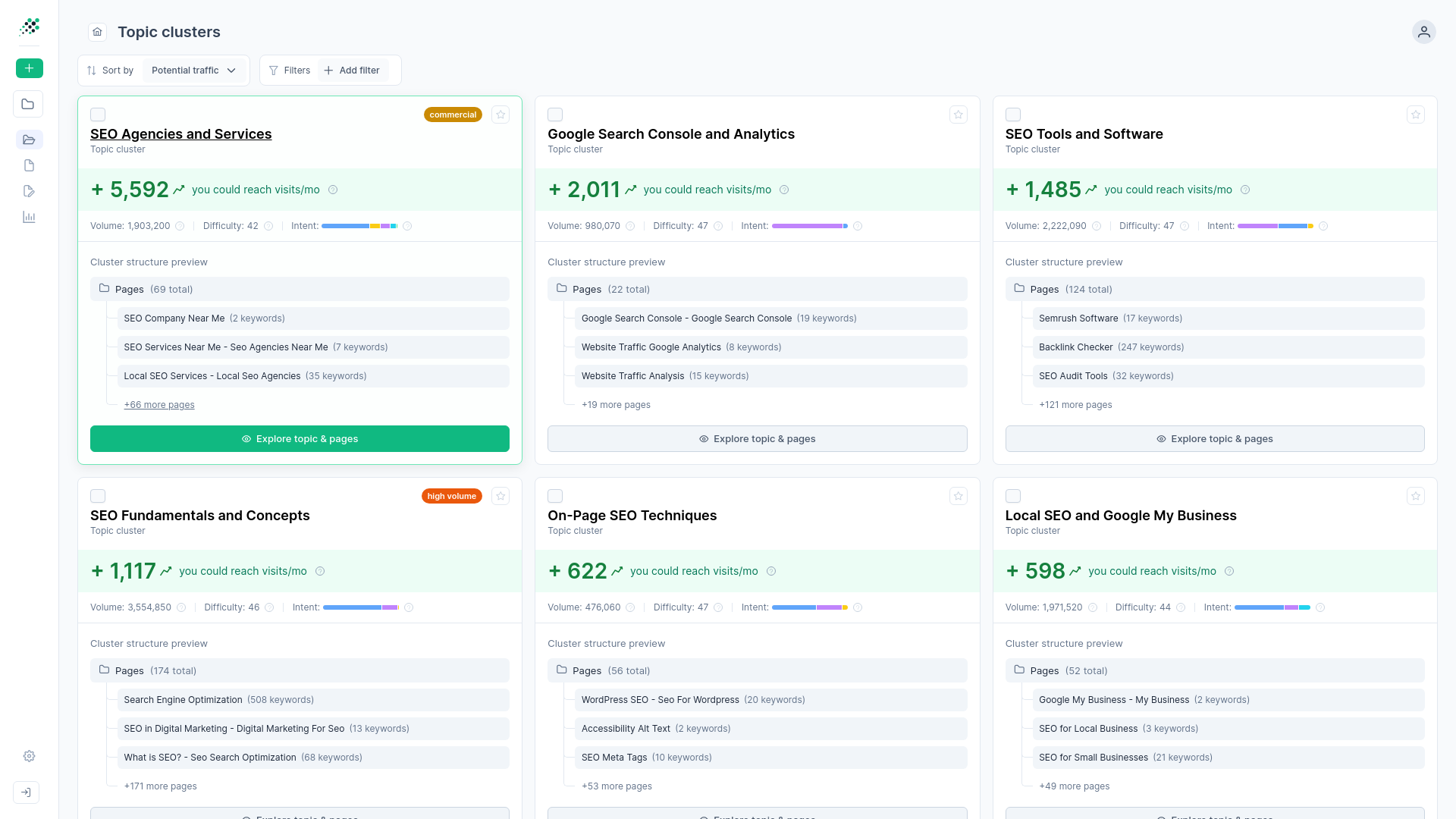
Here's a complete breakdown of how to automate your keyword discovery, filtering, and clustering pipeline.
RankDots: Free Keyword Research Tools
Two-Level Topic Architecture Maps
Five Topic Sorting Algorithms
Competitor Keyword Coverage Panel
Precise Local Geolocation Settings
Automate Your SEO Discovery Pipeline
Multi-Source Aggregation
Stop relying on a single clickstream database. RankDots queries eight distinct sources simultaneously to capture the emerging long-tail variations that limited competitor indexes miss.
Automatic Deduplication
RankDots automatically merges overlapping queries from different search sources into one unified list. You keep the most accurate metrics without scrubbing duplicate spreadsheet rows by hand.
Precise Volume Correction
Google Keyword Planner often lumps similar terms together with identical search metrics. RankDots detects these grouped fingerprints and distributes the numbers accurately to prevent traffic overestimation.
Strategic Topic Ranking
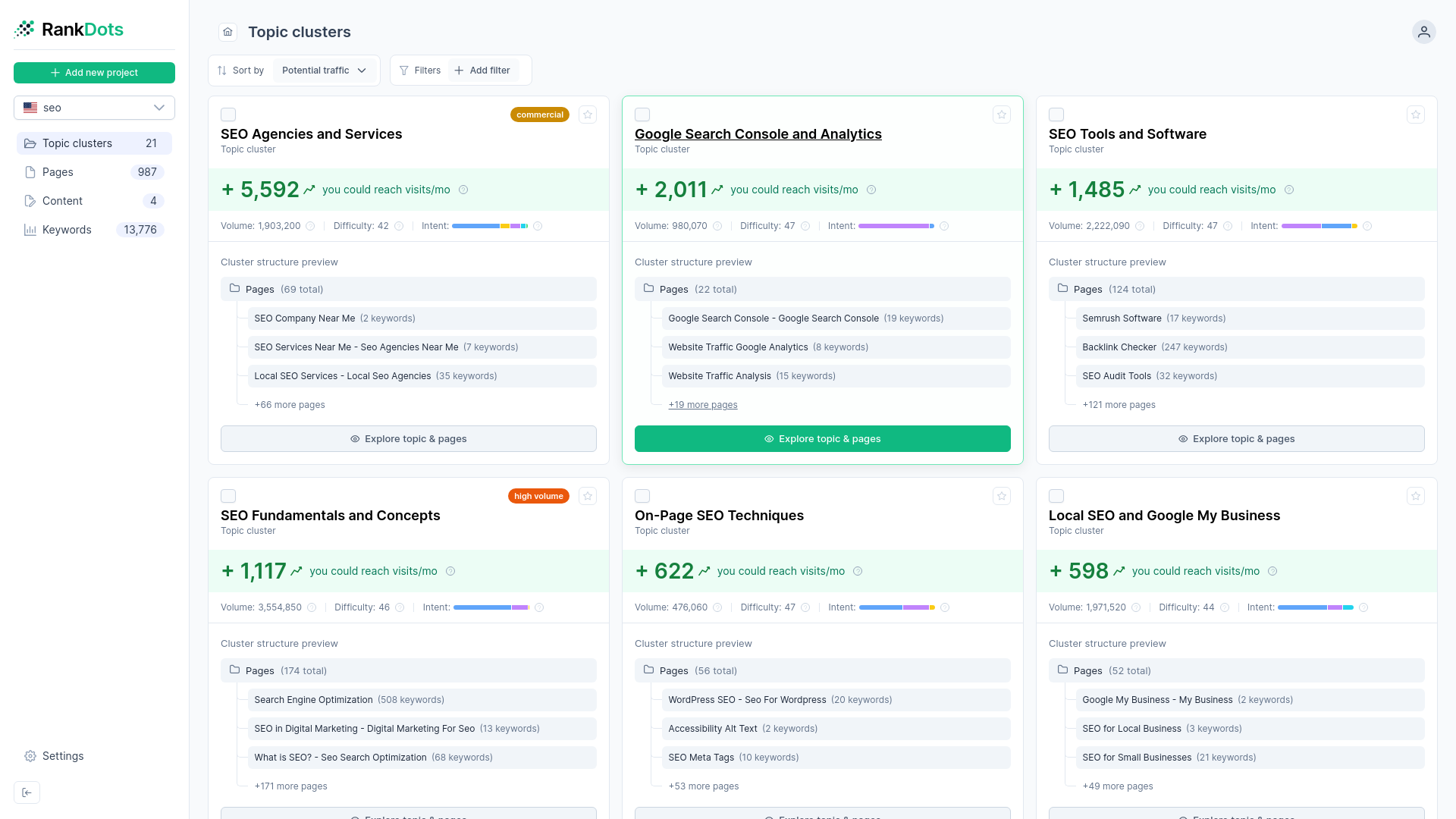
Prioritize your generated content clusters using five distinct recommendation algorithms. Whether your goal is to target commercial intent or maximize immediate traffic, you always know what to write next.
How to automate keyword discovery
Define your target seed input
Enter a starting term or domain into the platform. You immediately receive an instant content preview before the deep collection begins.
Launch the automated pipeline
Click start to activate these Free Keyword Research Tools. The system cross-references multiple sources and handles all deduplication automatically to eliminate manual data cleaning.
Review hierarchical topic clusters
You don't sort spreadsheets. You examine a structured two-level architecture instead. Every relevant term is grouped by intent to provide a ready-to-use site structure.
Prioritize your content calendar
Sort your newly built clusters using five distinct recommendation algorithms. Choose the exact topics that drive the highest potential traffic gain for your specific goals.
Discovering high-intent long-tail keywords
You need to cast a wider net to find the long-tail. Google reports that roughly 15% of the queries entered into search engines every single day have never been searched before. A single clickstream index misses these emerging trends completely.
Cross-referencing multiple data streams
To uncover hidden queries competitors miss, RankDots uses 8-Source Keyword Discovery. It cross-references distinct search data streams simultaneously across autocomplete behaviors, related searches, query panels, and live SERPs. You bypass the blind spots of a single database to capture the highly specific semantic terms that actually drive qualified conversions.
Eliminating gibberish with AI filters
If you've ever tried scraping autocomplete suggestions for a new product launch, you know the resulting list is usually a massive data dump filled with gibberish, competitor names, and irrelevant URL fragments. We got tired of watching teams waste entire afternoons cleaning these spreadsheets by hand.
RankDots applies AI Quality Validation to stop messy raw lists before they reach you. Every discovered keyword runs through strict linguistic rules that automatically remove the junk while preserving legitimate edge cases. You get a clean, validated list in minutes.
Mapping variations by search intent
Legacy tools provide generic, one-dimensional intent labels. Generic intent labels cause a classic workflow failure: you assign a topic to a freelance writer, and they draft a massive informational post when the actual search results demand a local commercial landing page.
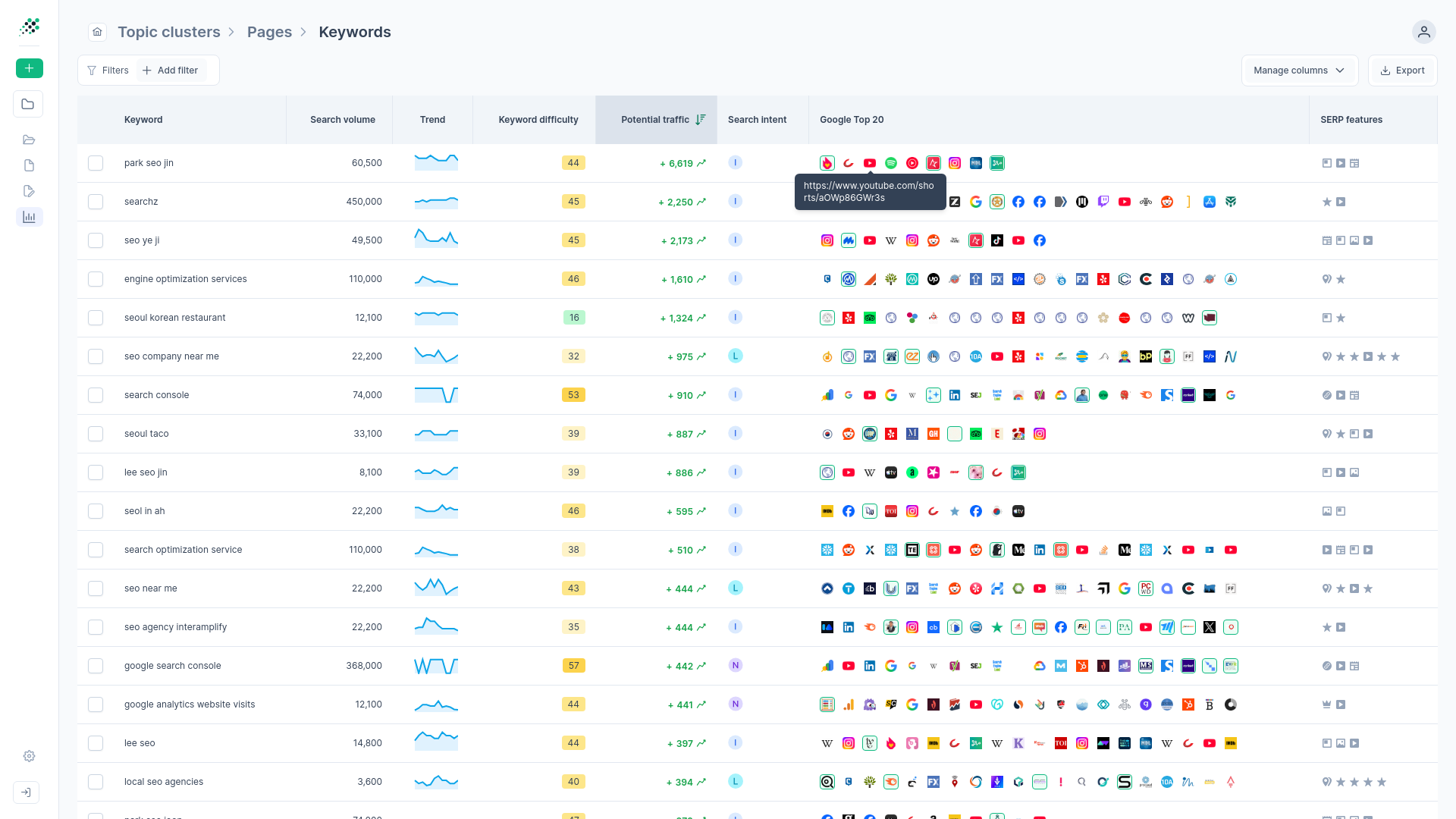
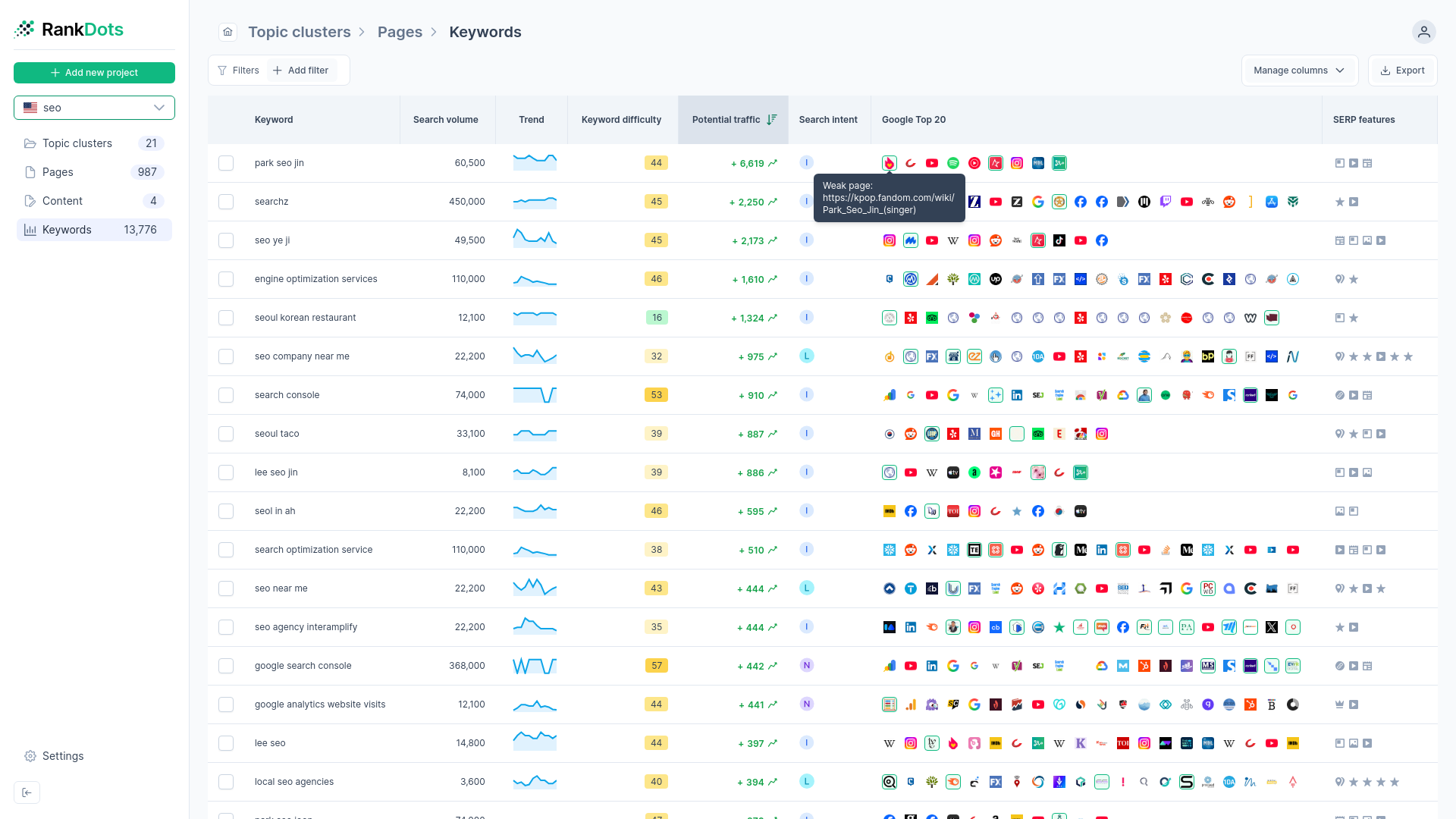
RankDots evaluates search intent across five distinct categories—including a dedicated local designation—and provides percentage-based intent scores. Long-tail variations create a disorganized mess if they remain a flat list. The platform automatically groups these low-volume queries into hierarchical parent topics based on intent scores and corrects grouped search volume distributions to build a targeted site architecture. You see exactly what format the content requires before a single word is written.
See why RankDots is #1




Frequently asked questions
What is the difference between standard keyword research and keyword clustering?
How do third-party keyword tools differ from Google Keyword Planner?
Why do most free keyword research tools have search limits?
How accurate is the search volume data in free tools?
Can you import existing keyword lists into RankDots for clustering?
Start building your keyword clusters today.
Stop wrestling with messy spreadsheet exports and generic metrics. Access RankDots's Free Keyword Research Tools to handle data validation and grouping automatically, so you can focus on publishing higher-converting pages. Set up your first project in minutes.