Turn Raw Keywords Into Content Silos With RankDots Page Opportunity Finder
Stop sorting spreadsheets manually. Let the AI map thousands of terms into a topic-first hierarchy with verified intent scores and concrete monthly traffic forecasts ready for production.
- Isolate easy-to-rank SERP weak spots instantly
- Replace guesswork with concrete ROI traffic forecasts
- Target precise percentage-based search intent
Staring at a spreadsheet with ten thousand raw keywords doesn't give you a content strategy—it just gives you a massive data entry chore. When you export a giant list from a traditional research tool, you face hours of error-prone sorting trying to figure out which terms belong together. The RankDots Page Opportunity Finder turns chaotic keyword lists into organized topic silos. It identifies competitive weak spots on the search results page and calculates precise percentage-based search intent. You get concrete monthly traffic forecasts to bridge the gap between initial research and final drafting.
We built this to give you a clear view of how automated clustering and verifiable intent scoring turn raw data into a ready-to-write content roadmap. You'll see how the pipeline hands you high-ROI topics ready for production.
High-ROI Page Opportunity Finder
SERP Weak Spot Detection
Pinpoint exact search positions currently held by pages with lower domain authority than yours to target easily beatable competitors.
Accessible Search Volume
Isolate the total monthly traffic available specifically across vulnerable search results to determine the realistic organic growth you can capture today.
Custom Page Difficulty
Evaluate how hard a topic is to conquer using a personalized 0–100 metric calibrated directly to your website's existing competitive strength.
Search Trend Velocity
Track 12-month historical data and three-month acceleration percentages to prioritize topics with surging audience demand before competitors notice.
Precision Conditional Filtering
Apply strict rules for keyword count, search intent, and potential traffic to drill down into the database and build highly targeted campaigns.
Performance Data Integration
Connect your existing analytics to view current rankings alongside new content gaps within a single unified dashboard.
Using the Page Opportunity Finder
Ingest live SERP data
Enter a core search term. RankDots pulls real-time keyword metrics and live ranking URLs to build your foundational dataset.
Review semantic topic clusters
The agglomerative algorithm groups raw terms into distinct page ideas, automatically mapping them to parent categories for a tight site architecture.
Filter for high-ROI targets
Apply strict conditions for specific intent blends and weak spots to prioritize immediate organic growth over vanity metrics.
Draft with one click
Hit the Create Content button to send an approved topic and all its semantic keywords straight into the AI writer.
Topic-first clustering and ROI forecasting
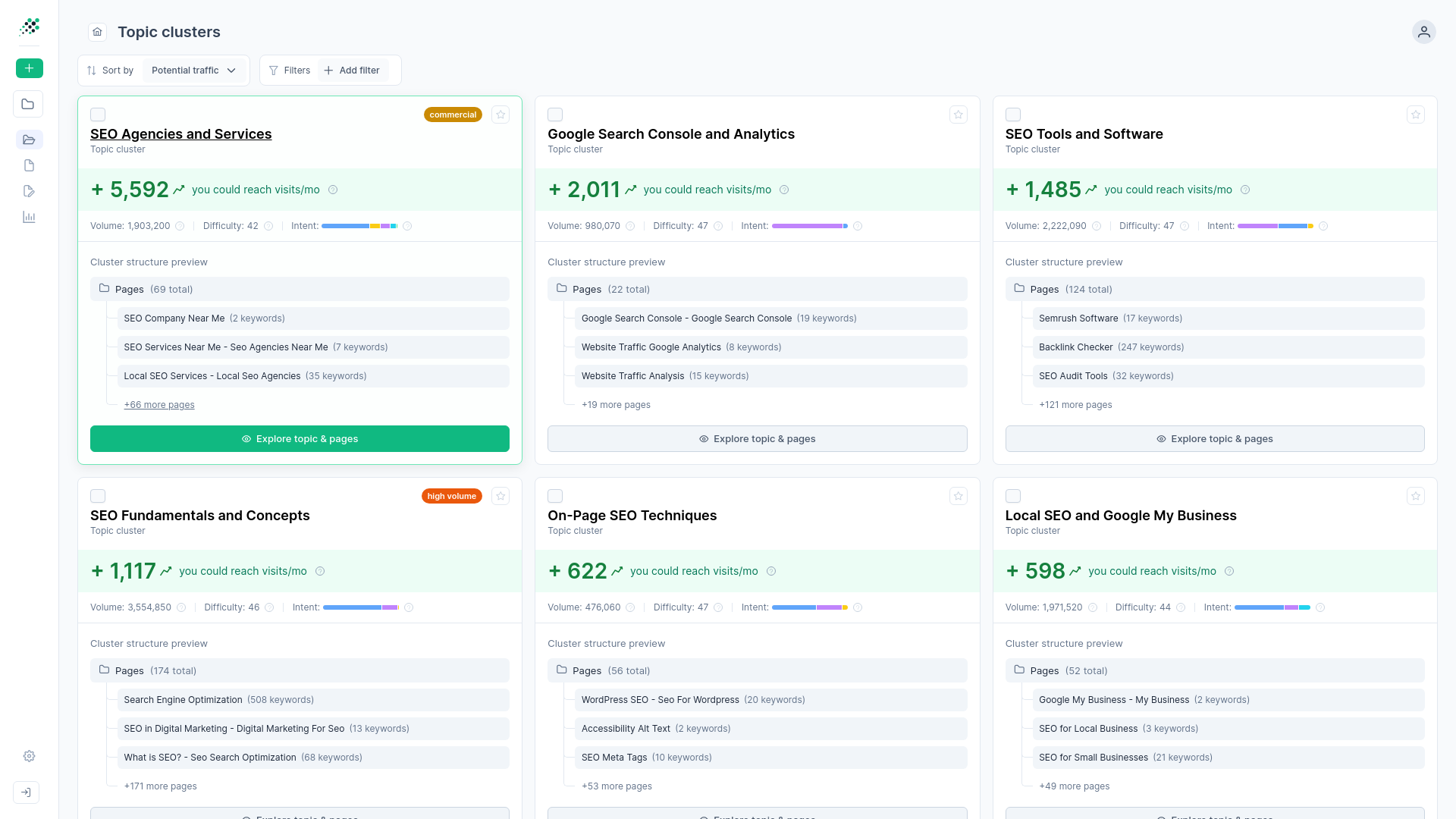
Most workflows start with a massive keyword list. RankDots reverses this. We organize your data using a topic-first hierarchy. The platform builds semantic topic clusters first to derive the optimal page structure. Then, it assigns keywords based on shared search engine intent. The clustering algorithm automatically builds a tight pillar-and-cluster architecture for your website, so you never have to map topics manually.
Verifiable intent scoring
Target a broad, high-volume keyword with a standard informational article, and you might fail to rank. If the search engine results page actually rewards a mix of listicles and product pages, a single-angle piece won't rank. Traditional binary labels like "Informational" miss how Google evaluates intent. RankDots calculates verifiable search intent scoring as a percentage distribution. You see exactly how the query breaks down—perhaps 55% Informational, 30% Commercial, and 15% Navigational. Match your content angle to that exact blend to resolve mixed-intent queries before you write a single paragraph.
Concrete traffic forecasting
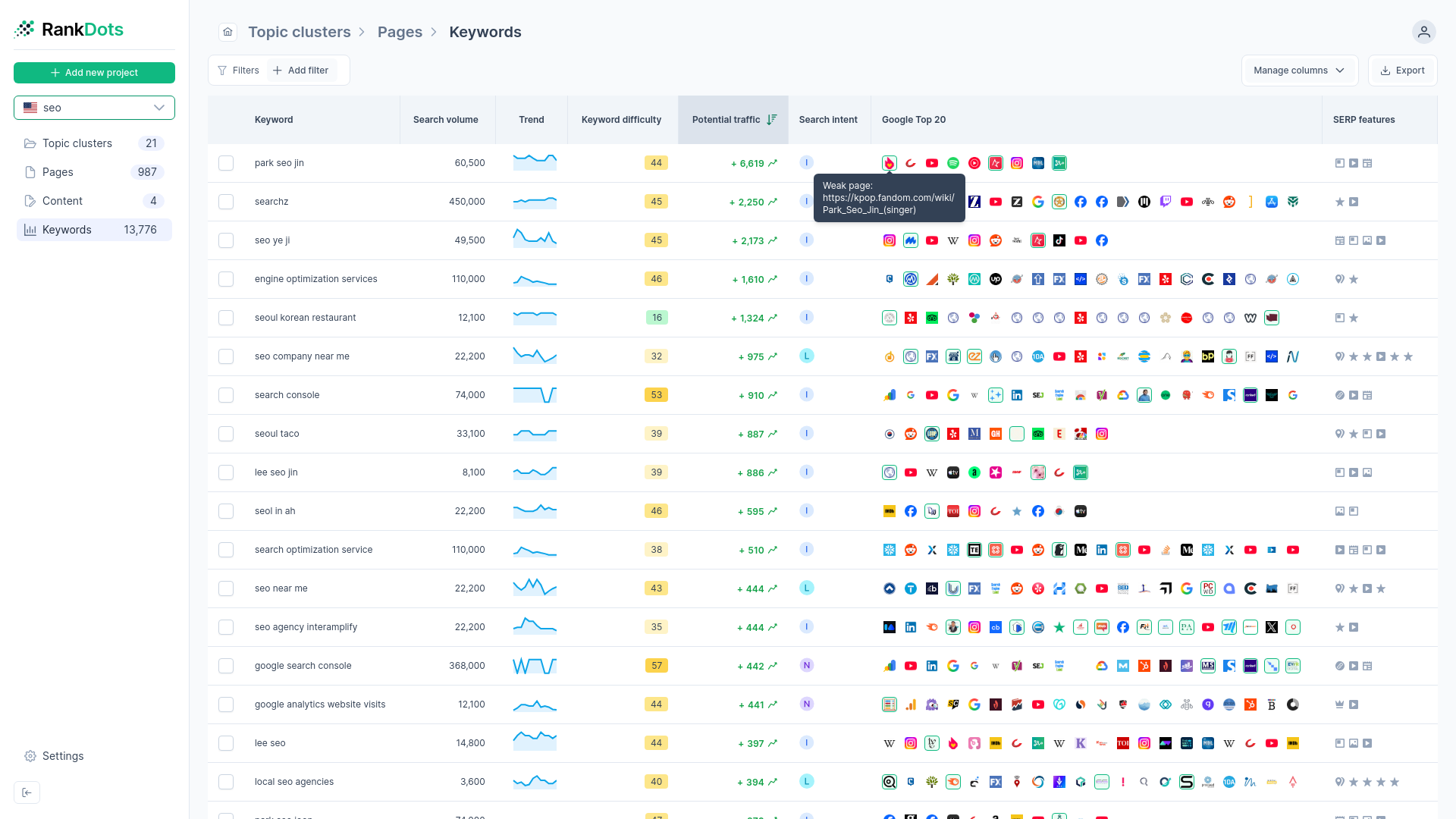
You need more than vague search volume metrics to pitch a quarterly content budget to leadership. Abstract keyword volume rarely proves business value or forecasts return on investment. The Potential Traffic metric converts those abstract numbers into concrete, projected monthly visitor counts per page. You get a specific ROI forecast for every article in your roadmap. You justify the content strategy with hard data. Push the approved topics directly to the AI writer and launch your campaigns with clear expectations.
Before you finalize that writing queue, you can also filter your clusters by difficulty to prioritize the fastest available wins.
Discovering SERP weak spots
You skip the guesswork. The Weak Spots metric shows how many SERP positions belong to pages weaker than your own domain. If the dashboard reveals 4 of 216, you know four keywords have easily beatable results on the first page. You see the organic traffic ceiling your current authority can reach, so you target the most viable topics first.
The frictionless content pipeline
The opportunity is only half the workflow. The Create Content button connects your research directly to production. You click one button next to your grouped topic, and the platform generates an SEO-ready article covering every semantic keyword in that specific cluster. The AI writer formats the copy for the search intent of the group. Your final draft automatically targets the patterns the search engine currently rewards.
Forecast ROI Inside The RankDots Opportunity Dashboard
See why RankDots is #1
Frequently asked questions
What is a Page Opportunity Finder and how does it work?
How does agglomerative clustering differ from traditional keyword grouping?
Why prioritize SERP weak spots instead of search volume?
Does the platform connect with my existing website performance data?
How accurate are the potential traffic forecasts?
Capture missing organic traffic with the Page Opportunity Finder.
Don't map search terms manually. RankDots isolates competitive vulnerabilities and provides concrete traffic projections so you'll target verifiable ranking gaps before drafting a single word.