How to Find Easy-to-Rank Keywords and Drive Early Traffic

If you've ever spent weeks writing a comprehensive, high-quality guide only to see it buried on page five, you're targeting the wrong terms entirely. Learning how to find easy-to-rank keywords involves analyzing actual search engine results pages (SERPs). Drop the generic difficulty metrics. Start by brainstorming seed topics, expand your list with research tools, identify specific vulnerabilities among currently ranking pages, and organize those terms into focused topic clusters. This guide walks through a 5-step process to bypass entrenched domain authority requirements and find realistic, low-hanging fruit to win your first surge of organic traffic. The gap between publishing great content and actually capturing readers comes down to targeting terms your site lacks the authority to win.
Quick Takeaways
- Find easy-to-rank keywords by brainstorming core seed topics, expanding them into specific long-tail queries, identifying weak or outdated pages currently ranking in the top ten, and grouping those realistic opportunities into strategic topic clusters.
- Look past generic keyword difficulty scores, as these blended averages often mask highly vulnerable spots where a thin forum thread or generic directory is currently ranking simply because nothing better exists.
- Stop ignoring low-volume search terms; highly specific, long-tail queries represent the vast majority of search behavior and frequently carry the highest purchasing intent for rapid conversions.
- Bypass heavy domain authority requirements by grouping related low-competition terms into self-reinforcing topic clusters rather than publishing disconnected posts.
- Always reverse-engineer user search intent by examining the exact content formats currently rewarded on the first page—targeting an easy keyword with the wrong page structure guarantees failure.
- Consistently monitor your site's search data to identify "page-two breakthroughs"—existing content sitting just outside the top results that needs only minor optimization to capture an immediate surge in organic traffic.
Why low-competition keywords matter
Data shows 96.55 percent of all published content receives no organic search traffic from Google. The reality of hitting publish and capturing readers depends on avoiding terms your site lacks the authority to win. When a local bakery launches their first blog to attract custom cake orders, starting with zero domain authority means head terms like "custom cakes" are entirely out of reach.
The momentum of early wins
Targeting realistic, low-competition keywords secures visitors quickly. Getting early traffic builds momentum without demanding heavy backlink campaigns. Industry data suggests you don't need many backlinks to rank for competitive keywords if you build internal authority first by ranking for easy keywords and internal linking. The bakery might write about "how to transport a three-tier wedding cake"—a highly specific query that larger recipe sites often ignore. Securing the top spot for these targeted questions proves to search engines that the domain provides valuable answers.
The reality of search behavior
Content on the second page offers zero practical value. Clicks drop significantly for URLs ranking past the first page. A mere 0.63 percent of searchers ever click on an organic result located on the second page, while the first position captures roughly 27.6 percent of all clicks. Finding easy-to-rank terms ensures your content surfaces where searchers are looking.
Building topical authority
The goal is not to stay small forever. Moving beyond isolated keyword hunting allows you to build self-reinforcing topic clusters that establish foundational authority. Data suggests that targeting topic clusters outperforms targeting isolated low-competition keywords because the cluster reinforces itself. When you interlink ten easy-to-rank articles about different aspects of cake ordering, the entire cluster gains strength, eventually allowing you to compete for more lucrative terms.
Evaluating keyword difficulty metrics
Most traditional SEO tools reduce the complexity of ranking into a single Keyword Difficulty (KD) score. This number provides a quick sorting mechanism, but relying on it blindly wastes effort.
The mechanics behind the score
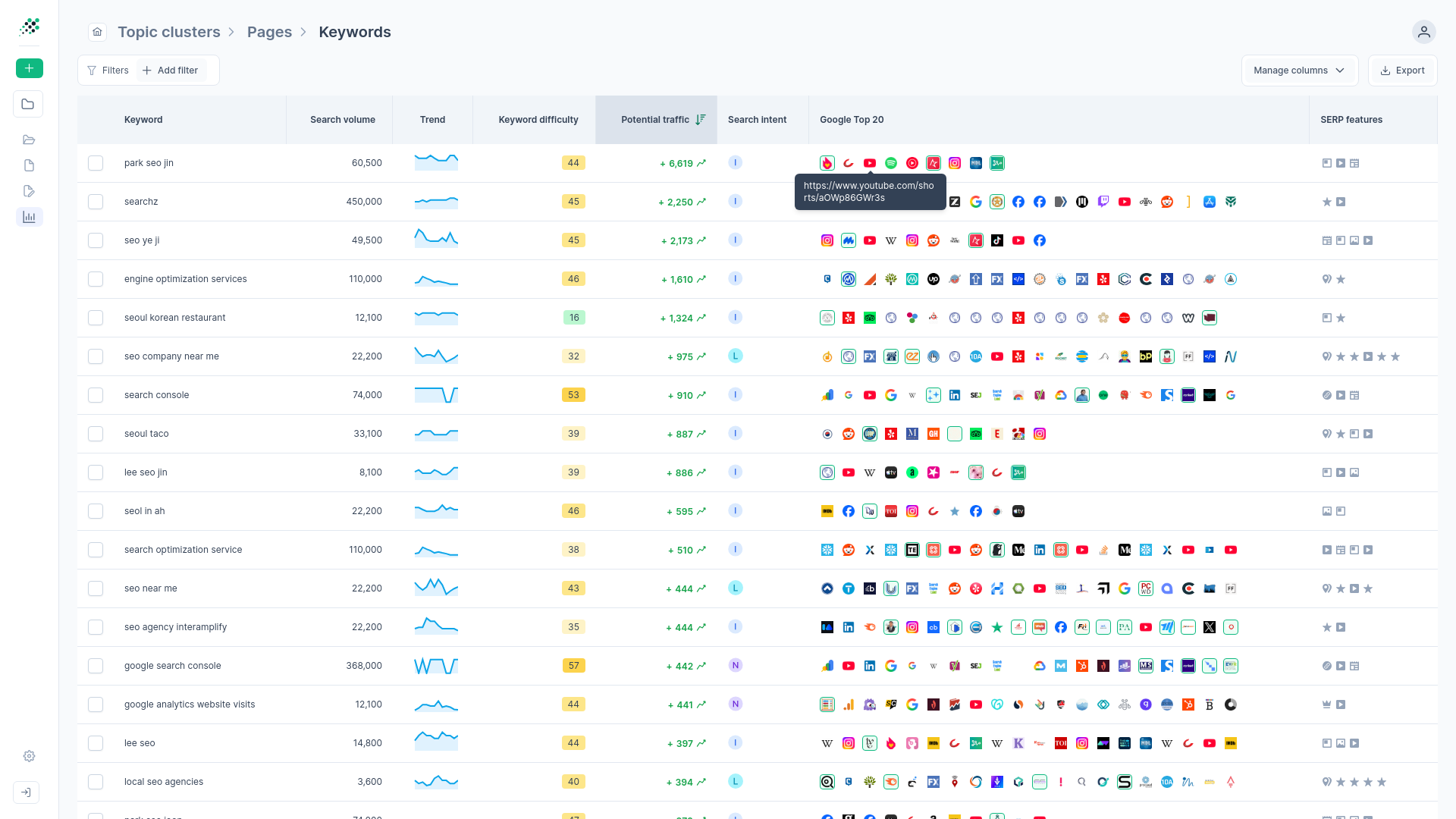
Standard difficulty metrics calculate an average based on the backlink profiles of the top-ranking pages. For example, a keyword difficulty of 40 on Ahrefs requires approximately 56 referring domains to reach the top 10 search results. Semrush calculates its difficulty score by analyzing over 10 different parameters. These scores give you a mathematical snapshot of link strength across the board. They average out the competition. If eight results are dominant industry giants and two are weak forum posts, the average score might still look prohibitively high, masking a perfectly viable opportunity.
Why abstract metrics fail beginners
We've seen countless content plans fail because the creator relied on a traditional tool's generic score. A beginner SEO might see a term labeled as easy, write a great post, and still fail to rank because the top results were actually highly authoritative sites with optimized content. The metric suggested the average link profile was low, but the actual search results contained no vulnerabilities. The algorithm rewards relevance and established trust, neither of which are fully captured by a simple two-digit number.
Shifting to SERP vulnerability analysis
Evaluate the pages currently ranking. Using RankDots, you can identify Easy-to-Rank Spots within the SERPs. The platform evaluates the specific URLs currently ranking in the top results. This reflects the true strength of the competition and shows exactly who you need to beat. If a low-authority site, a generic directory, or a thin forum thread currently holds a top position, that spot is vulnerable. Targeting these specific weaknesses yields far better results than trusting a blended average.
How to find easy-to-rank keywords in 5 steps
-
Identify seed concepts manually
Open an incognito browser window and type your core service into Google. Record the autosuggestions and "People Also Ask" questions in a spreadsheet. You'll walk away with a raw list of natural-language phrases directly from actual searchers.
-
Filter database suggestions by volume
Once you have your seed terms, drop them into a research database. Filter for search volumes under 1,000 to remove the broad, difficult phrases immediately and leave yourself with highly specific targets.
-
Audit the SERP for vulnerabilities
Review the first page of results to reveal exactly who you need to beat. Scan the current ranking pages for outdated PDFs, thin forum threads, or generic directories holding top positions.
-
Group terms using URL intersection
Organize your vetted keywords into related themes. Run a URL intersection check to confirm if Google already ranks the same pages for these terms. You'll finish with a structured content plan grouped by shared search intent.
-
Match the required content format
Search engines already tell you what they want to see. Check whether the current winners use listicles or deep educational guides, then match that format to give your new draft the best chance of ranking.
Step 1: Brainstorm seed topics using free workflows
Before running ideas through complex metric tools, start by gathering broad topical areas relevant to your core business. Free discovery workflows provide a solid foundation for your keyword strategy and keep you focused on user problems.
Mining autosuggest and related queries
Google itself is the most reliable source for understanding what people search. Start typing your core service into the search bar and watch the autosuggest dropdown. These autocomplete predictions represent real, active queries. Similarly, the People Also Ask feature reveals the specific questions your target audience needs answered. These free features expose the natural language your customers use. Start this process in incognito mode so your past search history doesn't skew the results. Document these raw phrases in a spreadsheet.
Building a baseline with free tools
Once you have a handful of seed ideas, run them through introductory tools to establish a baseline. With Google Keyword Planner, you can generate keyword ideas based on seed terms and group close spelling variants together. It's free to use, though it requires active ad spend to show precise search volumes. You'll see broad ranges, but it's enough to confirm that a topic has active interest.
These initial concepts ensure your eventual research remains grounded in business relevance. Starting directly in an advanced tool often leads to chasing high-volume terms that have nothing to do with your product. A manual foundation prevents that drift.
Step 2: Expand your list with keyword research tools
With a list of seed topics ready, the next phase involves feeding those concepts into dedicated databases to uncover the long-tail opportunities you can't find manually.
Using large databases
List expansion requires scale. The Ahrefs keyword database has 19.2 billion keywords, while the Semrush keyword database contains over 25 billion keywords. Pushing your seed terms through these platforms yields thousands of variations. The goal here is not to target the highest volume phrases, but to find the highly specific queries where search intent perfectly matches the solution you provide. Enter your seed terms and apply initial filters to remove the broad, impossible-to-rank terms that clog up the list.
Balancing volume and relevance
It's easy to get distracted by vanity metrics. Early-stage marketers frequently filter their keyword lists to ignore anything under one thousand monthly searches because it seems too small to matter. This mindset misses the reality of search behavior and discards the easiest wins. An analysis of 306 million search queries revealed that 91.8 percent of search terms are long-tail keywords, which represent the vast majority of Google queries. Reportedly, keyword monthly search volumes of less than 1,000 are often low enough to have less competition but high enough to generate valuable, converting traffic.
A term with 150 searches a month might sound insignificant, but if it represents high purchasing intent, securing the top spot brings highly qualified visitors to your site. A dozen of those small victories quickly adds up to meaningful business impact.
Step 3: Analyze SERP vulnerabilities for easy-to-rank spots
A recurring pattern appears when examining the top results for competitive local queries. The average difficulty score often looks intimidating, but individual positions within that top ten are surprisingly weak. A generic directory listing or a sparse forum thread might occupy the fourth spot because nothing better exists.
Spotting weak pages in the top results
The process of identifying an easy-to-rank keyword requires looking past the blended metrics to evaluate the pages holding the top spots. If a search engine is forced to rank a page with thin content, terrible user experience, or zero topical relevance, that specific position is vulnerable. You don't need to beat the large publisher holding the number one spot. You just need to provide a better answer than the outdated PDF sitting at number five.
Attacking competitor vulnerabilities directly
Evaluating competitors reveals realistic ranking opportunities. Consider a small business owner trying to attract custom cake orders. They can analyze a larger regional competitor to systematically find where that bigger site's armor is weak. The competitor might have high overall authority, but their specific page for "vegan wedding cake delivery" could be just a thin image gallery.
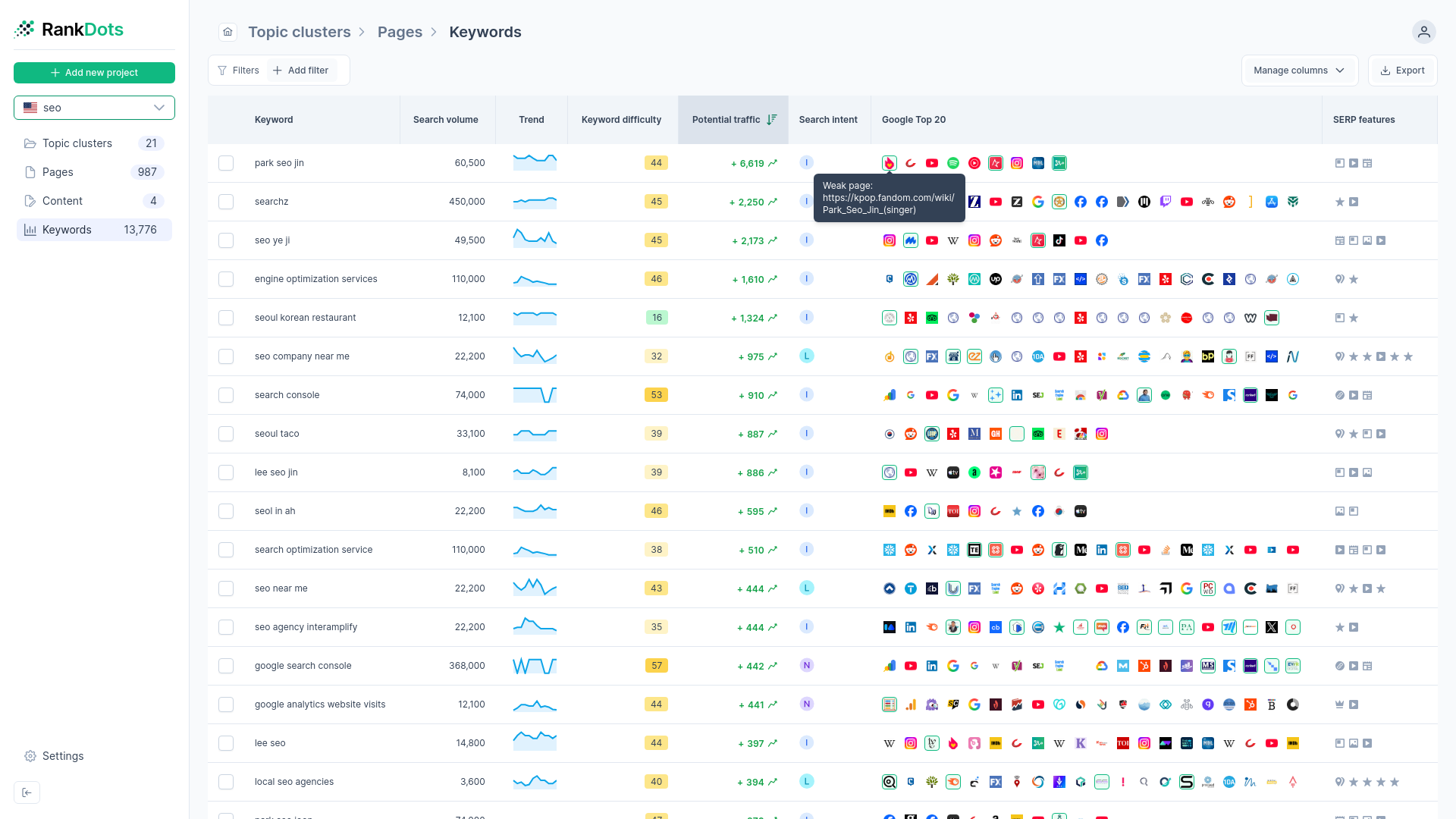
You can automate this process using RankDots to identify what it calls Easy-to-Rank Spots within the results. You receive a competitive assessment based on the specific URLs currently ranking, helping you analyze who you need to beat. When you enter a larger competitor's domain, you can see the exact terms where their currently ranking pages are beatable. You step into the role of the smart underdog, selectively stealing targeted traffic without needing a high-budget advertising campaign.
Calculating realistic search volume
You need to know if the effort is worthwhile after isolating these vulnerabilities. Standard search volume tells you how many people look for a term, but that number is meaningless if you can't reach the first page. You can solve this by looking at Easy-to-Rank Search Volume within RankDots. This metric combines the search volume of only the keywords where these vulnerable spots exist. It answers a highly practical question: among the keywords you can realistically rank for, how much total traffic is available? This grounded approach ensures your content calendar focuses on achievable growth.
Step 4: Group keywords into topical clusters
Random, disconnected blog posts rarely move the needle for a new site. Successful content strategy moves away from isolated articles and relies on a pillar-and-cluster model.
Moving from isolated posts to topic clusters
A content creator often starts by writing whatever low-competition term catches their eye on a given day. One post covers frosting techniques, the next discusses delivery logistics, and another reviews baking equipment. The breakthrough happens when they learn to bypass heavy backlink requirements by grouping related low-competition keywords together.
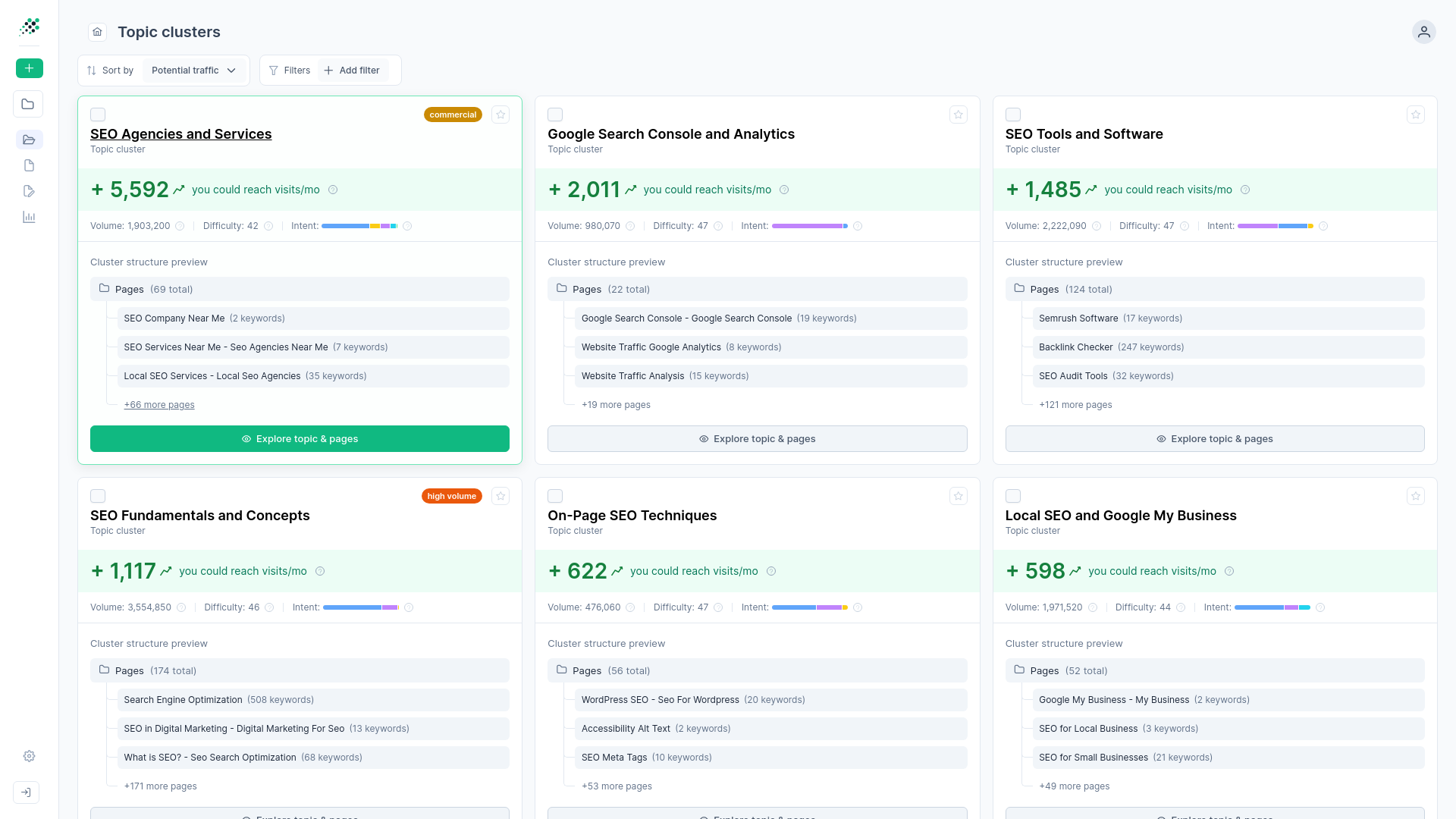
Organize these terms into logical themes to build a self-reinforcing network. If you write ten interconnected articles about different aspects of ordering a custom wedding cake, search engines begin to recognize the site as an authority on that specific subject. You can build this structure using the topic-first architecture in RankDots. You can run a proprietary clustering algorithm to group related terms into logical clusters that reveal low-competition themes where ranking is most achievable.
Validating clusters with URL intersection
It's easy to group keywords by shared phrasing, but it often leads to mapping errors. You might assume "custom cake pricing" and "custom cake cost" require different pages, while the search engine considers them the same topic. You can prevent this using URL intersection validation in RankDots. After initially grouping terms, you check if the exact same URLs rank in Google for multiple keywords within the proposed cluster. If the top-ranking pages overlap significantly, you can confirm the terms share a single intent and belong on one page. If the results look entirely different, you know the cluster is too broad and requires separation.
Building localized authority
When every article in a cluster links back to a central pillar page, the internal authority flows through the entire group. This strategy allows a smaller site to outmaneuver broader, generalized websites. You establish a stronghold in a highly specific niche, capturing the exact audience looking for your specialized solution.
Step 5: Map keywords to search intent
The discovery phase is only half the equation when learning how to find easy-to-rank keywords. In our analysis of failed content campaigns, the most frequent point of failure is a mismatch between what the user wants and what the page provides.
Decoding the searcher's goal
Every query carries an underlying motivation. Informational intent means the searcher wants to learn something, like "how to transport a tiered cake." Navigational intent indicates they are looking for a specific destination. Transactional intent signals readiness to purchase, such as "order custom cake online." Recognizing these distinctions dictates the structure of your page.
Aligning content format with the SERP
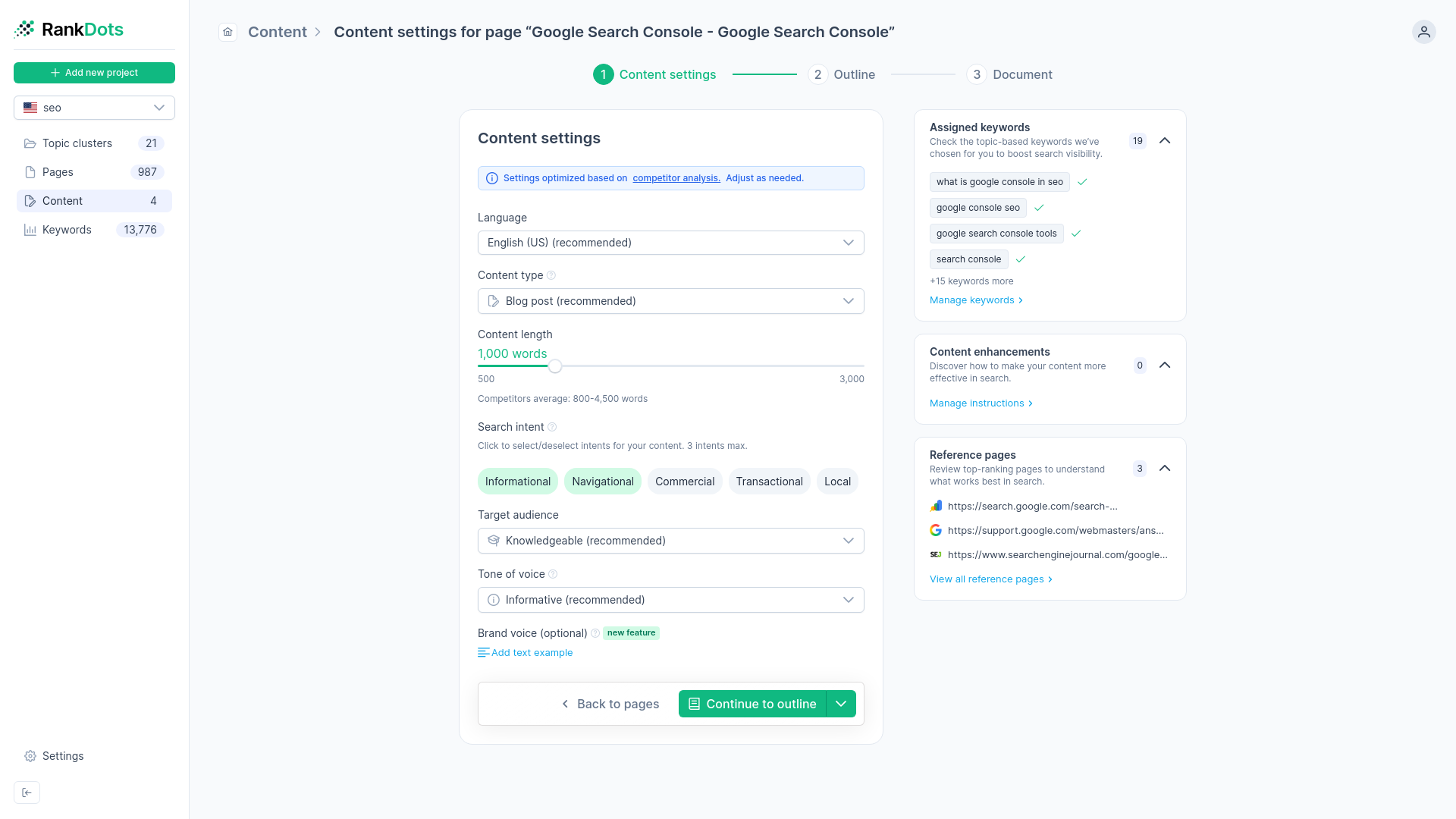
If you search a target term and the first page is filled with listicles, you'll need to write a listicle. If the results are entirely product category pages, writing a long-form educational blog post will almost certainly fail. Google reverse-engineers what users find helpful based on engagement signals. Your job is to match the content formats the algorithm currently rewards. Align your preferred page types, word counts, and structural patterns so your planned content fits the required mold.
The cost of intent mismatch
Targeting the right keyword with the wrong page type wastes your research effort. Teams often target a high-intent transactional phrase with a sprawling educational guide. The page might have flawless technical optimization, but it doesn't serve the immediate need of a buyer ready to convert. When intent mapping fails, the page struggles to rank, and the few visitors who do land there bounce immediately. Ensuring your format aligns with user expectations protects the investment you made in finding the keyword.
Integrating keywords into your content strategy
A validated keyword list holds no value until it shapes your publishing schedule. Moving from research to production requires a strict priority system. You have to decide which easy wins to execute first.
Prioritizing the editorial calendar
Balance effort against potential reward when mapping prioritized terms to an editorial calendar. Start by isolating the clusters that directly overlap with your core services. If you sell specialized baking equipment, prioritizing a cluster about maintenance tutorials makes more sense than a cluster about generic recipes. Schedule the foundational pillar page first, then map out the supporting cluster articles over the following weeks. This logical sequence ensures your writers build off established context, and the site architecture develops naturally.
Routing traffic with internal links
Early traffic creates a natural funnel for your primary business goals. As those low-competition articles begin to rank and attract visitors, intentionally direct that attention. Use internal links to connect this new top-of-funnel traffic directly to your core service pages. If an informational guide about cake sizing brings in a reader, an in-text link should guide them directly to your consultation booking page. These internal pathways do more than just route users; they signal to search engines which pages you consider most important, distributing the authority earned by the easy wins.
Expanding foundational authority
These early rankings build the foundation for broader topical authority. Using these early victories proves to search engines that your domain can satisfy user queries reliably. As your site accrues behavioral signals and natural engagement from these smaller victories, the overall domain strength improves. The cluster that started as a workaround for low authority eventually becomes the authoritative hub in its niche. Over time, this compounding strength allows you to graduate from purely low-competition terms and begin challenging larger competitors for moderately difficult, higher-volume keywords.
Tracking keyword performance over time
Publishing isn't the end. When we review historical performance data, the most lucrative traffic gains often come from tweaking existing assets.
Identifying page-two breakthroughs
Using a free tool like Google Search Console, you can monitor true impressions, clicks, and their average position in the SERPs. This first-party search data reveals page-two breakthroughs—existing pages sitting just out of reach of real traffic. A URL hovering at position twelve is already deemed highly relevant by the algorithm. It typically needs only a minor optimization push to cross onto page one, delivering an immediate, highly visible traffic jump.
Routine optimization workflows
Review your data consistently to capitalize on these near-misses. Set a monthly workflow to identify pages ranking between positions eleven and twenty. Enhance these specific assets by updating outdated statistics, improving the internal linking pointing to them, or expanding the content to better match the exact search intent. This process extracts maximum value from the content you've already produced and turns near-wins into reliable traffic.
Frequently asked questions
What makes a keyword easy to rank?
What is a good keyword difficulty score for a new website?
How do you prioritize which keywords to target first?
When should you target isolated keywords versus topic clusters?
Can a keyword with zero search volume still drive traffic?
Stop guessing and start finding easy-to-rank keywords today
Turn broad topic ideas into a prioritized content plan. See exactly which pages you can beat right now, and capture the early organic traffic your site needs to grow.