A 6-Step Framework for Increasing Organic Traffic Using Keyword Clusters

Most SEO campaigns start similarly: you export thousands of keywords from a research tool, open an overwhelming spreadsheet, and stare at rows of data with no clear idea of what to write first. The most reliable path out of that chaos is increasing organic traffic using keyword clusters. You can start by grouping related search terms by intent and covering them across a connected site architecture. That topic-first approach builds comprehensive pillar pages and supporting articles that signal deep authority to search engines.
The shift from targeting random queries to planning a structured layout makes your daily writing schedule highly predictable. What follows is a complete 6-step framework for grouping related terms, mapping your site hierarchy, and forecasting realistic search visibility.
What keyword clustering is and why it outperforms flat lists
Most web pages receive little or no organic traffic from Google, often because they target isolated keywords without a clear topical strategy. Building out connected content changes that baseline expectation.
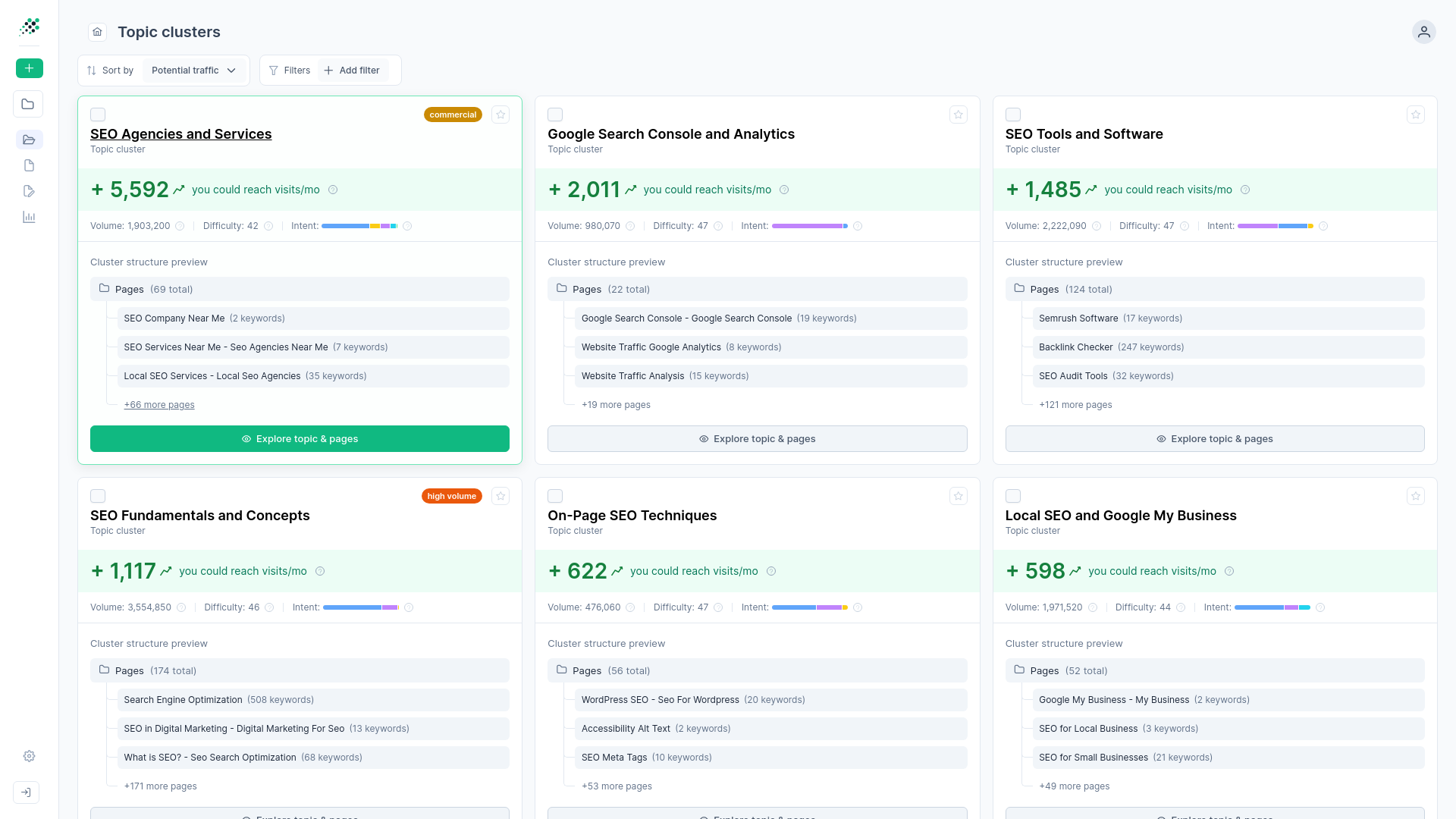
A deliberate keyword clustering strategy forces you to map out every subtopic before you write. Stop chasing one-off wins.
Mechanics of building a topic-first architecture
Stop treating every search query as a standalone task. Topic clustering organizes keywords into a two-level hierarchy. Parent topics become broad thematic guides. Subtopics become narrow, specific articles. They connect to form a web of related information. When we analyze top-ranking setups, the ones that perform best usually link specific answers back to a central hub. That structure proves to search engines exactly what the site is an expert in.
Correcting volume inflation
Raw search volume is notoriously misleading. Traditional keyword tools frequently group similar terms together and assign the total group volume to every individual term. You might land on page one for a keyword with high reported volume, only to receive a tiny fraction of the expected visitors because actual demand was spread across dozens of variants. When you group keywords before writing, you correct that inflation and see a realistic view of actual search demand.
Preventing keyword cannibalization
You might see your rankings drop suddenly if multiple pages on your website compete for the exact same search query. That internal competition is keyword cannibalization. Search algorithms get confused about which page is the definitive authority, often resulting in both pages being suppressed. Advance keyword grouping prevents this internal competition naturally by assigning every intent to one specific URL. You cover the topic once, comprehensively.
How to start increasing organic traffic using keyword clusters
-
Extract and clean your seed terms
Instead of staring at massive spreadsheet exports, export broad keywords from your database and immediately filter out irrelevant brand names and geographic modifiers. The result is a clean list containing only viable commercial and informational search queries.
-
Check live search result overlap
Run your cleaned list through an intersection check to see which keywords share 3 to 4 URLs in the top 10 results. You'll get a grouped list where each cluster represents one distinct search intent—the underlying goal behind a user's query.
-
Calculate realistic cluster traffic potential
Move past raw search volume. Estimate total aggregate clicks across the entire group based on current ranking positions. This leaves you with a prioritized list of topics sorted by their actual visitor yield.
-
Map clusters to your site hierarchy
Assign broad parent clusters as main navigation categories and specific subtopic clusters as supporting articles. You'll produce a visual content map showing exactly how your pillar pages connect to targeted posts.
Step 1: Export and clean your raw keyword data
Every clustering workflow begins with collecting raw search demand. The goal here is sheer volume.
You usually start by extracting broad seed keywords from standard industry databases. With tools like Ahrefs, Semrush, and Moz, you can pull massive lists of related terms and questions based on your core topics. You need a wide net before you can refine the data into actionable categories.
A massive CSV download from a traditional tool typically leaves you staring at thousands of disorganized rows. A common beginner instinct is to try color-coding related terms or manually sorting rows by search volume. That manual task is impossible to scale. The initial export is always full of junk queries, competitor brand names, and irrelevant geographic variations.
Before attempting to group anything, scrub the list. Filter out terms that include the names of platforms you don't integrate with. Remove queries that indicate a search for a free alternative if you only sell premium software. Clean data ensures your eventual clusters represent actual business opportunities, not vanity metrics. Manual spreadsheet management breaks down quickly when handling thousands of rows, but establishing a clean baseline makes the next phase significantly more accurate.
Step 2: Group keywords using SERP validation
Semantic grouping based on how words look is a common trap. The only reliable way to know if two keywords belong on the same page is to check what currently ranks for them in the live search results.
Checking live URL intersections
Uncertainty often hits when deciding if two closely related search queries should be covered in one long-form guide or split into two separate articles. Live search results provide the answer. Let the overlap in those results dictate your page separation. If the same URLs rank for both terms, the search engine considers the intent identical. If the results are completely different, you need two separate pages.
Setting a distinct overlap threshold
You need a hard mathematical rule for when to merge terms. A threshold of 3 to 4 overlapping URLs ranking in the top 10 search results is the standard rule to confirm that multiple keywords share the same search intent and belong on the same page. When we review successful content architectures, strict adherence to that overlap threshold prevents bloated, unfocused pages.
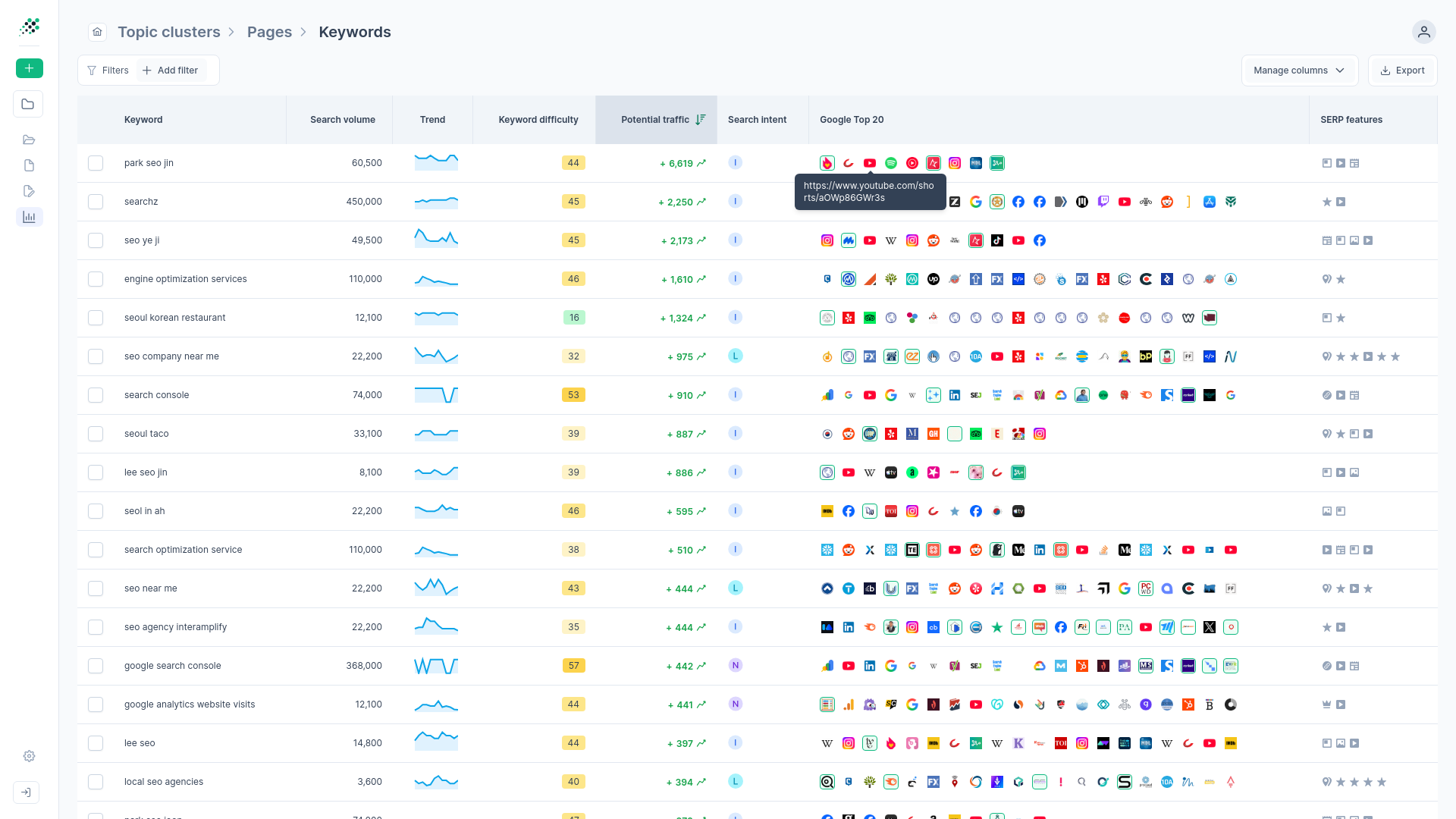
Automating search intent categorization
Manual intersection checks for a spreadsheet of 5,000 keywords take weeks. You can automate this via URL Intersection Validation using platforms like RankDots. The system checks the live search results for your entire list, clusters the terms based on the overlap rule, and flags if a cluster is too broad. It also categorizes the dominant search intent instantly. Automated overlap analysis eliminates the guesswork of manual grouping and sets concrete boundaries for every article you write.
Upfront intent data is critical for cleanly separating informational guides from commercial landing pages. You can quickly filter your topical map to route educational queries to the blog while reserving high-intent commercial clusters for dedicated product pages.
Step 3: Map your clusters to a visual content architecture
Once your keywords are validated and grouped by intent, the raw data should become a structural blueprint for your website.
The strategy actually takes shape when you translate groupings into a clean parent-child hierarchy. The largest, broadest clusters dictate your main navigational categories. The smaller, highly specific clusters become the supporting articles that live beneath them. A visual topical map provides absolute clarity on what to write next, unlike a flat list of isolated keywords.
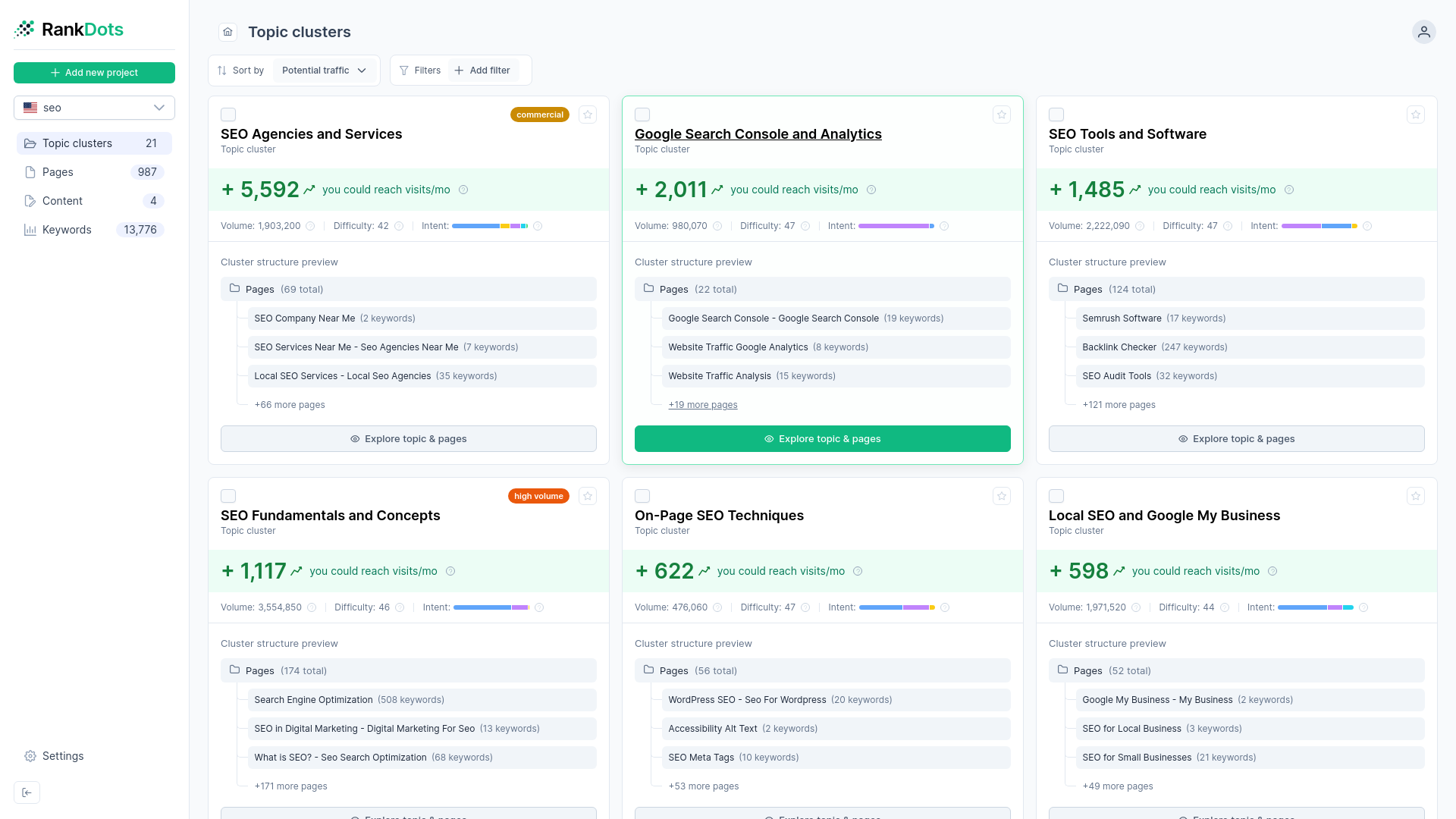
Imagine shifting from publishing random software comparisons to actively designing a structured topic cluster. You map out a central CRM pillar page first. Then you connect specific subtopics directly to that central hub to support it. The exact shape of your site's expertise emerges when you visualize central pillar pages and connect them to specific supporting URLs.
The mapped structure also highlights content gaps. When you lay out the full architecture visually, weak spots in your current library become obvious. You might realize you have five supporting articles for an email marketing hub, but no central pillar page to tie them together. Those identified gaps dictate your highest-priority writing tasks.
Step 4: Draft comprehensive pillar pages for core topics
The pillar page is the anchor of your topic cluster. It should be authoritative, broad, and structured to distribute ranking power downward to your supporting articles.
Start by structuring a broad hub designed to cover the overarching parent topic completely. If the cluster is about remote work security, the pillar should define the concept, outline the core risks, and summarize the best practices. It doesn't go into granular detail on every single subtopic. It's the definitive overview.
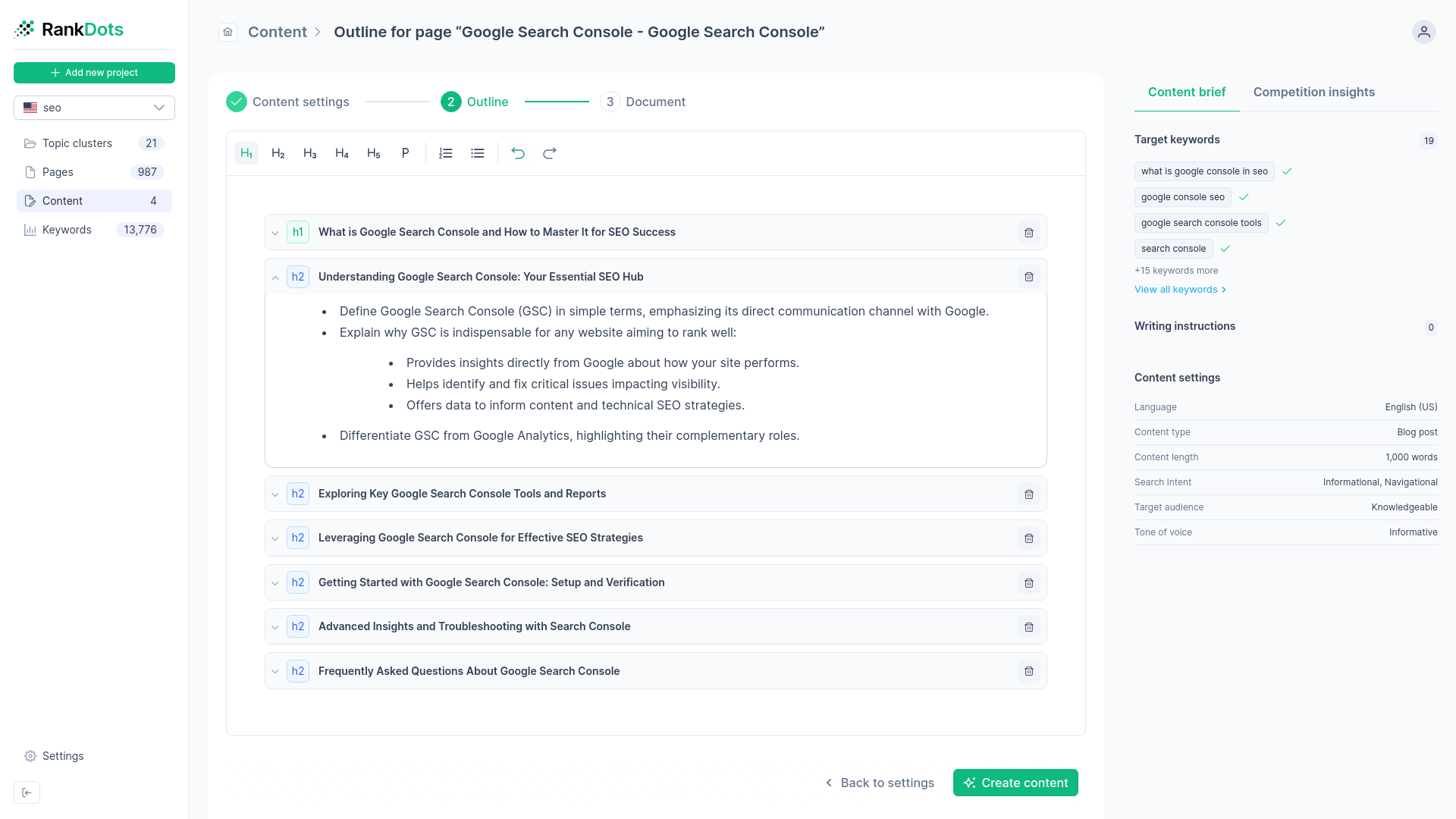
Imagine auditing your recent blog posts and realizing you published three different articles covering slight variations of the exact same software review. None rank well because the search engine is confused about which page is the definitive authority. One authoritative pillar page prevents that cannibalization entirely.
Format long-tail cluster variations as subheadings to build relevance naturally. Use your clustered keywords to title your H2 and H3 elements. That structure ensures the page comprehensively addresses the secondary questions searchers have. However, avoid the robotic writing that sometimes occurs when strictly following rigid scoring systems from optimization tools like Surfer SEO. Write for human clarity first.
Design deliberate internal linking sections to direct authority. Every time you mention a subtopic on the pillar page, link out to the specific supporting article that covers it in depth.
Step 5: Publish supporting content and build internal links
Supporting content does the heavy lifting for long-tail search traffic. These pages target the hyper-specific queries that your pillar page only briefly touches on.
Draft highly specific, narrow-scope blog posts for every subtopic within the cluster. If your pillar page covers the broad concept of budget tracking, a supporting article might specifically detail how to track variable income for freelance graphic designers. The goal is to answer one distinct question better than anyone else on the internet. Distribute exact-match keywords and related semantic terms naturally across these connected articles as you write.
The architecture only functions if the pages communicate with each other. Enforce strict, bidirectional internal linking back to the central pillar page. The supporting article needs to link up to the pillar, and the pillar should link down to the supporting article. Reciprocal link structures create a closed loop of authority. When one supporting article starts gaining traction and earning external links, that ranking power flows up to the pillar and cascades back down to the rest of the cluster.
Step 6: Measure baseline performance and traffic growth
You need a shift in perspective to track success. Evaluate realistic traffic potential based on aggregate cluster positioning. Stop obsessing over raw volume for individual queries.
Trackable traffic requires connected pages. Websites that organize their content into structured topic clusters generally see noticeable traffic increases compared to sites that publish isolated, standalone pages. To measure that growth accurately, monitor total organic visitors across the pillar and all supporting articles as a single unit. A supporting page might only bring in 20 visitors a month, but if the cluster contains 40 supporting pages, the aggregate business impact drives meaningful revenue.
Prioritize your content creation workflows based on realistic yield. When operating with a limited monthly budget, you need to know which topics will deliver the highest return before you write a single word. RankDots calculates a Potential Traffic Growth metric to predict the realistic number of organic visitors a site can attract by fully addressing a cluster, factoring in your current ranking positions, click-through rates, and competitive density.
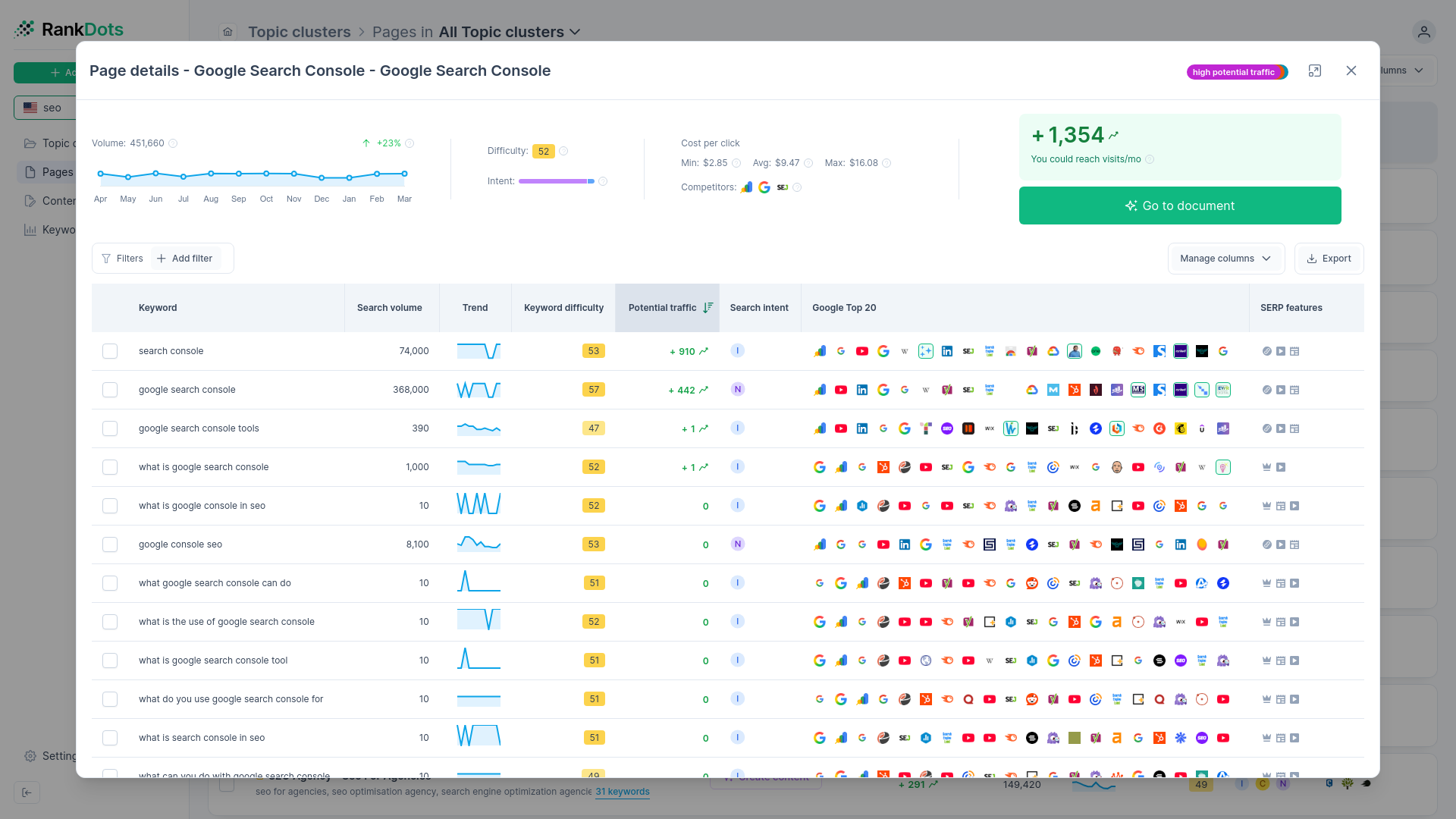
Identify trends early to invest your content budget efficiently. Over time, whole-cluster performance measurement changes content creation from a guessing game into a predictable growth pipeline.
Frequently asked questions
What is keyword clustering and why is it important?
How many keywords should be included in a single cluster?
What type of content should be created for each keyword cluster?
How do you optimize clustered content for organic growth?
Does RankDots automate the keyword clustering process?
Build a structured content architecture that drives organic traffic.
Stop guessing which search terms belong together. Start increasing organic traffic using keyword clusters built on live search data, and focus your time on writing authoritative content.