Stop Cannibalizing Traffic With Topic-First Keyword Mapping for SEO

Two high-effort blog posts published by your content team are alternating on page two of Google for the exact same search query. A modern, topic-first approach to keyword mapping for SEO uses live SERP overlap to build topical clusters. This prevents keyword cannibalization and naturally structures your website into a pillar-and-cluster architecture.
Historically, this process involved exporting a flat spreadsheet of keywords and manually pasting them next to individual URLs based on text similarity. We often see teams spend days doing this manual alignment, only to launch their content and watch it cannibalize existing pages anyway. Flat spreadsheets can't account for how search engines actually group topics.
Here's a 5-step framework for building a topic-first site architecture that stops your internal pages from competing against each other.
Follow these five steps to move away from flat lists and build a proper pillar-cluster architecture.
Quick Takeaways: Keyword Mapping for SEO
- Keyword mapping for SEO is the strategic process of grouping search queries by live user intent and assigning them to specific URLs to build a pillar-cluster architecture that prevents self-competition.
- Stop relying on text similarity to group terms; validate actual search intent by ensuring multiple keywords share at least three to four ranking URLs in live search results.
- Aggressively filter your raw keyword exports to correct inflated search volume metrics and prioritize targets based on commercial intent and real ranking potential.
- Identify and consolidate competing legacy pages into a single master asset to resolve keyword cannibalization, which can otherwise cause severe drops in organic traffic.
- Leverage your mapped clusters to create bidirectional internal linking pathways that funnel acquired ranking authority from broad pillar pages down to specific supporting articles.
- Treat your keyword map as a living architectural document by conducting quarterly reviews to adjust target URLs as search intents and ranking formats evolve over time.
What is keyword mapping and why it matters
Moving from spreadsheets to topic clusters
Traditional mapping treats keywords as isolated entities. You paste a query into a column, assign it to a URL, and move to the next row. This flat-list approach ignores how topics relate to one another hierarchically. Modern mapping requires building the overarching topic map first, establishing the relationship between a core pillar and its supporting concepts, before you assign a single keyword to a page.
The mechanics of keyword cannibalization
If two of your pages fight for the same term, Google struggles to pick a winner and dilutes your ranking potential. When a domain forces two pages to compete for the same intent, search algorithms struggle to determine which page deserves the primary ranking signal. Data shows that online stores experiencing keyword cannibalization and overlapping content issues can see up to a 40% drop in organic search traffic because Google may evaluate the entire domain as less relevant.
The topic-first solution
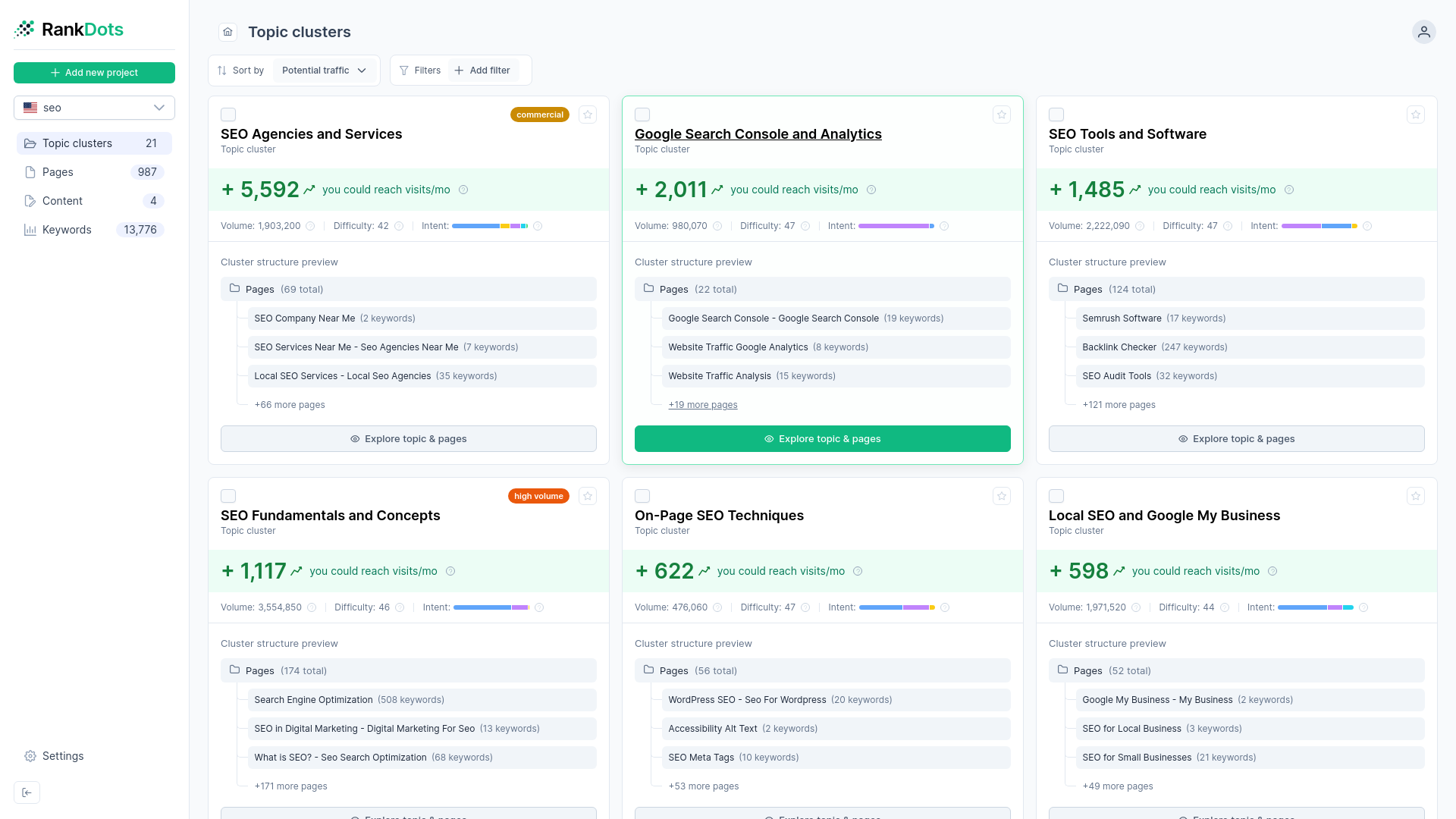
Resolving cannibalization requires grouping keywords by search intent. Intent grouping prevents duplicate content and naturally creates a structured pillar-cluster site architecture. Implement this topic-first methodology using RankDots. Instead of starting with a flat list of keywords, you can build a topical map first and then assign keywords to pages based on shared search intent. The workflow shifts your focus from managing chaotic lists to orchestrating a clear content roadmap.
Clustering by intent ensures every planned URL serves a distinct, non-competing purpose.
How to execute topic-first keyword mapping for SEO
-
Extract and correct seed query data
Export your raw search query list from your discovery tool. Run the data through a metric correction algorithm to distribute grouped search volumes accurately. You'll have a clean, realistic dataset ready for filtering.
-
Filter the dataset by business intent
Remove queries with zero commercial relevance or extremely low search volume. Discard terms that fall outside your current domain authority constraints. Your list now contains only keywords with genuine ranking potential.
-
Cluster terms using live SERP overlap
Group the filtered keywords based on shared ranking URLs rather than text similarity. Set your overlap threshold to require at least three matching pages. The result is a set of intent-validated topical clusters.
-
Establish the core parent query
Select the highest-volume, most relevant phrase within each established cluster. Assign this term as the central focus for the target page. You now have a clear anchor phrase guiding content production.
-
Map clusters to specific target URLs
Export your live index from Google Search Console. Match each validated cluster to an existing page, consolidate competing legacy assets, or create placeholders for new content. You'll finish with an actionable architectural blueprint.
Step 1: Gather your seed keywords and data
Extracting raw queries
Every mapping project starts with raw discovery. You typically export thousands of queries from traditional discovery tools like Ahrefs or Semrush. Grouping an unorganized list of thousands of keywords by hand takes days and introduces errors. The sheer volume of data creates spreadsheet fatigue, pulling attention away from strategy. Since 94.74% of keywords have monthly search volumes of 10 or less, the vast majority of your raw export requires aggressive filtering before categorization.
Correcting inflated search volumes
We regularly see marketing teams plan major content sprints based on high search volumes reported by standard keyword planners, only to see a fraction of the expected traffic post-launch. Google Keyword Planner notoriously groups similar keywords and reports the combined search volume for each individual keyword, leading to severe overestimations. To fix this metric distortion, use RankDots volume correction to detect keywords with identical metric fingerprints—such as exact search volume, trend patterns, and paid competition levels—and distribute the volume fairly among the group members for realistic data.
Prioritizing real potential
Raw volume tells a poor story about business value. You need metrics that indicate ranking potential. Filter your corrected seed list by keyword difficulty, current domain authority constraints, and commercial intent signals. Discard low-intent variations early. A smaller, accurate dataset is far easier to map than a bloated list of inflated metrics.
Step 2: Analyze search intent and SERP overlap
The danger of NLP text similarity
The most common failure point in site architecture is assuming similar phrasing equates to similar search intent. Content directors frequently group terms together because they share similar words, assuming they belong on the same page. If you rely on NLP text similarity and ignore how Google organizes topics, you mix search intents on a single page and harm your rankings. A user typing "best crm software" wants a review list, while a user typing "crm software pricing" wants a transactional comparison. The text overlaps, but the intent diverges completely.
Checking live SERP intersections
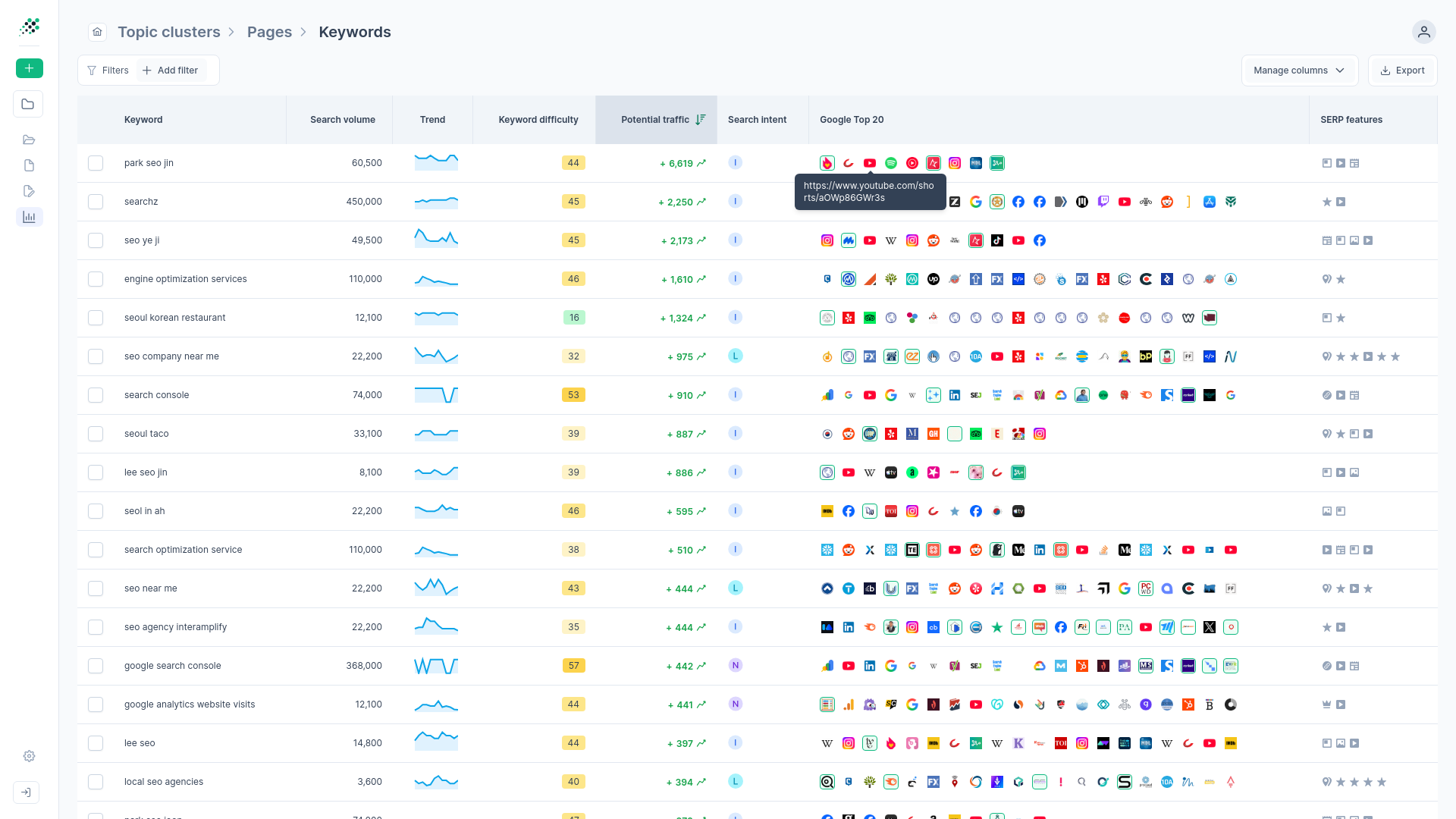
Live search results are the only source of truth for intent validation. After applying an initial grouping strategy, you need a reliable way to ensure that the URLs currently ranking intersect for the keywords in your cluster. If multiple terms share the same ranking URLs, the algorithm agrees those terms are related and belong on the same page. You can automate this in RankDots, which clusters keywords using live SERP overlap without relying purely on text-similarity. If keywords share the same ranking pages on Google, Google groups them together automatically.
A SERP-based clustering algorithm removes subjective human bias from this categorization process.
Setting overlap thresholds
Not every overlapping keyword belongs in a single cluster. Evaluate the threshold of similarity. When we audit a site, we look for at least three to four shared URLs on page one to confidently merge two keywords onto a single target page. If they only share one URL, the intents are splitting. Create distinct pages for terms that fall below the overlap threshold to ensure you directly satisfy the specific user journey.
Step 3: Build topical clusters around pillars
Establishing primary overarching clusters
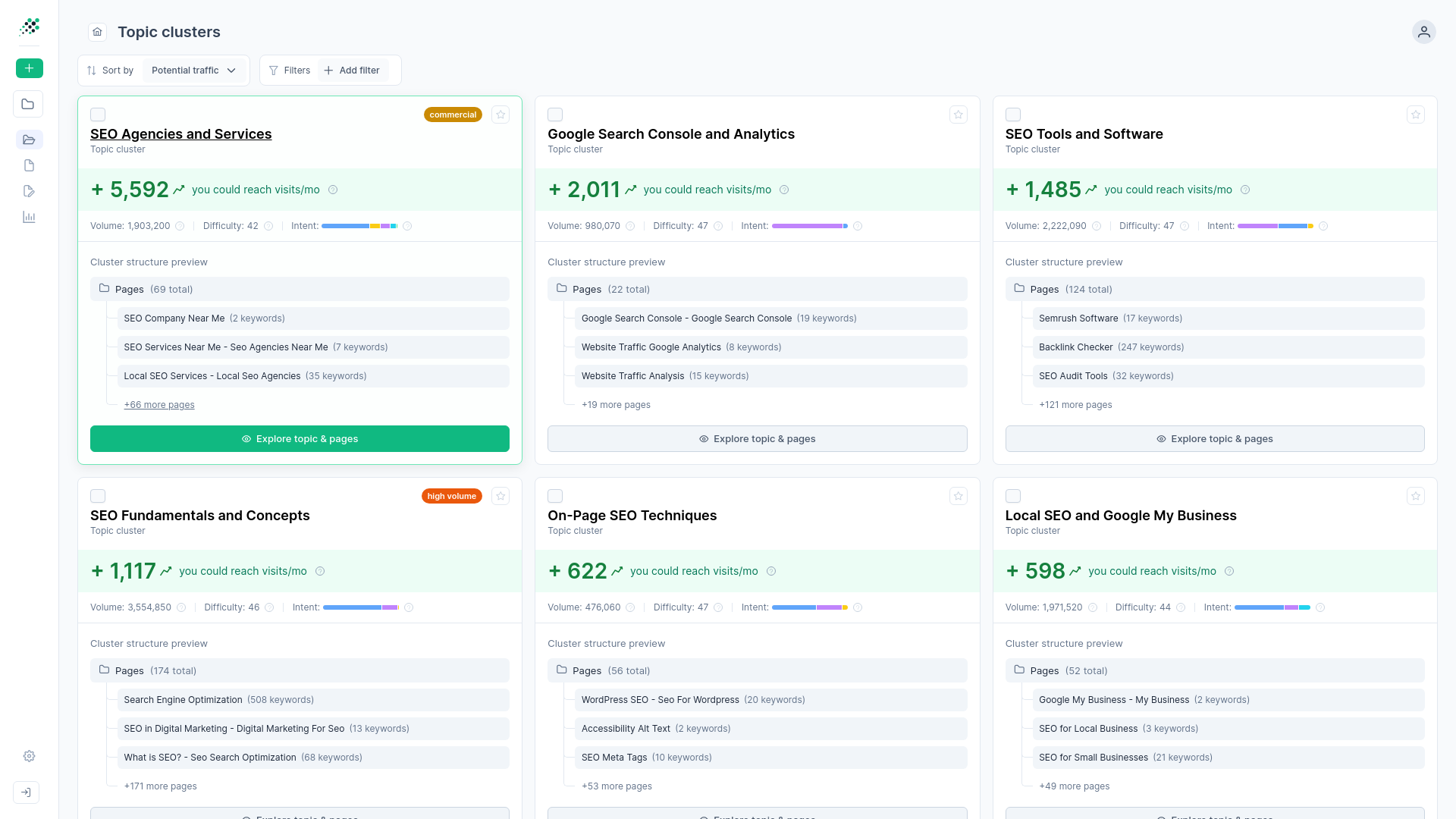
Map your validated keyword groups into broad thematic buckets before deciding on specific URLs. This thematic grouping cements the topic-first architecture. A comprehensive topical map organizes the raw data into primary categories and secondary clusters. An online pet supply store expanding into a comprehensive dog training hub should establish "Puppy Training" as a core pillar cluster, with secondary sub-clusters for "Crate Training" and "Leash Walking".
Identifying the parent query
Every thematic group requires a parent query. This is the primary anchor term that defines the cluster's core intent. The parent query dictates the primary focus of the page, while the remaining terms are supporting variations. Identify this anchor phrase early. It is the strategic center of gravity for the entire content unit, preventing writers from drifting off-topic during production.
Spotting structural content gaps
A topical map naturally exposes immediate content gaps. A visual hierarchy makes missing subtopics obvious. You might realize your dog training hub has extensive coverage on positive reinforcement but entirely lacks a sub-cluster on behavioral correction. Use these exposed gaps to prioritize new content creation. Build out the missing supporting articles to complete the cluster and signal topical authority to search algorithms.
Step 4: Assign clusters to target URLs
Mapping to existing assets
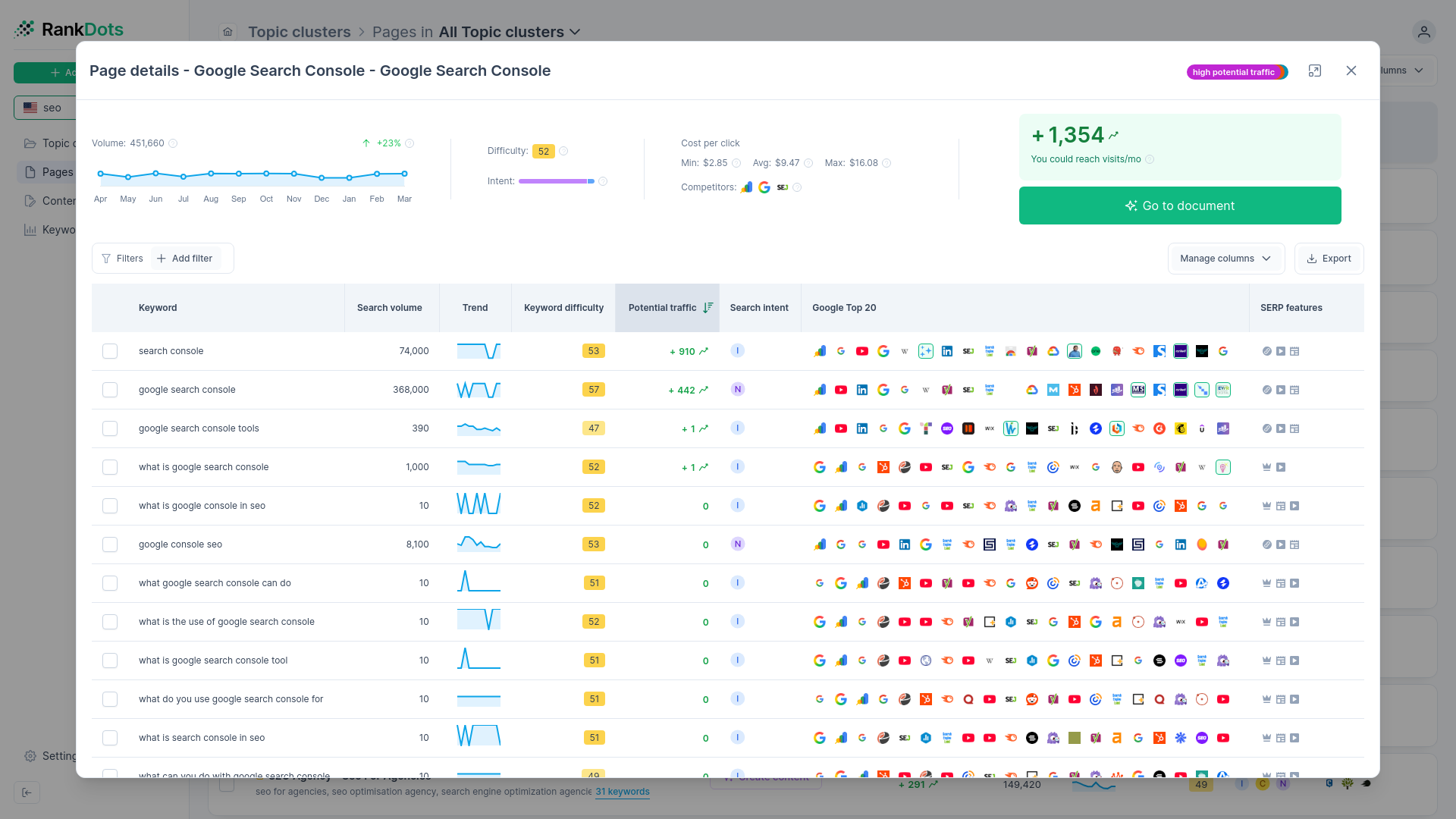
With your topical clusters established and intent validated, assign them to your live URLs. Export your current index from Google Search Console and match each cluster to the most relevant existing page. Don't create a new page if a live URL already satisfies the primary intent of the cluster. Document these assignments clearly and mark which existing pages need an update to include newly discovered secondary keywords.
Consolidating legacy pages
During this assignment phase, you'll inevitably find multiple live URLs that fit into a single cluster. This is the exact cannibalization scenario that hurts organic growth. Identify these competing legacy pages and select the strongest one to keep based on current traffic and backlink profile. Internal case studies demonstrate that using keyword mapping to merge older articles competing for the same search intent can result in a 466% year-over-year increase in search clicks. Implement 301 redirects from the weaker competing pages to the consolidated master asset.
Creating placeholders for net-new URLs
Clusters that don't map to any existing content represent your expansion roadmap. Create placeholders for these net-new URLs within your architectural map. Define the target slug, the parent query, and the supporting keywords for each placeholder. This step finalizes the transition from a messy inventory audit into a proactive blueprint. The result is a clean list of URLs. Some require optimization, some require consolidation, and others need entirely new drafts.
Step 5: Structure your site architecture
Connecting internal linking pathways
Intent-validated clusters directly inform your internal linking structure. Use the hierarchy you established to connect your mapped URLs through strategic pathways. The overarching parent topic page should link down to every supporting sub-topic page, and those supporting pages should link back up to the core parent. This bidirectional linking solidifies the relationship between the assets in the eyes of search crawlers.
Distributing authority naturally
A deliberate linking pathway distributes ranking authority effectively. Broad pillar pages like "Puppy Training" naturally attract more external backlinks due to their comprehensive nature. Proper connections channel that acquired authority from your pillar down into highly specific sub-clusters like "Leash Walking". This structural flow allows a new supporting article on a niche subtopic to rank quickly by building on the established strength of its parent pillar.
Building a scalable editorial calendar
Transition the final architectural map into an actionable editorial calendar. Because you already grouped the topics by intent and assigned them to specific URLs, prioritizing the production schedule becomes straightforward. Produce the broad pillar page first, followed by the secondary supporting clusters. This ensures your content team builds out full thematic sections of the website systematically while avoiding disconnected, random posts.
Frequently asked questions
How does keyword mapping prevent keyword cannibalization?
What are the best free and paid tools for keyword mapping?
What should I do with my keyword map once it's finished?
How frequently should I update my keyword map?
Post-mapping action plan
Creating a developer handoff pipeline
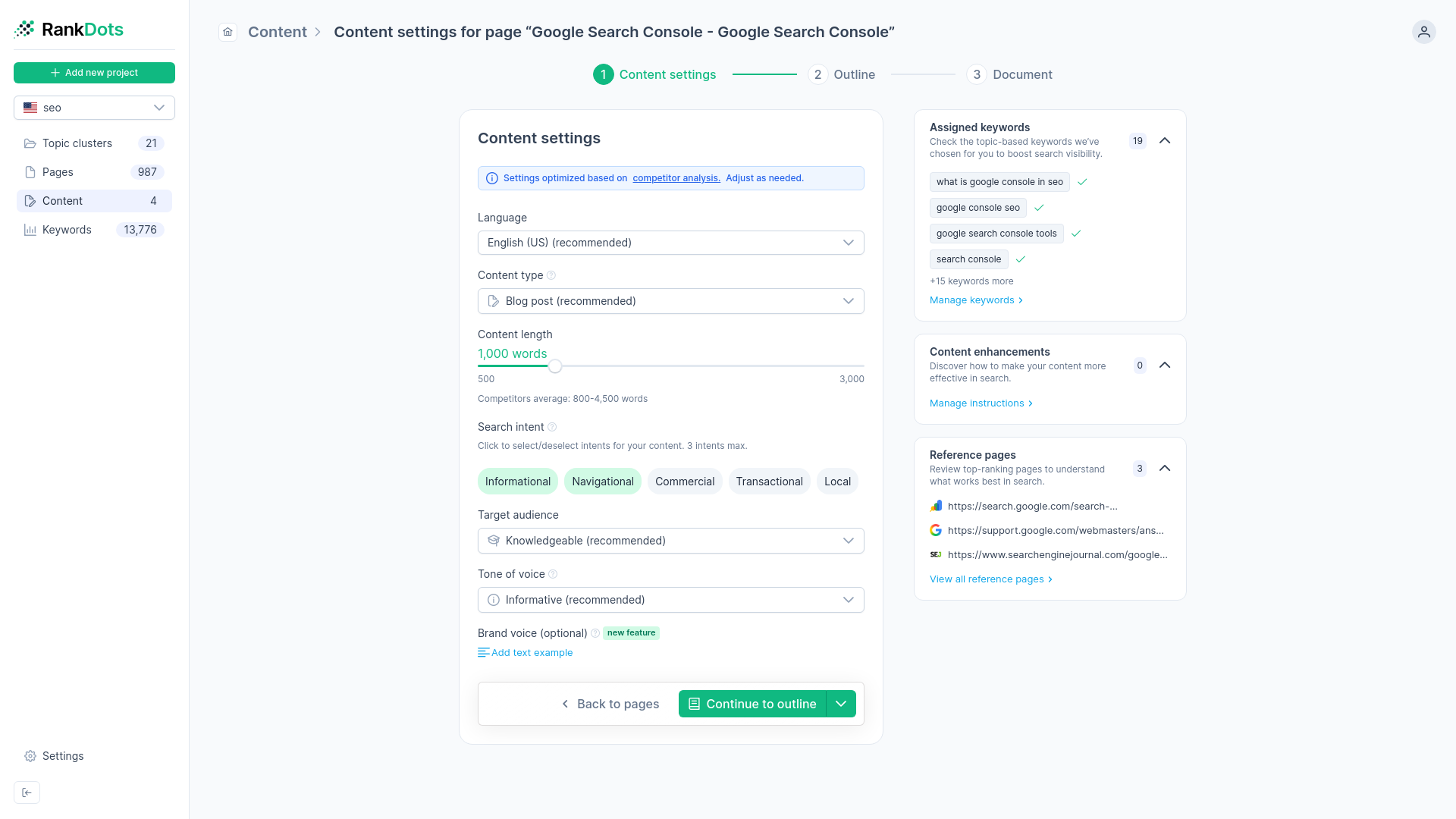
Translating the finished map into a structured pipeline bridges strategy and execution. Hand off the consolidation directives to your technical team and provide exact 301 redirect mapping from cannibalized pages to the new target URLs. Simultaneously, feed the net-new URL placeholders into your content brief generation process so writers receive the specific primary and secondary keywords assigned to each draft.
Establishing ongoing tracking protocols
Connect the finalized target URLs to your daily rank tracking software. Monitor the parent query for each URL specifically. Because you mapped intent deliberately, you should expect to see fewer instances of the wrong URL appearing in search results. Check Google Search Console regularly to verify that the newly consolidated pages are consolidating impressions and no longer splitting them.
Scheduling quarterly review cadences
Search intent shifts as user behavior evolves. Establish a quarterly review cadence to audit your primary clusters against live SERP layouts. If Google begins rewarding video formats or entirely different page structures for your parent queries, you'll need to adjust the content type of your assigned URLs. The map is a living architectural document, not a static spreadsheet.
Stop guessing intent and map your topic clusters automatically.
Ditch the messy spreadsheets that force your pages to compete against each other. Automate your keyword mapping for SEO using live search results to ensure every URL targets a distinct intent.