How to Choose Keywords for SEO + AI Search: A Step-by-Step Guide

Staring at a spreadsheet of 5,000 raw keyword ideas without knowing which ones will drive conversions is a fast track to data paralysis. A raw keyword spreadsheet tells you what people type, but it rarely reveals what they actually mean. Learning how to choose keywords for SEO + AI search starts by brainstorming core topics, generating ideas with AI tools, and analyzing search intent. Next, evaluate keyword metrics, group terms into semantic clusters, reverse-engineer the SERP, and map those clusters directly to specific content types for maximum visibility.
Hunting single, isolated terms based purely on volume no longer works. Google AI Overviews currently appear on approximately 48% of tracked search queries. AI has become a permanent fixture in standard search engine results pages. Customers also use conversational, natural-language questions in AI chat interfaces instead of short typed fragments. To capture this traffic, you need a semantic strategy that targets underlying meaning, not exact-match phrases. Here is a complete 7-step workflow for discovering, validating, and grouping keywords that rank in both traditional and AI-driven search engines.
By the end of this workflow, you'll have a fully mapped site architecture ready for content production.
Quick Takeaways
- To choose keywords for both SEO and AI search, shift from targeting isolated exact-match phrases to a semantic, topic-first strategy that clusters queries based on underlying user intent.
- Stop building your strategy around product features; brainstorm seed keywords by mapping your core offerings directly to specific customer pain points and real-world scenarios.
- Cross-reference multiple data sources to capture conversational, natural-language prompts and high-converting, long-tail variations that reveal actual buyer friction.
- Always map search intent before drafting content, and protect your traffic by avoiding simple factual questions that generative AI overviews will answer instantly.
- Look beyond inflated raw search volume and basic difficulty scores; prioritize true traffic potential by targeting low-competition queries where users are actively trying to solve a problem.
- Abandon manual, text-based keyword grouping in favor of semantic clustering to prevent keyword cannibalization and organize your site into a clean hierarchy.
What is topic-first keyword architecture?
Mapping one search phrase to one page creates chaos. Topic-first architecture groups dozens of related phrases under a single umbrella concept based on search intent. It organizes your site into broad pillar pages and highly specific supporting content.
If you write separate articles for slight variations of the same phrase, you'll usually cause keyword cannibalization. We frequently see teams publish one guide for "best CRM" and another for "top CRM software," only to watch them compete against each other in the rankings. Modern search engines group these terms by their underlying meaning and ignore exact phrasing. If a search engine determines that two different queries serve the identical user intent, it ranks the exact same set of URLs for both.
Hierarchical keyword organization prevents this overlap. It also provides a clear roadmap for internal linking. When you build out a cluster, the supporting subtopic pages funnel authority up to the main pillar page. Websites that implement a hierarchical topic cluster architecture generally build deeper topical authority, leading to stronger organic traffic compared to isolated keyword targeting.
Organize by intent, not by string.
The business benefit of this approach is predictability. Capturing the entire conversation around a pain point removes the need to guess which individual term might stick. You stop wasting budget on redundant pages and start building authoritative resources that search engines trust.
How to Choose Keywords for SEO + AI Search in 7 Steps
-
Map business offerings to customer pain points
List three to five broad problems your product solves based on customer support data. Ask a conversational AI like ChatGPT to generate common beginner questions around these themes. This gives you a refined list of focused seed concepts.
-
Extract queries from multiple data sources
Enter your seed concepts into a primary platform like Google Keyword Planner and cross-reference with a third-party tool. Filter the raw data to isolate long-tail keywords (highly specific phrases of three or more words). You'll walk away with a comprehensive list of potential search terms.
-
Categorize terms by specific user intent
Review your list and label each query by search intent (the user's underlying goal), categorizing them as informational, navigational, commercial, or transactional. Identify conversational prompts and remove simple factual questions. Now your list only contains queries that need deep expertise.
-
Evaluate difficulty and traffic potential metrics
Look past raw search volume (the total number of searches) to evaluate actual traffic potential and keyword difficulty (how hard it is to rank). Prioritize low-competition queries where the top ranking sites have domain ratings below your own. This leaves you with a shortlist of realistic targets.
-
Group related keywords into semantic clusters
Search engines group terms by meaning, so use a semantic grouping tool to organize your filtered list by search intent, not exact phrasing. Separate these groupings into broad parent topics and specific subtopics to build a clean blueprint for your site architecture.
-
Reverse-engineer the live search results
Check the live search results to confirm the exact same URLs rank for multiple terms in your cluster. Analyze the top results to identify required content formats. This confirms that Google actually treats these keywords as a single topic.
-
Assign validated clusters to specific pages
Map broad parent clusters to comprehensive pillar pages and narrow questions to supporting blog posts. Place your primary target term directly in the new page's URL slug and H1 tag. You're now ready to start creating content.
Step 1: Brainstorm core topics and seed keywords
Every keyword research phase starts with seed concepts. These are the broad, foundational themes your target audience cares about before they know your product exists.
Map core business offerings to pain points
When we audit content strategies, the most common mistake is starting with the features you sell while overlooking the problems you solve. If a local specialty coffee roaster builds a new e-commerce website, they might initially think their seed keyword is "coffee beans." That term is too broad to be actionable. Map the offering directly to specific customer situations. What are buyers actually trying to achieve? They want "low acid morning coffee," "espresso beans for home machines," or "coffee subscription gifts."
Look across your existing customer data, sales calls, and support tickets to identify these recurring themes. Group them into three to five broad parent topics. These parent topics will eventually become the pillars of your website hierarchy.
Use conversational AI for lateral expansion
Traditional tools often restrict your thinking to linear word matches. This is where large language models excel. ChatGPT easily generates natural language variations and lateral connections you might miss in a traditional spreadsheet.
Prompt the AI with your target audience and core offering. Ask it to generate the specific questions a beginner would ask, the advanced metrics an expert would track, or the comparison criteria a buyer would evaluate. The goal here is not to pull search volume data. AI platforms lack native search volume metrics and carry a risk of hallucinations if you ask them for quantitative data. Instead, use them to generate a large, unstructured list of angles, objections, and scenarios.
Refine broad concepts into starting seeds
Take the raw output from your brainstorming sessions and filter out the noise. You want to transition from broad industry concepts down to specific, targeted starting points. "Coffee brewing equipment" is too vague. "Pour-over coffee kettle temperature control" is a focused seed. You'll feed these refined seed keywords into dedicated SEO tools in the next phase to map the complete landscape.
Step 2: Generate keyword ideas using traditional and AI tools
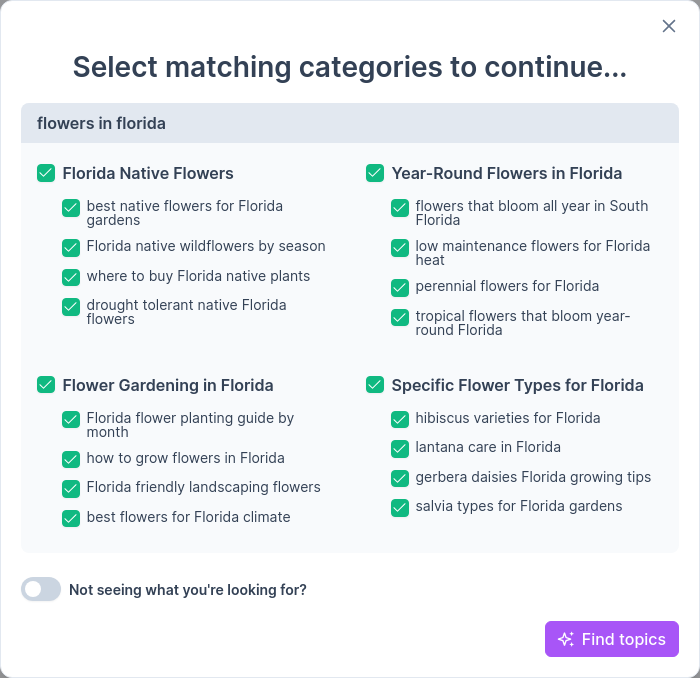
Now you need to extract the queries people type into search boxes or ask voice assistants.
Cross-reference multiple data sources
Relying on a single tool leaves significant blind spots in your strategy. Different platforms excel at different types of discovery. Google Keyword Planner is a primary source of truth that provides official search volume estimates directly from the ad network. However, it tends to report broad search volume ranges and frequently groups distinct variations into identical volume buckets.
To build a complete list, cross-reference traditional data with third-party software. You can use the Semrush Keyword Magic Tool to find related terms from a seed keyword and the Keyword Gap tool to analyze competitors. Data from multiple environments ensures you capture both traditional queries and conversational AI prompts.
Extract long-tail variations
A raw list of 5,000 keywords from a free tool kills momentum quickly. Raw keyword data lacks context, meaning, and prioritization. Actively filter the raw data for long-tail variations to find actionable patterns.
Long-tail keywords of three or more words make up the vast majority of all search queries. While they individually drive less traffic, long-tail keywords generally deliver much higher conversion rates than short-tail terms. Look for autocomplete suggestions, "People Also Ask" questions, and related searches. These variations reveal the specific friction points your audience experiences.
Map the entire keyword landscape
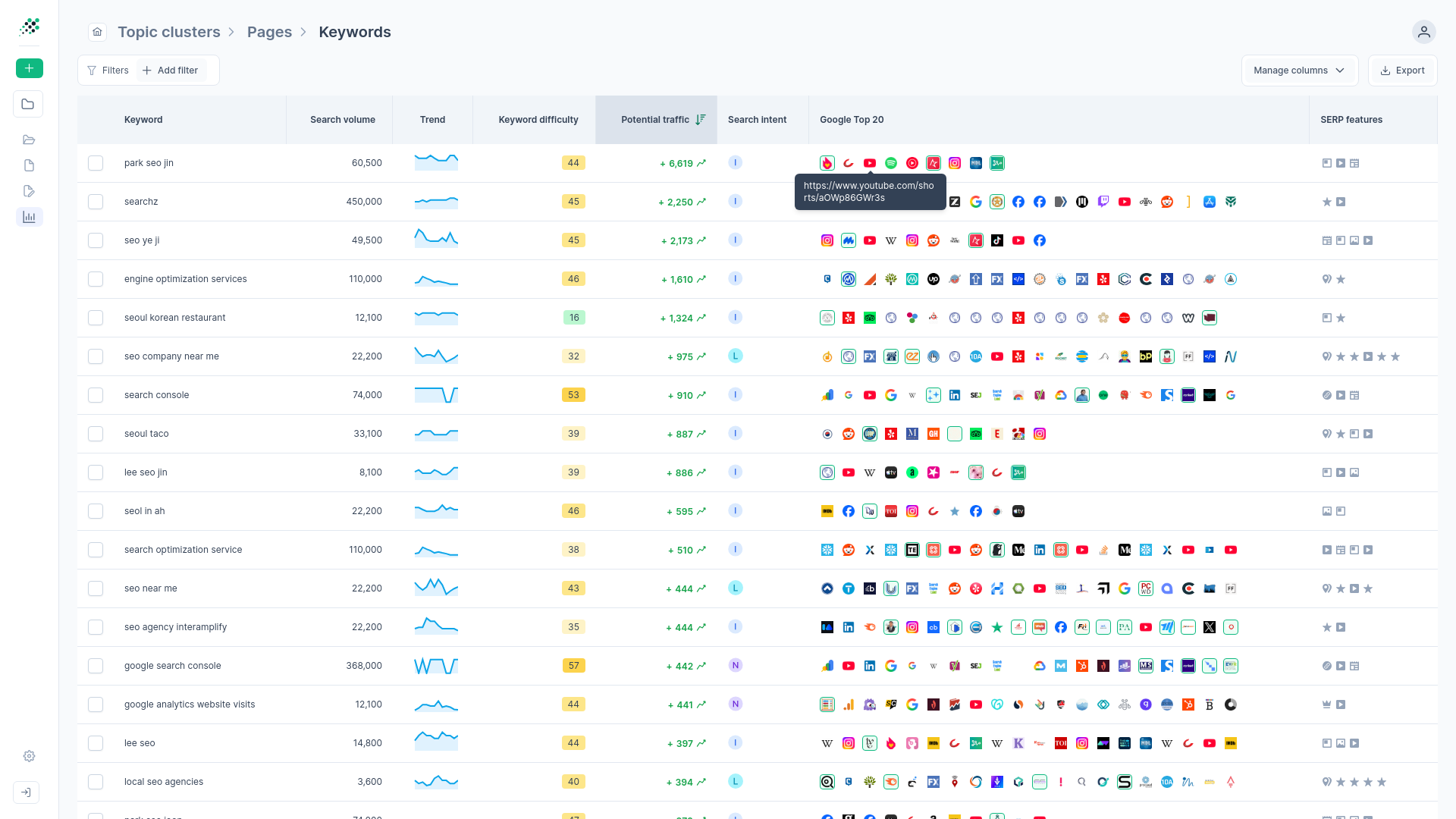
Standard discovery involves plugging in a seed and exporting a list. Landscape mapping requires pushing further. With RankDots, you cross-reference eight distinct data sources simultaneously. This approach pulls from ad networks, autocomplete APIs, live search results, and backlink providers to map out every possible iteration of a topic. Cross-referencing multiple sources cuts out the manual effort of deduplicating overlapping spreadsheets. The objective is to gather the total universe of relevant queries before moving on to the crucial step of evaluating what those searchers actually want.
Step 3: Analyze search intent for target queries
Search volume tells you how many people are looking. Search intent tells you what they want to find. If you skip this analysis, you'll build the wrong type of page for your target audience.
Map intent before you draft.
Categorize queries by intent type
Every query falls into one of four primary intent categories. Navigational searchers want to find a specific website. Informational searchers want an answer or a guide. Commercial searchers are comparing options before a purchase. Transactional searchers are ready to buy right now.
More than 50% of search queries on Google and other search engines have informational intent. People want to learn before they spend. If you create a hard-selling product page for a keyword where searchers are looking for educational guides, that page will refuse to rank. We've noticed this pattern across top-ranking pages: mismatched intent causes searchers to bounce immediately back to the results. This signals to the algorithm that your content failed to answer their question.
Identify conversational AI prompts
AI overviews and generative chat interfaces have shifted how people format their questions. Users no longer type "best CRM software." They write, "What is the best CRM for a freelance graphic designer who needs automated invoicing?"
These conversational queries require a different approach. Look for question modifiers like "how do I," "what happens if," and "can you use." When you identify these highly specific prompts, ensure your content addresses the nuanced context without repeating the core phrase.
Protect against zero-click searches
Intent analysis also helps you spot queries you should avoid entirely. Many Google searches now end without a click to an external website. AI Overviews, rich snippets, and direct answers drive this shift.
If a keyword asks a simple, factual question, an AI summary will likely answer it directly on the results page. The searcher never clicks through. Focus your effort on queries that require deep expertise, personal experience, or complex comparisons. Those are the topics that motivate users to click into your website for the full story.
Step 4: Evaluate keyword metrics and difficulty
Most keyword research derails at the metrics phase. We often see teams fixate on a single column in their spreadsheet (raw search volume) and ignore the context surrounding those numbers. That approach guarantees you'll build content that never gets seen.
The illusion of raw search volume
You write an article targeting a 50,000-volume vanity keyword. Six months later, you check your analytics and see zero traffic and zero conversions. High-authority sites with decades of history outranked you. This scenario plays out when teams chase top-level numbers without questioning the data source.
Search volume estimates are frequently misleading. The Google Keyword Planner groups similar keywords and distinct variations into identical volume buckets. Google Keyword Planner frequently overestimates search volumes. When a tool bundles "running shoes" and "shoes for running" together, it inflates the perceived value of both terms. Uncorrected search volume data makes financial projections and content budgets unreliable.
Look beyond basic difficulty scores
Keyword difficulty isn't a universal truth. It's a relative metric that changes based on your own website's authority. A difficulty score of 40 might be a breeze for a ten-year-old industry publication, but impossible for a brand-new domain.
Analyze the domain rating gaps manually to find achievable targets. Look at the specific websites ranking on the first page. If your Domain Rating sits far below the SERP median, you likely won't rank.
We evaluate true traffic potential, as isolated keyword volume rarely tells the whole story. In platforms like Ahrefs, you can use the Traffic Potential metric to estimate the total organic traffic a top-ranking page receives across all its long-tail variations. A page ranking for a primary keyword with only 200 searches a month might actually pull in 1,500 monthly visitors because it simultaneously ranks for dozens of related secondary phrases.
Prioritize low-competition, long-tail terms
The most lucrative keywords rarely have the highest search volume. Hyper-competitive vanity keywords look great in pitch decks, but they rarely drive immediate business value.
Shift your focus to low-competition, long-tail terms that reflect specific friction points. A user searching for "best CRM" is just browsing. A user searching for "how to migrate contacts from spreadsheet to CRM" is actively working on a problem. Target the friction.
A filtered list with realistic difficulty gaps and specific intent prevents wasted resources and captures highly qualified traffic.
Step 5: Group and organize keywords into semantic clusters
A sprawling list of keywords is just a data dump. A chaotic site architecture pits your own pages against each other for the exact same search intent.
Ditch manual shared-word grouping
Imagine spending weeks writing separate articles for slight phrasing variations — one for "affordable coffee roasters" and another for "cheap coffee roasting machines." Months later, you realize they are cannibalizing each other in the search results. They swap positions but never break onto the first page.
Manual grouping based on shared text causes this exact overlap. Traditional sorting relies on exact strings. If the words look different, marketers put them on different pages. But modern search algorithms process underlying intent. They know that "affordable auto insurance" and "cheap car coverage" mean the exact same thing to a user. If you don't group these terms together before you start writing, you'll duplicate your efforts and dilute your site's authority.
Use AI for semantic clustering
Manual grouping across thousands of rows is brutal. The smarter approach uses automated semantic clustering to build groupings based on search intent. It completely bypasses simple text matching.
Proper semantic grouping consolidates related long-tail variations into single, authoritative guides.
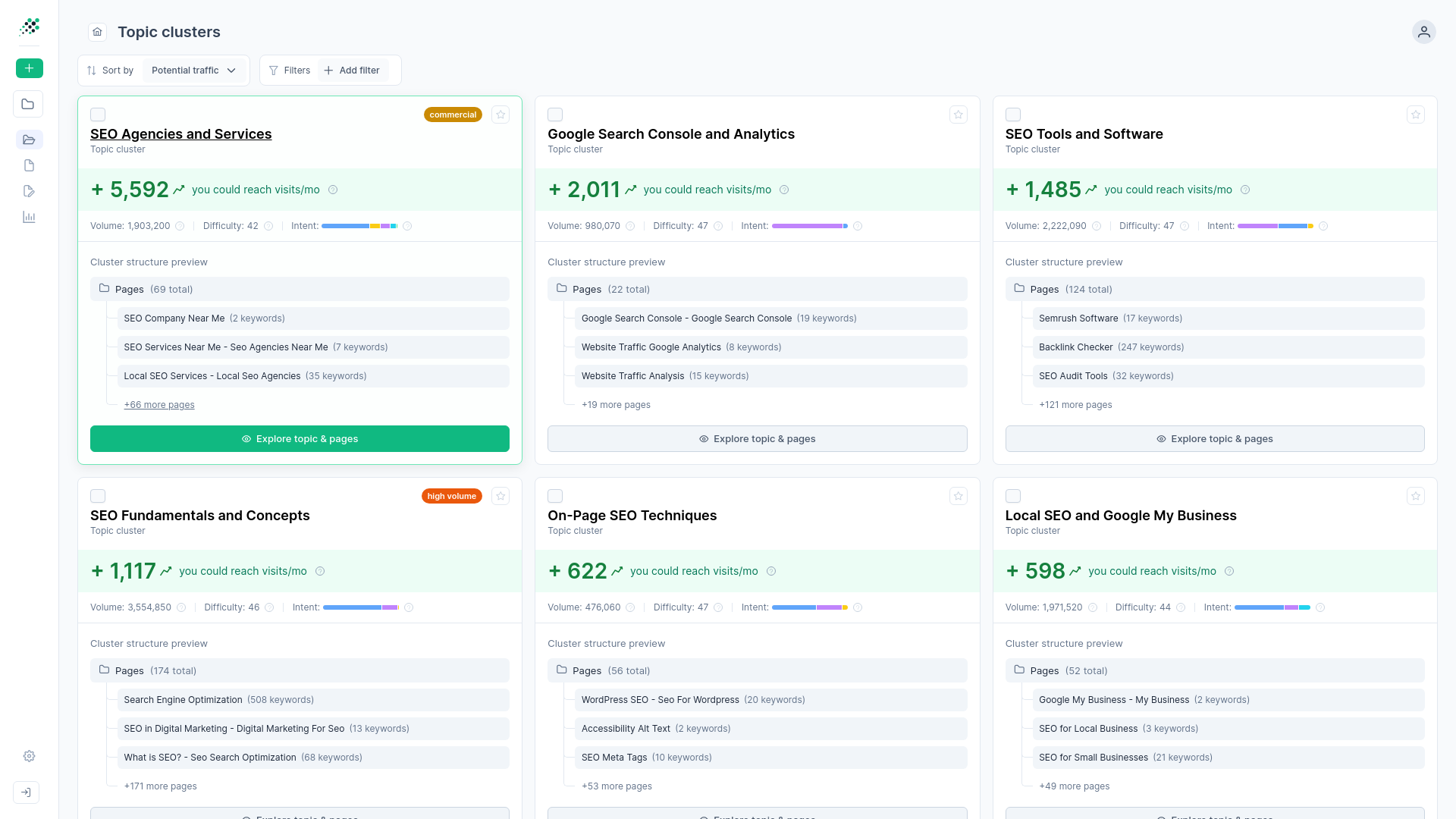
With RankDots, you can automatically group keywords based on meaning into logical, hierarchical topic clusters. The proprietary AI clustering algorithm analyzes what the searcher wants and organizes terms exactly how a search engine understands them.
The semantic clustering feature in RankDots automatically maps these relationships. Automated clustering eliminates the guesswork of deciding which keywords belong on the same page.
Build a clean hierarchical structure
Once your terms are clustered by meaning, organize them into a structured hierarchy. You need a blueprint that tells you what type of content to build.
Divide your clusters into two distinct levels:
- Broad parent topics that will become your comprehensive pillar pages.
- Highly specific supporting subtopics that will become your dedicated blog posts.
For example, "espresso machine maintenance" is a parent topic. "How to descale a dual boiler" and "replacing group head gaskets" are supporting subtopics.
Grouping terms keeps your site architecture clean and efficient. Every time you write a new piece of content, you know where it fits within the larger ecosystem. You stop producing redundant content and start building deep, authoritative resource hubs that signal your expertise.
Step 6: Reverse-engineer the SERP and AI responses
Before writing a single word, you need objective proof that your strategy aligns with what search engines reward. Search volume alone is insufficient. You have to look at the live search results.
Validate clusters with URL intersection
You need objective validation that a group of keywords should be targeted on a single page before investing hours into writing. An epic guide based on your own assumptions carries significant risk.
Check the live search results to see if the exact same URLs rank for multiple keywords within your cluster. If they do, the search engine agrees those keywords are related. You can apply this exact logic through the URL Intersection Validation feature in RankDots. The intersection tool verifies if Google ranks the same URLs for multiple keywords within a cluster. If yes, the cluster is validated by Google's own ranking behavior. If not, the cluster is flagged as too broad and usually needs to be separated.
Identify structural content gaps
Once your cluster is validated, look at what the top-ranking competitors actually provide. We often notice patterns in the formats that dominate specific queries.
Are the top results listicles, ultimate guides, or simple interactive calculators? You can reverse-engineer Google's ranking patterns using RankDots to find these structural opportunities. Analyze page types, content structures, word counts, and topical depth to identify content gaps that raw metrics miss. If every result on the first page is a step-by-step video tutorial and you plan to write a wall of text, you'll lose.
Assess AI overviews and zero-click risks
We recommend evaluating the top of the search results page. Look for featured snippets, "People Also Ask" boxes, and AI-generated overviews.
Search engines frequently answer simple, factual questions directly on the results page. If a keyword asks a basic question, an AI summary will likely answer it instantly. The searcher gets what they need and leaves. When you spot these zero-click environments, pivot your strategy. Focus your effort on targeting terms where users clearly need to compare structured formats, interactive tools, or visual workflows that an AI overview can't render.
Step 7: Map selected keywords to content types
The final step transforms your validated keyword clusters into a concrete publishing roadmap. You know what terms to target and what the SERP requires. Now map those insights directly to your website's architecture.
Structure protects visibility.
Align clusters to specific formats
Not every keyword cluster belongs in a blog post. Many teams mistakenly force transactional keywords into informational articles.
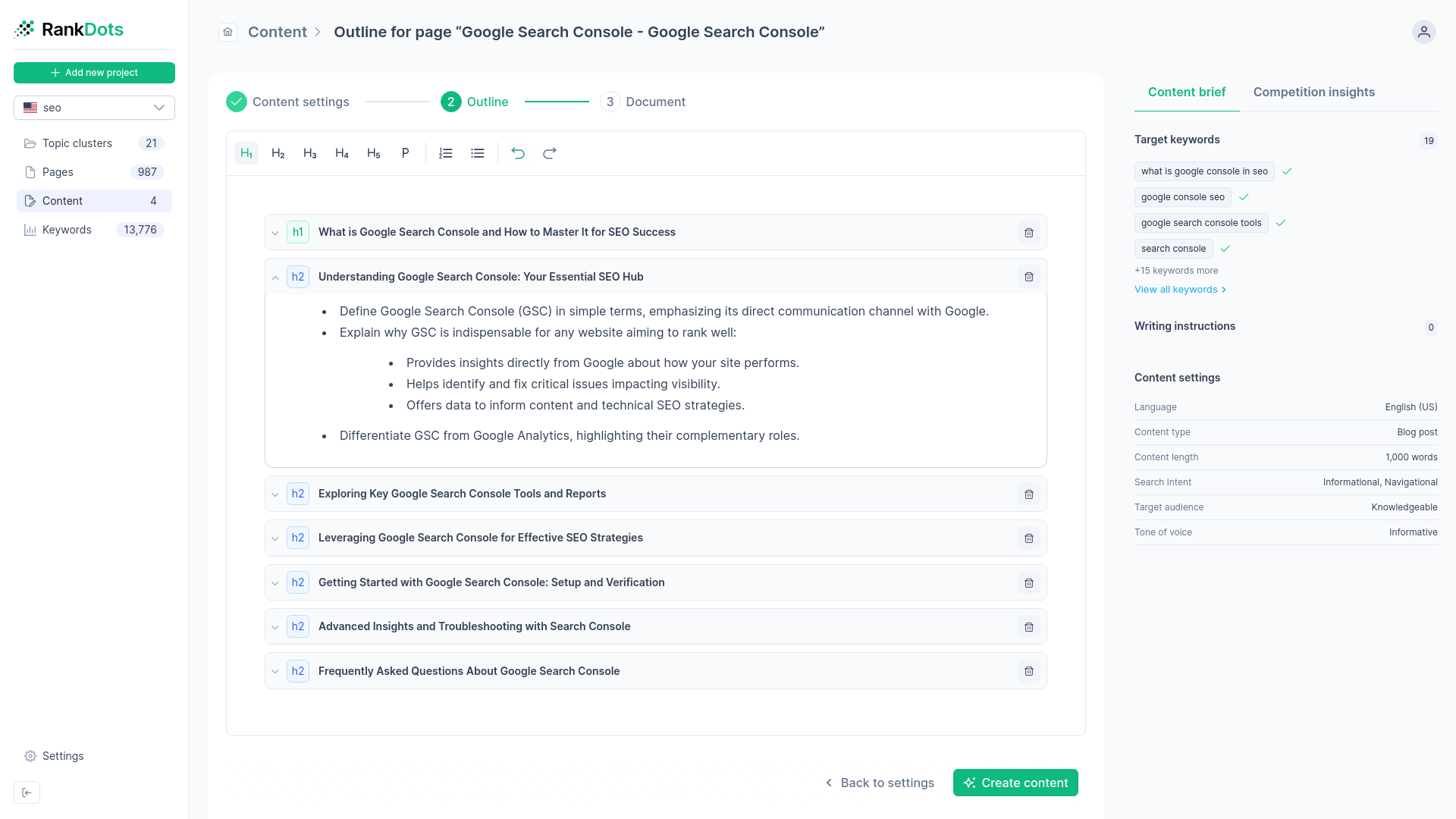
Map your validated parent topics to the correct page formats. Broad, educational clusters should become comprehensive pillar pages. Highly commercial clusters should map to dedicated product or service pages. The specific, narrow questions generated during your research should become supporting blog posts or glossary entries.
Integrate terms into URL structures and headings
Once the page format is set, establish the on-page hierarchy. The placement of your target terms matters just as much as their presence.
Place your primary target keyword in the URL slug and the H1 title. Pages with URLs that contain the primary target keyword often see higher click-through rates. From there, use your secondary terms and semantic variations within the H2 and H3 subheadings. A logical document outline makes it easy for search engine crawlers to understand the page's core focus.
Create a cohesive internal linking strategy
The architecture only works if the pages are connected. You need a cohesive internal linking strategy that connects your subtopics back to their parent themes.
Every time you publish a supporting blog post, link it upward to the relevant pillar page using descriptive anchor text. We usually see this simple linking adjustment push stalled clusters onto the first page. It funnels authority up the chain and signals which page is the definitive resource for the broader topic.
Frequently Asked Questions
How do you choose keywords for SEO and AI search?
How do you find relevant keyword ideas?
How do you apply keyword research to your website content?
What is the goal of choosing keywords for local SEO?
Build topic clusters that capture targeted search traffic
Stop manually sorting spreadsheets and let automated clustering group your terms by search intent. Turn those validated topics directly into a prioritized content strategy to start capturing traffic that actually converts into customers.