The complete guide to SEO keyword categories: From intent to semantic clusters

It happens constantly. You pour hours into a comprehensive guide targeting a massive search term, only to watch Google ignore it because searchers actually wanted a direct product page. Treating all search queries as fundamentally equal guarantees a high failure rate. The solution lies in keyword categories, which group search queries based on their primary characteristics to guide your entire content strategy.
Look at the category to understand what the search engine expects to see, rather than guessing the format.
Semantic SEO principles ensure you organize these categories by meaning rather than surface-level text.
This guide explains how to organize search data by function rather than just text, helping you build a highly converting topical architecture.
Quick Takeaways
- Keyword categories are structural blueprints that group search queries by their underlying meaning and user intent, rather than surface-level text, to guide your entire website's content architecture.
- Top-of-funnel discovery searches require educational formats like comprehensive guides to build initial brand trust, acting as an ecosystem entry point rather than a direct sales pitch.
- Failing to build dedicated pages for specific branded navigational queries allows external review sites and forums to intercept your most loyal, relationship-driven traffic.
- Mid-funnel searchers demand objective comparisons; hiding the flaws of your own offerings or using heavy-handed sales copy at this stage destroys trust and drives potential buyers away.
- Attempting to rank educational content for bottom-of-funnel queries guarantees failure because ready-to-buy searchers require a frictionless path directly to a checkout cart or pricing matrix.
- Chasing vanity volume metrics with broad search terms ignores the reality that highly specific, long-tail variations account for the vast majority of actual search demand and deliver drastically higher conversion rates.
What are keyword categories and why do they matter?
The structural foundation of modern SEO
Most keyword spreadsheets are flat lists of raw data. We've watched teams export massive lists, immediately sort by the highest search volume, and plan to target the biggest ones first. The result is usually blind ambition followed by frustration when they realize they can't rank against enterprise competitors.
Keyword categories fix this by giving that raw data structure. They're the architectural blueprint for your website, determining which topics become pillar pages, which become blog posts, and which belong on product pages. Unclassified keyword lists often lead to redundant content competing against itself in the search results.
The business impact of getting it right
The cost of ignoring categorization is wasted effort. You end up acquiring traffic that never converts or, worse, driving no traffic at all because your content format doesn't match the searcher's expectation. For instance, a local independent bookstore building an e-commerce presence might try to rank for "bookstore" instead of "buy mystery books online."
The former is a generic head term; the latter has distinct intent. Short-tail keywords make up almost 20% of all searches, but they rarely convert as well as their specific, longer-tail counterparts. Logical grouping ensures you spend your writing budget on queries that drive revenue.
Moving beyond search volume
Generalized tool metrics are dangerous without an intent-driven lens. Data from mainstream keyword research tools can mislead you; search volume estimates are overestimated 54.28% of the time and are only roughly accurate in 45.22% of cases. We recommend a system that maps meaning, not just volume.
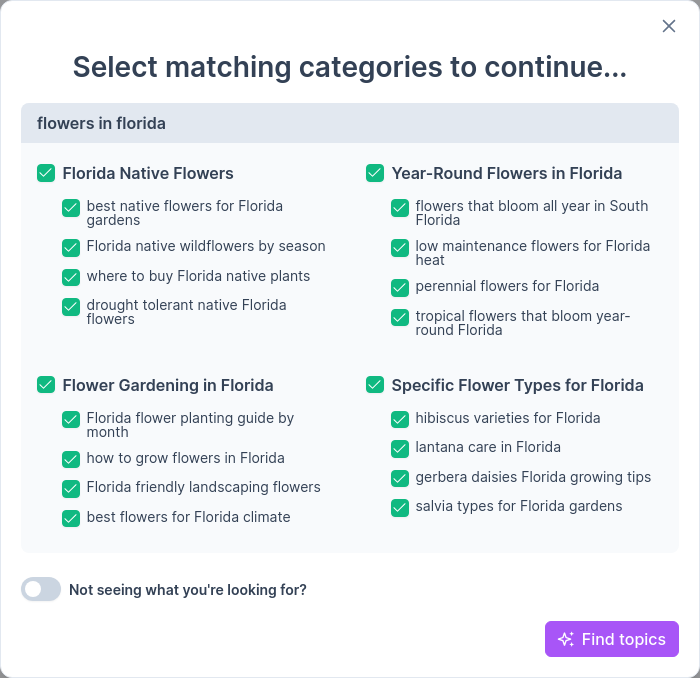
To counter this, you can use platforms like RankDots and their AI Category Generation & Taxonomy to automatically generate a structured taxonomy containing four to six content categories and specific subtopics based on a single seed keyword. That taxonomy prevents you from chasing inflated numbers and anchors your strategy in real topic structure.
Informational intent keywords
Characteristics of top-of-funnel queries
These are the discovery terms. Searchers use informational intent keywords when they want an answer, a definition, or a tutorial. You can usually spot them by modifiers like "how," "what," "why," or "guide."
For our local bookstore example, an informational query looks like "how to start reading science fiction." The searcher isn't looking to buy a specific book right this second; they want a pathway into the genre. They're at the beginning of their journey, gathering context before they ever consider making a purchase.
Matching content formats to intent
When we review top-ranking pages for these terms, the required content formats are almost exclusively blog posts, glossaries, and comprehensive tutorials. You usually can't rank a product category page for a "how-to" query. The intent demands education, not a sales pitch.
You can use tools like AnswerThePublic to map this stage, transforming standard autocomplete data into visual mind maps that group queries by linguistic modifiers. Mapping these modifiers helps you build out the exact questions people ask, allowing you to structure your headings around real curiosities rather than guessed topics.
Measuring success beyond direct sales
You can't evaluate informational content using bottom-of-funnel conversion metrics. The average conversion rate for informational blog posts is approximately 2%, while typical newsletter signup rates average around 1.95%.
Measure success through brand awareness and internal click-throughs to deeper pages, rather than expecting immediate purchases. The goal is to capture the reader's attention and introduce them to your ecosystem. Once they trust your educational material, they are much more likely to return when they have commercial intent.
Navigational intent keywords
The mechanics of branded search
Navigational queries happen when the searcher already knows exactly where they want to go. They type a brand name, a specific product line, or a company portal directly into the search bar. They use the search engine as a routing mechanism rather than typing a full URL. For our bookstore, this looks like "Oak Street Books hours" or "Oak Street Books online store."
These searches are critical because the user has already bypassed the discovery phase. They want you.
Capturing login and support queries
A common mistake is ignoring the long-tail variations of navigational terms. Users frequently search for support documentation, return policies, or login portals. If you don't build dedicated pages for these queries, third-party review sites or competitors might intercept your branded traffic.
These terms are critical because they represent users who already have a relationship with your brand. When a customer searches for your return policy and finds a confusing third-party forum instead of your official page, the brand experience fractures.
Monitoring click-through anomalies
Because the intent is so focused, performance expectations are drastically higher. Branded search queries that rank in the first organic position achieve an average click-through rate of 60.4%, capturing significantly more traffic than non-branded terms.
We rely heavily on Google Search Console to monitor these specific terms. Since it provides direct search performance data from the search engine's own systems, it's the best place to spot sudden drops in branded CTR. A sharp decline usually indicates a technical indexation issue or a competitor aggressively bidding on your brand name in paid search.
Commercial intent keywords
Identifying mid-funnel modifiers
Commercial intent sits between casual research and the final purchase. The searcher knows they need a solution but hasn't chosen the specific product or provider yet. These queries are defined by comparative modifiers like "best," "top," "vs," "alternatives," and "review."
For the bookstore building its catalog, a commercial query is "best sci-fi novels" or "e-reader vs physical books." The user is weighing options. They have their wallet nearby, but they need validation before opening it.
Building objective content formats
The format here should facilitate a decision. Searchers at this stage lose trust quickly if they encounter heavy-handed sales copy. They want objective formatting.
Comparison tables and well-structured listicles perform best. The goal is to provide the exact data points the reader needs to weigh their options. If they search for "alternatives," they expect a genuine comparison, not just a landing page stating why your product is superior. If you hide the flaws in your own offering during a comparison, readers will hit the back button to find an unbiased reviewer.
Bridging education and purchase
Commercial content does the heavy lifting of moving a user from top-of-funnel awareness to bottom-of-funnel action. It's the bridge.
Here, you introduce your offering as the logical conclusion to their research. When you logically link these commercial guides to specific product pages, you build a topical architecture that captures intent at the exact moment the user is ready to decide. You aren't forcing the sale; you're providing the easiest path forward once the comparison is complete.
Transactional intent keywords
Characteristics of bottom-of-funnel queries
When a searcher reaches the end of their journey, their vocabulary shifts entirely. They stop asking "how" or "what" and start typing modifiers like "buy," "cheap," "discount," or "pricing." These are transactional intent keywords, and they indicate a user who has their credit card ready. For our bookstore example, "buy hardcover science fiction books" is a clear transactional signal. The user isn't browsing for ideas anymore; they are looking for a specific product and a reliable place to purchase it.
The search results page changes for these terms. The organic listings get pushed down by shopping carousels, sponsored product grids, and local pack maps. Search engines understand the user wants to spend money, so they display the fastest routes to a checkout cart.
Why educational articles fail here
If you try to capture bottom-of-funnel traffic with an educational post, the page automatically fails because it forces the searcher to read instead of taking action. If someone searches for "CRM software pricing," they don't want a 10-minute read on the history of customer relationship management. They want a grid with dollar amounts.
When you try to force an educational blog post to rank for a transactional query, search engines ignore it because the behavioral signals from users—like immediate bouncing—prove the format is wrong.
Factoring in the transactional share metric
When auditing a search landscape, it helps to understand how these queries distribute across the web. A large-scale analysis of keyword intent revealed that over 30% of search queries in the studied corpus were primarily transactional, while nearly 3% of search result pages displayed competing or mixed intents. That means a large portion of your potential search landscape requires hard conversion pages, not educational content.
Building dedicated product category pages and straightforward pricing matrices is a strong strategy for these terms. You secure the transaction by making the purchase path frictionless. If the user has to click through three paragraphs of SEO text to find the checkout button, they will buy from a competitor who respected their time.
Classification by keyword length
The trade-offs of short-tail keywords
The shortest queries—one- or two-word phrases like "shoes," "accounting software," or "books"—define entire industries. Content teams frequently pull lists from tools like Semrush or Ahrefs, sort by the highest volume, and target those massive terms first. Even if they manage to rank, the result is usually an influx of unqualified visitors who bounce immediately because the page doesn't solve their specific problem.
While short-tail terms offer broad visibility, they suffer from low intent and fierce competition. Someone searching "books" could want a definition, a local store, or a publishing platform. The effort required to rank rarely justifies the murky conversion potential.
The strategic advantage of long-tail keywords
Long-tail keywords flip that dynamic, using three or more words to capture highly specific user intent. A long-tail variation of "accounting software" is "cloud accounting software for freelance designers." The search volume drops significantly, but the conversion probability increases substantially.
The strategic advantage is that long-tail terms filter out the noise. A user typing a five-word query has already done their initial research. They know the exact problem they need to solve, which means they are significantly closer to making a purchase decision. These specific queries are easier to target because the competitive barrier to entry is lower. You don't need a million backlinks to rank for a hyper-specific problem if your page provides the undisputed best answer.
The reality of search demand
It feels counterintuitive to chase queries with tiny search volumes, but that's where the actual volume lives. An analysis of query distribution reveals that 95% of all search terms receive 10 or fewer monthly searches. Collectively, long-tail keywords account for more than 70% of the overall search demand curve.
When you ignore the long tail, you ignore the vast majority of how human beings actually search the internet. People type full questions and hyper-specific scenarios into search engines every second. To capture that traffic, step away from the vanity of broad search volumes and lean into the granular specificity of the long tail.
Moving to semantic clustering and topic architecture
The evolution from legacy exact-match targeting
Early search engine algorithms were essentially digital librarians sorting through index cards. If a page didn't contain the exact string of letters a user typed, the algorithm couldn't reliably serve it. Keyword optimization meant picking one specific phrase and hammering it into a page. If you wanted to rank for "best budget laptop," you made sure that exact string of words appeared in the title, the URL, the first paragraph, and the subheadings.
As natural language processing evolved—driven by systems like Google's RankBrain—algorithms learned to read for meaning rather than just counting words. Today, a search engine understands that "inexpensive notebook computers" and "best budget laptop" represent the exact same user intent, even though they share zero words.
Dispelling the keyword stuffing myth
Content briefs frequently still require writers to inject an exact-match phrase every 200 words to avoid over-optimization, or cram in a bizarre list of 'LSI keywords' generated by a free tool. The result is robotic, unreadable prose. Reportedly, Google representatives have stated that LSI (Latent Semantic Indexing) keywords don't technically exist in their ranking systems.
However, data suggests LSI keywords help search engines understand the context of content, significantly boosting SEO relevance despite the technical claims. The fix isn't mathematically stuffing related phrases; it's writing comprehensively about the topic so the natural vocabulary emerges on its own. The context matters far more than the exact match string.
Grouping by meaning to prevent cannibalization
When you organize content by text rather than meaning, you end up creating duplicate pages. A traditional text-matching approach would tell you to build one page for "cheap car insurance" and a totally separate page for "affordable auto coverage." That leads directly to keyword cannibalization. Because the authority is split between two separate URLs competing for the same search intent, neither page ranks well.
Semantic grouping unites these terms under their underlying meaning. You can use specialized platforms like Keyword Insights to run large-scale keyword clustering and solve this. Similarly, you can use the RankDots semantic clustering pipeline to group keywords by meaning rather than surface-level text matching, identifying connections like 'affordable auto insurance' and 'cheap car coverage' instantly.
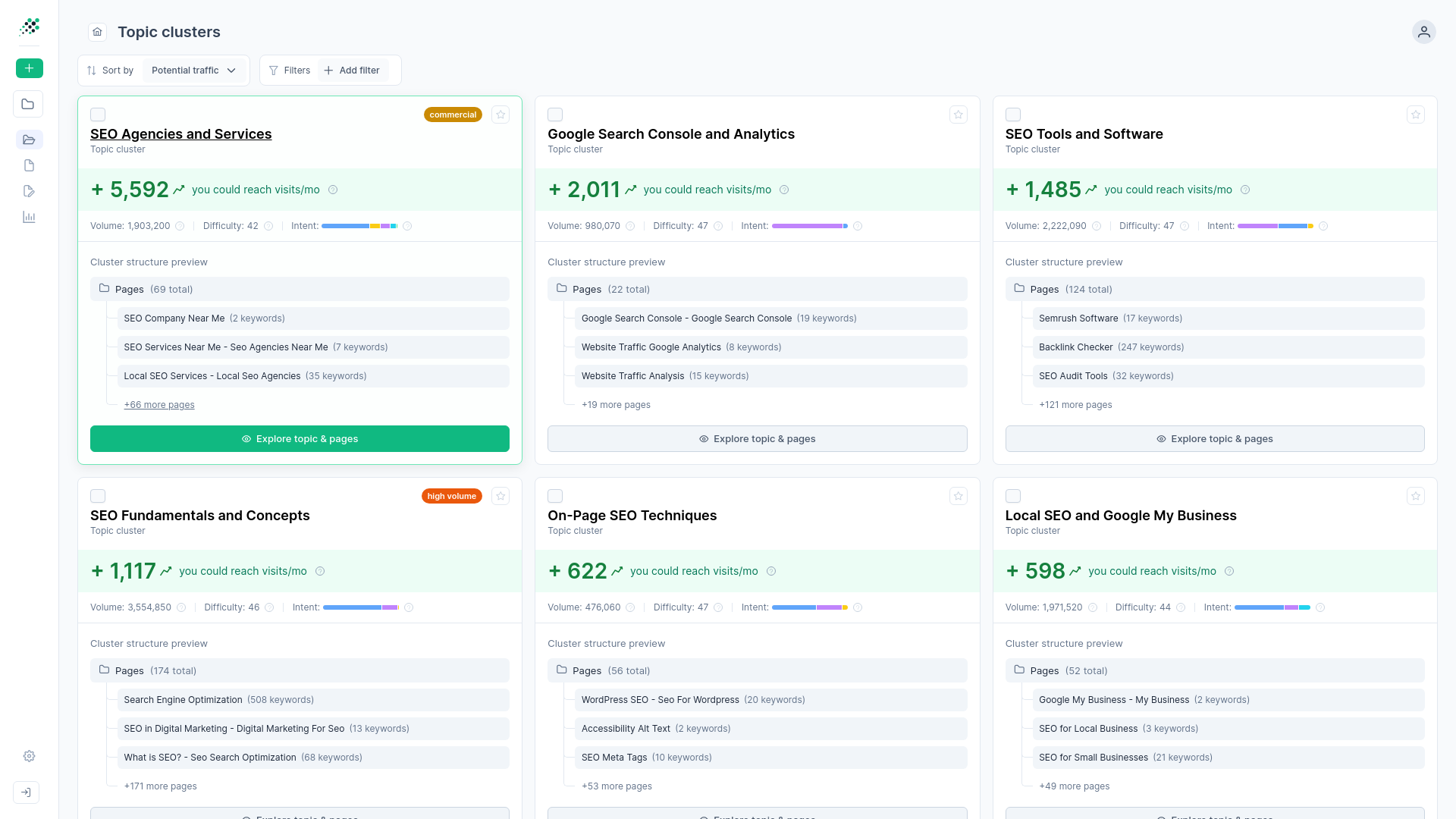
This architectural reorganization drives real outcomes. Websites that reorganize their content into semantic topic clusters see an average organic traffic increase of 40% compared to sites using non-clustered content strategies. You build comprehensive pillar pages that cover the entire cluster, satisfying the user and the algorithm simultaneously.
Traditional vs. semantic keyword categories
| Comparison point | Traditional keyword categories | Semantic clustering |
|---|---|---|
| Primary focus | Surface-level text matching | Shared meaning and user intent |
| Site architecture | Separate pages for exact phrases | Pillar pages for topic clusters |
| Cannibalization risk | High internal competition | Low risk via unified intent |
| Volume accuracy | Accepts inflated grouped metrics | Aggregates search volume by intent |
| Traffic impact | Fragmented ranking authority | 40% average organic traffic increase |
| Tool examples | Standard keyword planners | RankDots or Keyword Insights |
Developing a strategic keyword mix
Balancing authority builders with conversion drivers
A healthy content architecture never relies exclusively on one type of query. If you only target broad short-tail keywords, you'll struggle to gain traction and generate early revenue. Conversely, if you only target ultra-niche long-tail queries, you might convert at a high rate but fail to build the broad topical authority required to establish your brand.
The most effective architectures use a hybrid approach. You use top-of-funnel informational terms to cast a wide net and build brand awareness, while simultaneously deploying long-tail commercial and transactional pages to capture revenue. The broad pages are authority funnels, passing internal link equity down to the highly specific conversion pages.
Identifying and correcting skewed search volume
This mix requires accurate data, which is harder to find than most realize. It's common to open Google Keyword Planner and find a dozen similar keywords that all show the exact same high monthly search volume. Marketers often think they found dozens of distinct high-volume targets, completely unaware of the tool's grouping flaw.
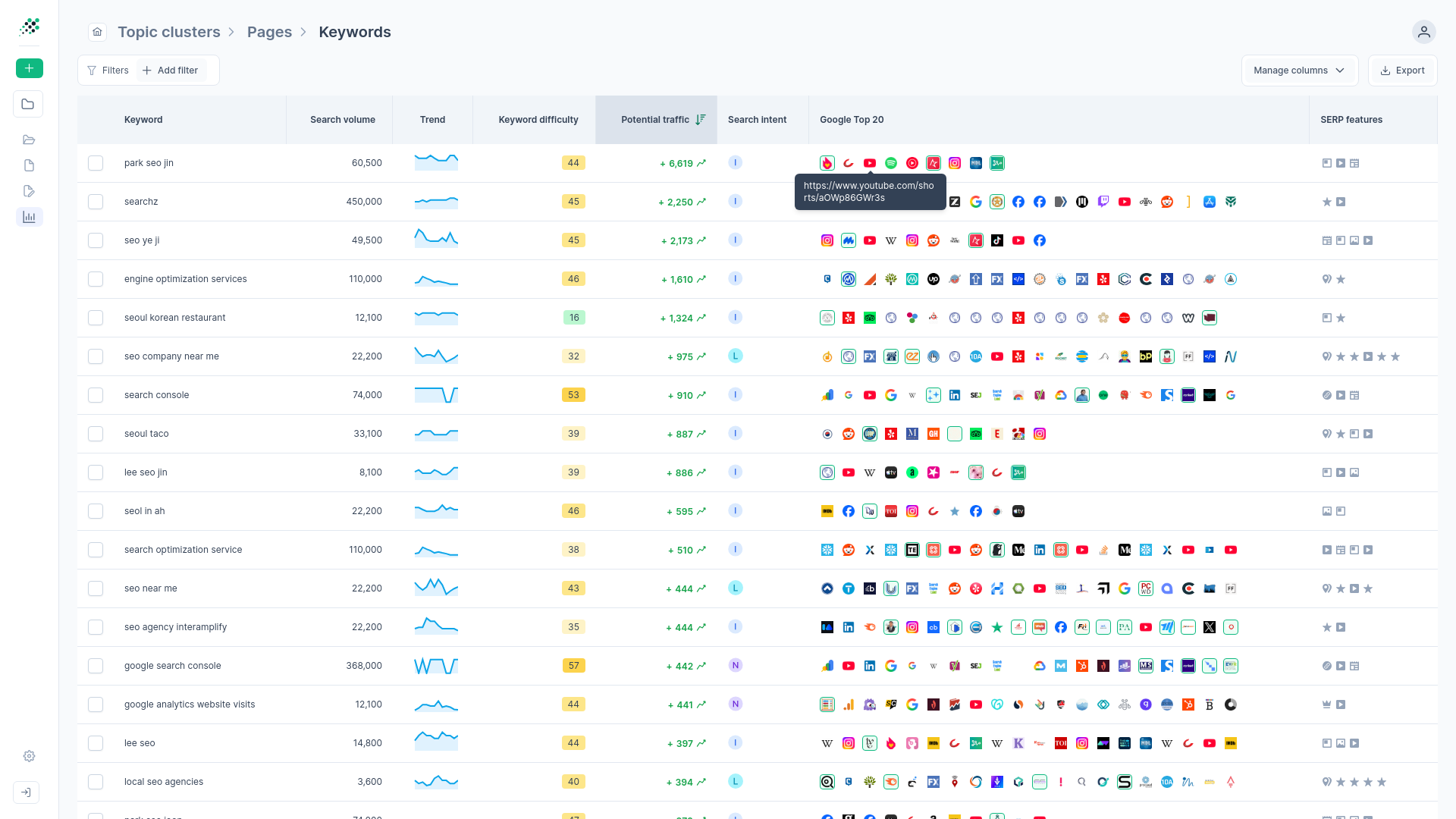
This data distortion happens because Google groups singular and plural forms, misspellings, and close variants into a single reporting bucket. If you build a content calendar around three distinct keywords that share the same grouped volume, you'll wildly overestimate your potential traffic. With RankDots, you can correct Google Keyword Planner's search volume grouping flaw using an algorithm that detects matching metric fingerprints and mathematically redistributes the volume fairly across the keyword group. The actual distribution prevents you from prioritizing a keyword based on a phantom number.
Mapping clustered topics to the buyer journey
You finally collect a list of 500 relevant, deduplicated keywords. Now what? A flat spreadsheet without organizational structure causes total paralysis.
The next step is mapping those semantic clusters to specific stages of the buyer journey. A cluster focused on "what is CRM" maps to a top-of-funnel informational blog post. A cluster built around "CRM vs spreadsheet" maps to a mid-funnel commercial comparison page. A cluster for "CRM monthly pricing" maps to a bottom-of-funnel transactional page. That mapping ensures every piece of content you write serves a distinct business function.
Strategic workflow for keyword selection
Step 1: Identifying seed topics based on core offerings
Every successful research process starts outside the SEO tools. You begin by identifying seed topics based on your actual business offerings, not abstract search metrics. If you run a local bookstore, your seeds are the genres you sell and the location you serve. The best seed topics are broad enough to contain dozens of sub-topics but narrow enough to represent a specific vertical of your business. These core concepts become the anchor points for everything that follows.
Step 2: Generating a structured taxonomy
The traditional next step involves days of manual spreadsheet sorting. An AI-powered system transforms that messy concept into a structured plan using your core seed topic. With RankDots, you can use an AI algorithm to automatically generate a structured taxonomy containing 4 to 6 content categories, with each category containing 3 to 5 subtopics, based on a single seed keyword. The immediate categorization gives you a logical framework before you ever start writing.
Step 3: Validating topic clusters using live SERPs
Once you have your clusters, validate that search engines agree with your logic. The most reliable method is live SERP validation. You check live Google search results to see if the exact same URLs rank for multiple keywords within your proposed cluster. If the overlap is high, it validates that Google treats these keywords as semantically related. If there's no overlap, your cluster is probably too broad and needs to be split into separate pages to match intent correctly.
Step 4: Assigning content formats based on intent
The final step bridges research and execution. You look at the validated intent of each cluster and assign a strict content format.
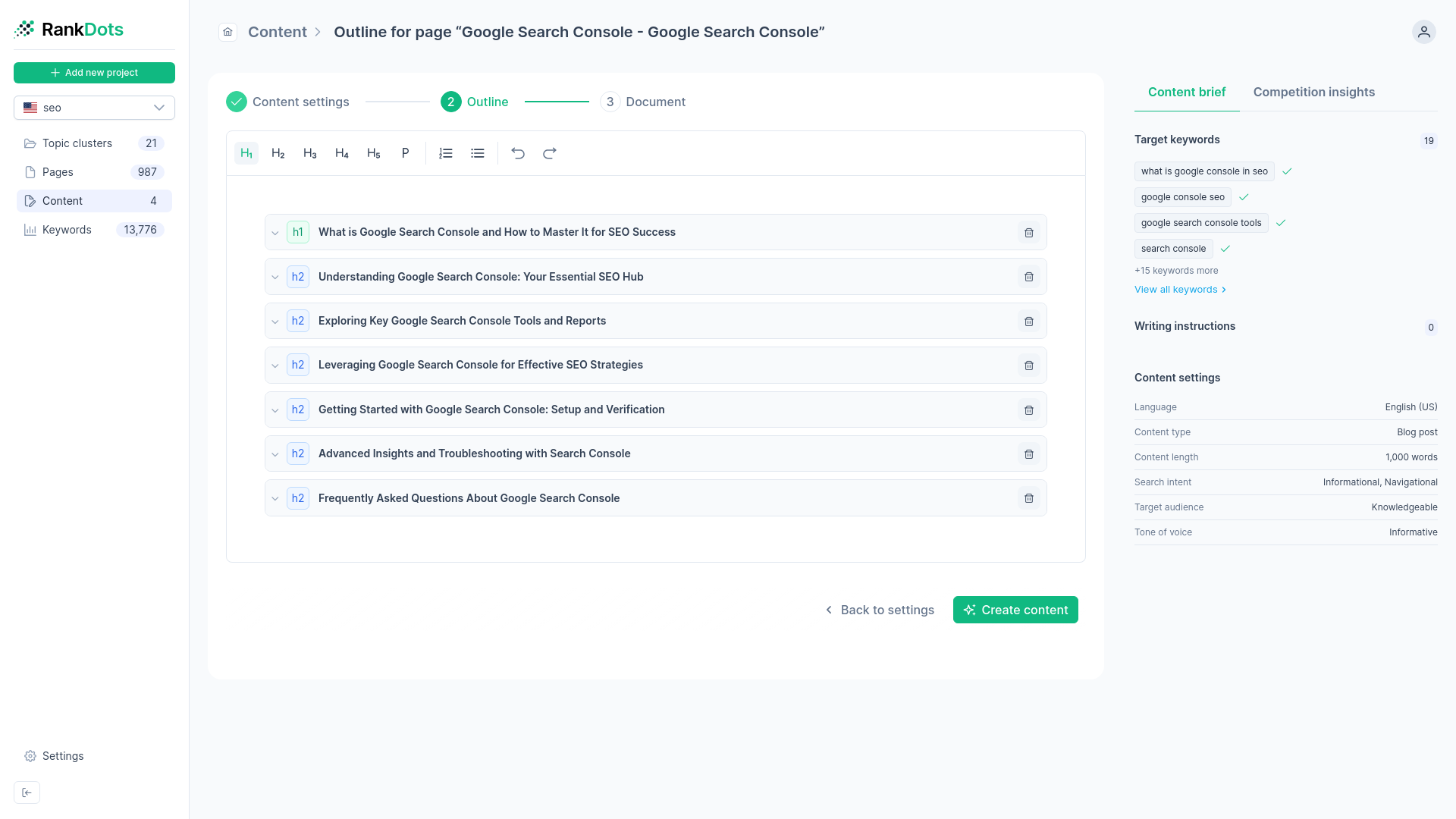
If the cluster demands a listicle, you build a listicle. If it requires a specialized calculator, you build a calculator. Aligning the format to the verified intent removes the friction from content creation. Writers don't have to guess what angle to take. They receive a brief that targets a specific semantic cluster, backed by accurate search volume, mapped to a proven format. That's how you turn raw data into a reliable, high-converting architecture.
Frequently asked questions
What is the difference between a keyword and a search query?
How many keywords should be used in a single article?
Are paid keywords for Google Ads different from organic SEO keywords?
What are LSI keywords and do they still impact SEO?
How do you determine the search intent of a specific keyword?
Can a single keyword have multiple search intents?
Transform flat keyword lists into a structured topical architecture.
Sorting spreadsheets by hand wastes hours. Group your search data into precise keyword categories based on verified intent to prevent cannibalization and capture high-converting traffic.