Keyword Mapping Strategy: Moving Beyond Spreadsheets to Pillar Clusters

Managing raw keyword lists in a flat spreadsheet usually triggers self-competition and wasted budget. A keyword mapping strategy solves this by grouping search terms into a structured hierarchy of parent topics and subtopics. Data suggests this framework prevents keyword cannibalization and ensures every piece of content targets distinct organic demand because you assign each clustered topic to a specific URL based on search intent. Attempting to manage raw keyword variations in a flat spreadsheet creates internal competition and wastes budget. We see teams attempting to categorize massive lists for new product launches, only to watch their spreadsheets degrade in performance near the 10-million cell limit. This manual sorting drains resources, as agencies managing 10 or more accounts waste between 30 and 50 hours each month performing manual keyword research.
This guide covers a complete 5-step framework for building a topic-first site architecture. You'll learn how to transition from chaotic data to a validated structure that definitively stops internal competition.
Quick Takeaways: Keyword Mapping Strategy
- A keyword mapping strategy groups search terms into a structured hierarchy of parent topics and subtopics based on user intent to eliminate self-competition and optimize budget.
- Clean baseline keyword data by stripping away artificially inflated volume metrics to ensure traffic forecasts presented to leadership represent actual search demand.
- Abandon superficial text-matching filters and group terms by semantic intent, ensuring you separate educational guides from transactional queries to build targeted buyer paths.
- Resolve internal debates over content separation by analyzing live search engine results to validate URL intersection and objectively prove where distinct pages are necessary.
- Transform abstract keyword lists into a structured hub-and-spoke site architecture by assigning validated parent topics to pillar pages and linking them to supporting subtopic content.
- Reclaim lost organic traffic by running routine cannibalization audits to identify, merge, and redirect legacy URLs that inadvertently compete for the exact same search intent.
The business case for topic-first architecture
Presenting a quarterly SEO performance review to the executive board requires more than just traffic graphs. You need to prove that the time spent mapping keywords translates directly into bottom-line business value. A topic-first site architecture provides that proof by aligning specific pages with specific buyer intents.
When inbound searchers land on a page that directly answers their exact query without clutter, they convert at significantly higher rates. A strict keyword map ensures high-intent visitors are not distracted by generic top-of-funnel content. You build distinct paths.
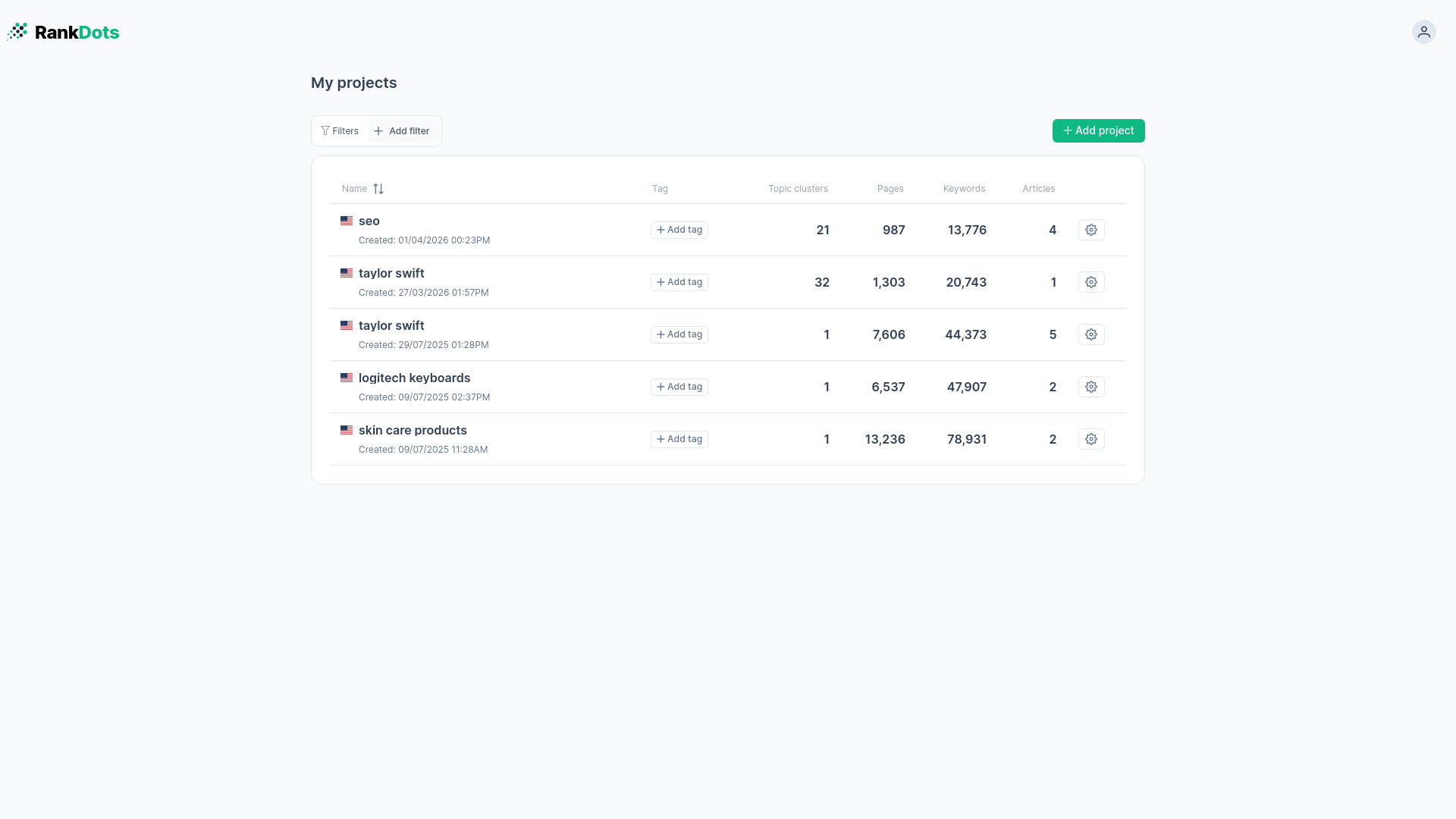
Content produced without this structure often leads to self-cannibalization. Teams waste budget creating multiple articles that inadvertently compete for the same search intent. The search engine then rotates which page it ranks, diluting your authority and frustrating users. You protect your investment when you map clustered intents to dedicated URLs. Every new piece of content serves a unique purpose, scaling revenue efficiently instead of cannibalizing your existing traffic.
How to automate your keyword mapping strategy in 4 steps
-
Import and clean your raw keyword lists
Upload your seed variations via CSV import to consolidate your data. The system automatically deduplicates entries and merges external metrics to create a single, clean baseline list.
-
Group terms into parent and subtopic hierarchies
Run the semantic clustering engine to organize your list based on actual search intent. You'll end up with a structured two-level map of broad pillar topics and specific supporting angles.
-
Verify intent boundaries with live search overlap
Apply URL intersection validation to your new clusters. The algorithm checks live search results to confirm identical URLs rank for multiple terms, definitively splitting any groups where the actual ranking pages diverge.
-
Transition mapped clusters into structured content briefs
Move your validated subtopics into the built-in content wizard. Configure your target settings and approve the generated outline to produce a structured document draft directly from your topic map.
Step 1: Aggregate and filter your baseline keyword data
The foundation of any good map is a clean dataset. We usually start by pulling baseline seed variations from analytics and third-party databases. Google Search Console provides exact ranking positions and real organic clicks for your existing pages. You can then expand that list using tools like Ahrefs or Semrush to find competitor gaps and new topic variations.
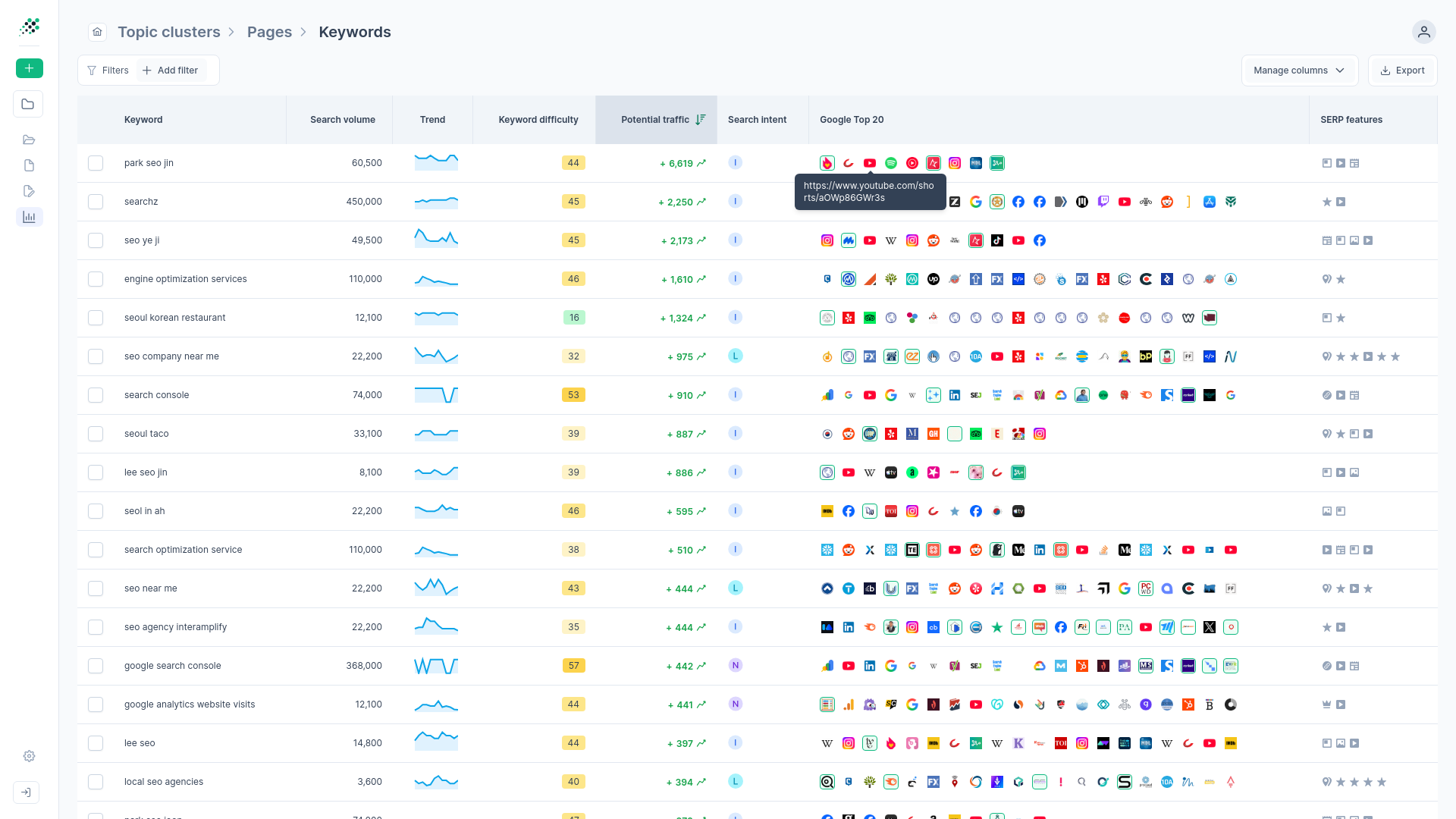
External tools expose clear content gaps where your existing pages fail to capture active search demand.
Be careful with raw volume metrics during this phase. When reviewing exported data to estimate potential traffic for a new campaign, you might notice artificially inflated numbers. Google often lumps similar keywords together in its keyword planner, reporting the total group volume for each individual term. If you take these numbers at face value, you risk presenting wildly inaccurate traffic forecasts to leadership.
We always filter out this search volume overestimation before building the final map.
Clean and deduplicate your raw lists before attempting to map them to your site hierarchy. Remove obvious outliers, filter out irrelevant modifiers, and normalize the data. You want a refined list of actual search demand, not an inflated spreadsheet of redundant variations.
Step 2: Cluster terms by semantic search intent
Manual mapping quickly breaks down when you need to organize hundreds of topics into a cohesive hierarchy. Moving away from a flat blog structure requires grouping terms by their actual meaning rather than just matching text strings.
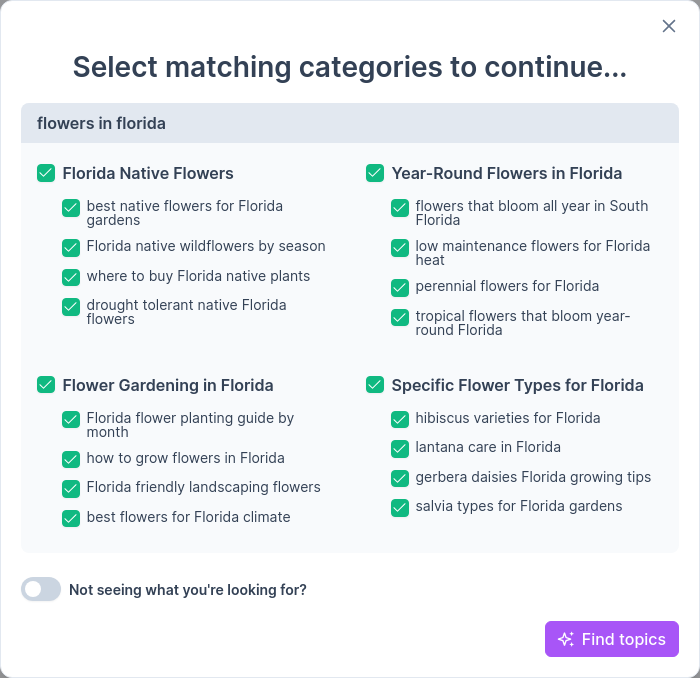
Proper semantic clustering organizes your raw spreadsheet data into a clear hierarchy.
Moving beyond superficial text matching
Most legacy methods rely on spreadsheet filters to group keywords containing the same specific word. That approach rarely works today. People use entirely different vocabulary to ask the exact same question. A platform like RankDots lets you group keywords based on semantic search intent. Semantic intent ensures you cluster phrases like "affordable auto coverage" and "cheap car insurance" together despite them sharing zero overlapping words.
Structuring parent topics and subtopics
Once you identify the semantic relationships, organize them hierarchically. Broad thematic areas become your parent topics, which naturally map to your primary pillar pages or category hubs. The specific angles and long-tail variations within those clusters become your subtopics. You can automatically structure keywords into this two-level pillar-and-cluster hierarchy using RankDots to create a clear blueprint for your architecture.
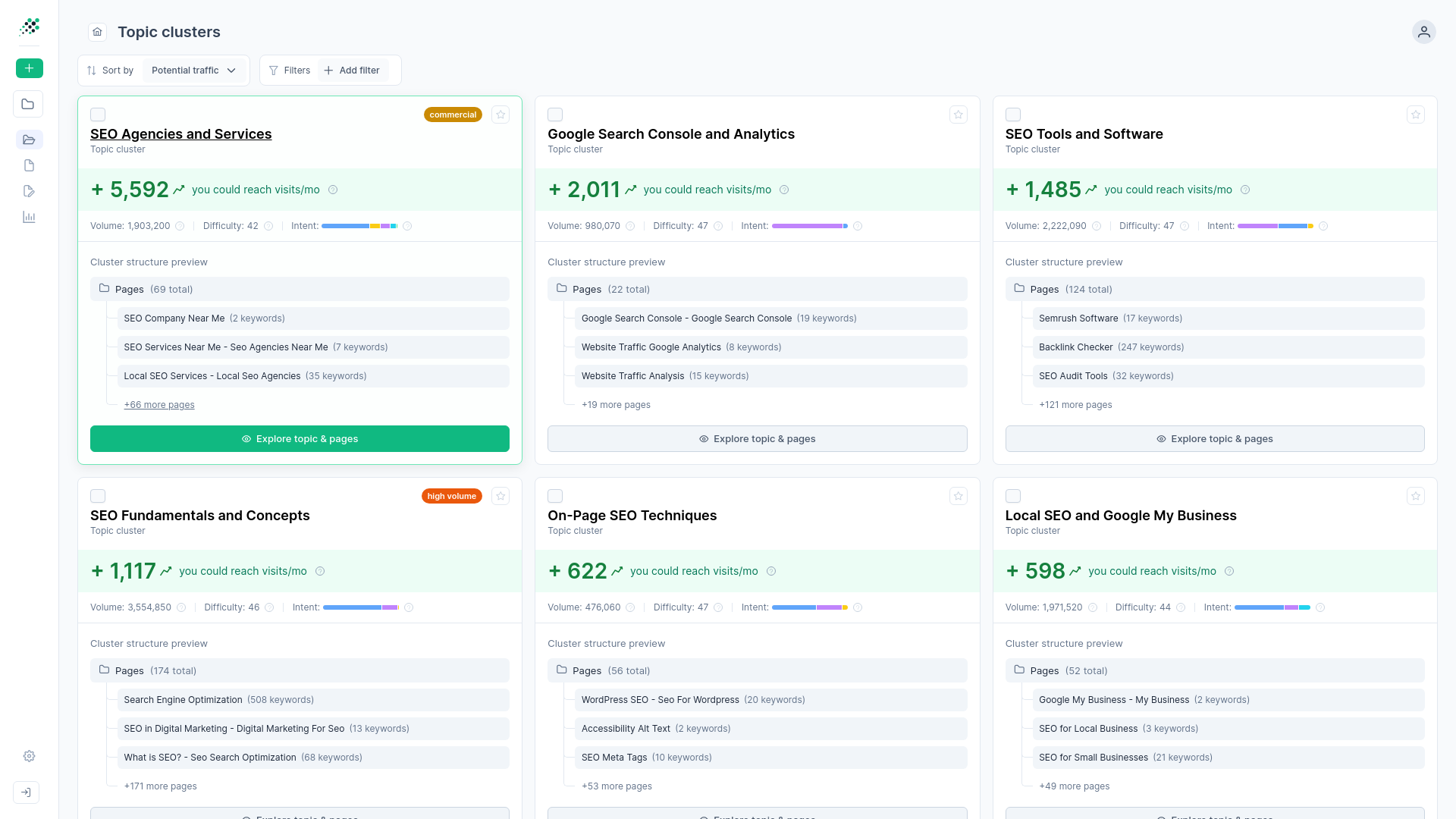
A strict pillar and cluster architecture ensures every supporting article logically connects to its broader parent topic.
Separating informational and commercial intent
Within any newly formed topic cluster, you will find a mix of user goals. Someone searching for "how CRM software works" wants an educational guide, while someone typing "enterprise CRM pricing" is ready to buy. Separate educational queries into one sub-cluster and transactional queries into another to avoid confusing the search engine or the user.
Step 3: Validate groupings using live SERP URL intersection
When your content team debates whether two specific keyword variations need separate blog posts or can be targeted on the same page, guessing is dangerous. Analyze live search results to avoid creating redundant pages or a single page that is far too broad.
The role of live search data
The only objective way to settle intent debates is by looking at what Google currently rewards. We validate groupings using URL intersection validation. This process involves analyzing live search results to confirm if identical URLs rank for multiple keywords in your cluster.
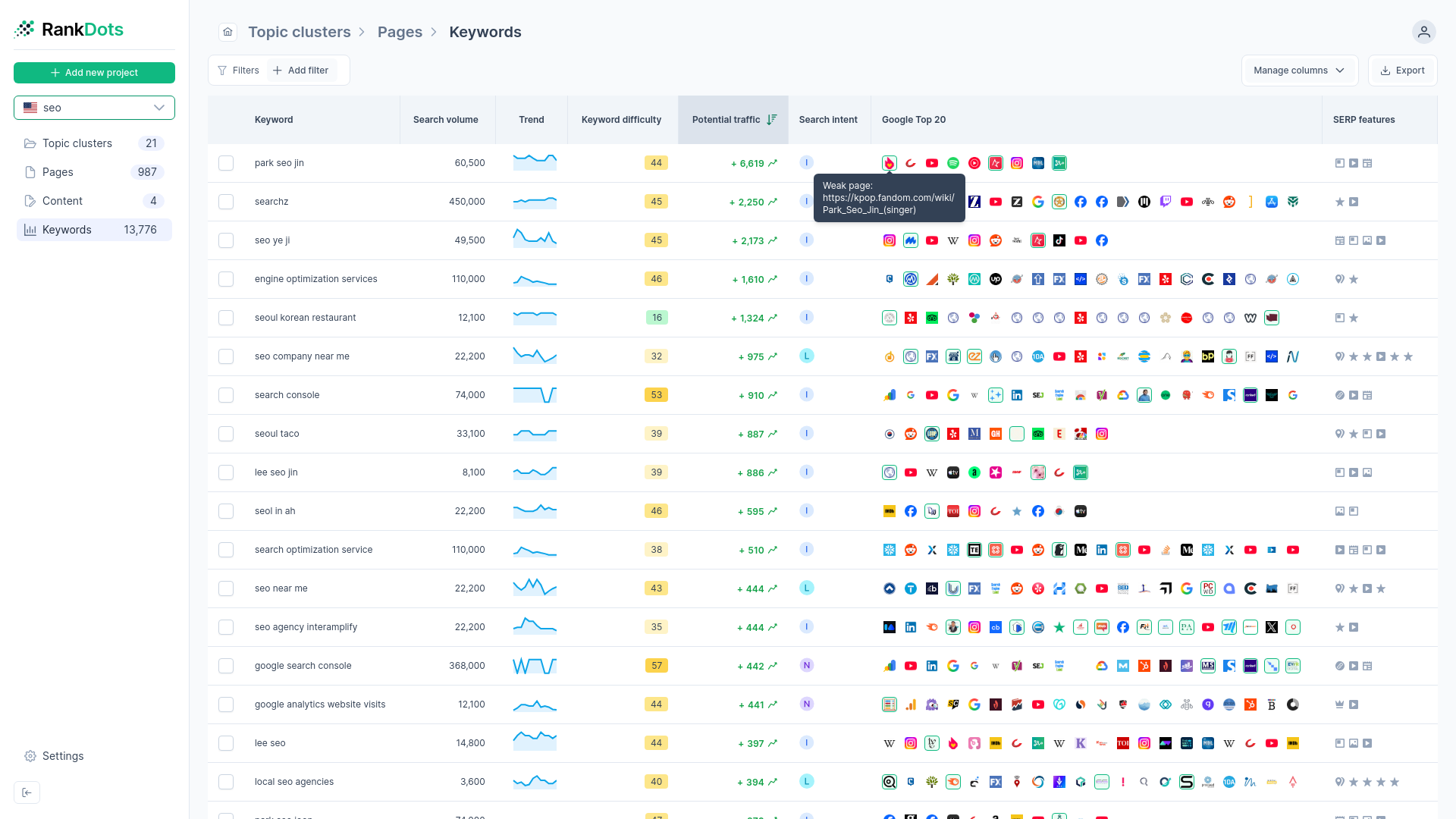
Routine search intent validation prevents you from mistakenly grouping terms that require distinct pages. If the top-ranking pages for "B2B CRM" and "CRM for B2B" are exactly the same, the search engine views them as the same intent.
Direct SERP intersection proves this overlap objectively and provides a definitive answer without internal debate.
Automating the validation process
Manual verification of every keyword pair is tedious and slow. You can handle this automatically through the URL Intersection Validation algorithm in RankDots, which checks the live search results to see if the same URLs rank for multiple keywords within a cluster. If the overlap is high, the cluster stays together.
Splitting clusters based on SERP divergence
When the search engine results show distinctly different URL sets for two terms you thought were related, split the cluster. Reject any manually grouped terms that fail this real-world overlap test. Validating live overlap definitively prevents you from targeting conflicting intents on a single URL.
Step 4: Map your clustered intents to specific page hierarchies
With your clusters validated, you can now assign them to specific locations on your website. Assigning these clusters turns an abstract list of topics into a navigable architecture.
Assigning parent topics to pillar pages
Your broadest validated clusters are the foundation of your site structure. Assign these parent topics to primary pillar pages or core category hubs. For a software company, a parent topic like "Sales Automation" deserves a comprehensive pillar page. This page is the central authority on the subject. It provides a broad overview and captures high-volume, top-of-funnel search demand.
Mapping subtopics to supporting content
The specific angles within your parent clusters belong on dedicated supporting pages. Map these subtopics to individual blog posts, detailed resource pages, or specific product features. "Sales automation email templates" or "how to automate follow-ups" address distinct, narrower intents. Supporting URLs keep your content highly focused and relevant to specific user queries.
Integrating internal linking models
A keyword map is incomplete without defined relationships between pages. Build your internal linking model directly into the structural map. Link supporting subtopic pages back up to their respective parent pillar pages. This hub-and-spoke model distributes page authority effectively and helps search engine crawlers understand the topical hierarchy of your site.
Step 5: Audit for keyword cannibalization and consolidate pages
When you investigate a sudden drop in organic traffic for a core commercial topic, the culprit is often internal. Situations arise where multiple existing blog posts compete for the exact same organic search intent. This keyword cannibalization confuses search algorithms, so they constantly rotate which URL ranks.
To diagnose this, review your organic landing page data. Look for queries where impressions are split across two or more URLs on your domain. If both pages target the identical intent, you need to consolidate them.
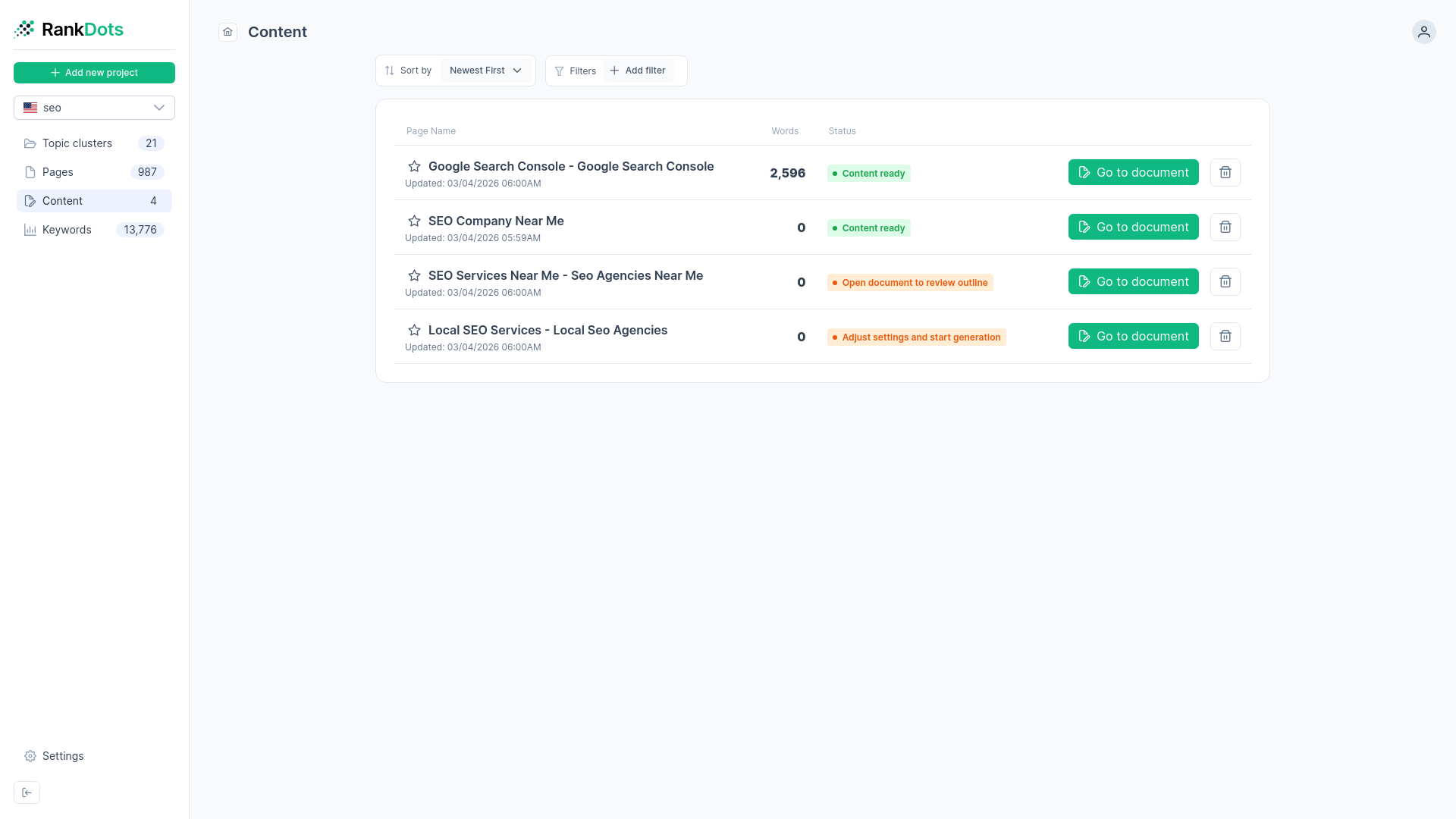
Decide whether to redirect, rewrite, or merge the overlapping legacy URLs. If one page has strong backlinks but poor content, and the other has great content but no authority, combine the best elements into the stronger URL. Then, implement a 301 redirect from the discarded page to the newly consolidated parent URL. Finally, update all internal links that previously pointed to the redirected page to point directly to the new consolidated destination.
Advanced strategies for future-proof site structure
Future-proofing your site requires moving entirely away from flat lists. Dynamic strategies built on Google Sheets eventually bottleneck your entire production pipeline. The goal is to build an automated, clustered intent pipeline that adapts to market changes smoothly.
When new search demand emerges, don't just toss it into a random blog category. Evaluate the new topic against your established pillar-and-cluster framework. If it shares ranking URL overlap with an existing subtopic, update the current page to include the new angle. If it represents a genuinely new intent, slot it into the appropriate parent cluster as a brand new supporting node.
The most efficient teams bridge the gap between structure and execution without friction. Once you have an approved, clustered topic map, move directly into creating an integrated content production brief. A clear map tells your writers exactly what intent to satisfy, which related entities to include, and which internal pages to link to. It completely removes the guesswork from content creation.
Frequently Asked Questions
What is keyword mapping and what is a keyword strategy?
Why is keyword mapping important for SEO?
How do you check competition on a target keyword?
What are common keyword mapping challenges and solutions?
How do you use your keyword map effectively after creating it?
Action plan: Moving beyond spreadsheets
A dynamic pillar-and-cluster structure fundamentally changes how you publish content compared to chaotic, manual lists. Stop guessing what belongs together. Let real data dictate your site architecture.
Prioritize SERP URL intersection over raw volume estimates every time. Headline search volumes can be misleading, but the actual pages a search engine chooses to rank reveal the true underlying intent. Split them apart when the URLs diverge.
Your immediate next step is to analyze your existing baseline inventory. Pick one core product category or blog hub that feels cluttered. Run a cannibalization audit on those specific pages, consolidate the competing URLs, and map the remaining content into clear parent topics and subtopics.
Automate your keyword mapping strategy and scale organic traffic.
Don't let manual spreadsheets slow down your content production. Transition to an automated clustering workflow to group terms by true search intent instantly. You'll save hours of tedious data sorting every month.