Beyond the Spreadsheet: 8 SpyFu Alternative Platforms

SpyFu provides a massive database of competitor keywords, but exporting a giant spreadsheet without a clear execution plan often leads to workflow paralysis. Finding a capable spyfu alternative means looking for platforms that bridge the gap between data gathering and content execution. SEO professionals waste between 15 and 25 hours every week on repetitive manual tasks, such as monitoring search rankings and compiling data into spreadsheets. Marketing analysts also dedicate up to 40% of their work hours solely to data preparation and wrangling. When you export thousands of rows from multiple databases, manual semantic grouping becomes a severe workflow bottleneck.
Modern competitor keyword research shifts away from static lists toward systems that automatically group terms by semantic intent.
A top option should provide more than just raw keyword data; it should offer actionable insights that map directly to your site architecture. Tools like Semrush and Ahrefs excel at comprehensive intelligence, SE Ranking provides budget-friendly rank tracking, while platforms like RankDots move beyond traditional data gathering through AI-driven topic clustering. Below is a complete breakdown of 8 tools evaluated by their data accuracy, execution workflows, and pricing structures.
Quick Takeaways
- A capable spyfu alternative must do more than export raw keyword spreadsheets; it needs to bridge the gap between data gathering and actionable content execution to prevent workflow paralysis.
- Stop relying on generic keyword difficulty scores that treat all websites equally, and instead evaluate competition relative to your domain's specific historical authority to find beatable search results.
- Automate your semantic grouping based on search intent rather than simple word matching to drastically reduce manual sorting time and eliminate internal content cannibalization.
- Expand your visibility strategy beyond traditional search engine results pages to include Answer Engine Optimization, ensuring your brand surfaces in emerging artificial intelligence chat interfaces.
- Audit your software budget by mapping weekly feature usage to avoid paying premium enterprise prices for dormant modules or getting trapped by arbitrary lookup limits on entry-level tiers.
- Consolidate your production pipeline by choosing unified systems that allow you to move directly from keyword discovery to fact-verified content generation without switching between disjointed applications.
Selection criteria for modern SEO workflows
Finding the largest keyword database is secondary to finding a system that groups search terms by intent and maps them directly to your site's ranking capability. To evaluate modern platforms, look past headline features to see how they handle daily pipeline friction.
Moving beyond generic difficulty metrics
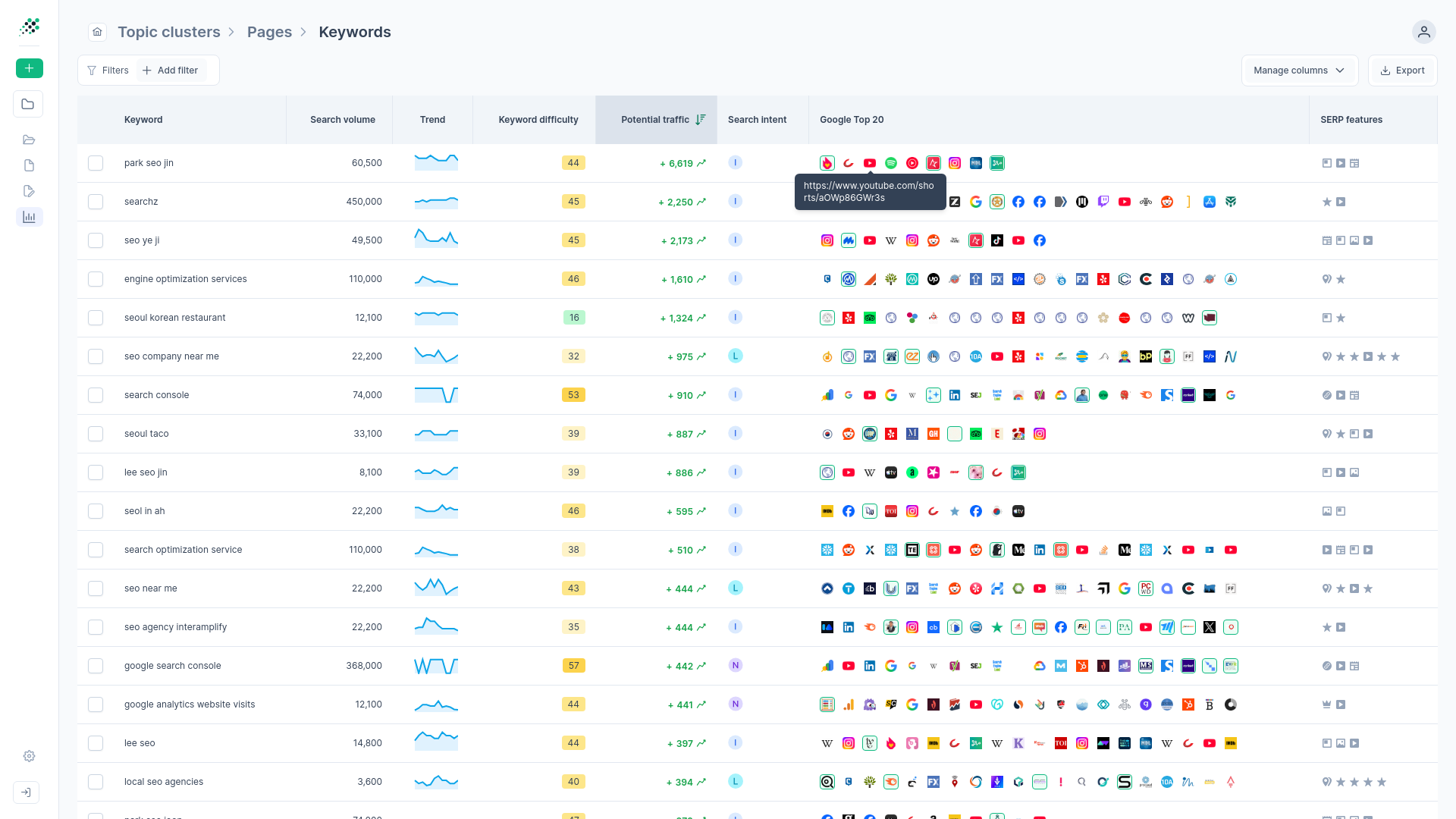
Most software relies on broad difficulty scores that treat every website equally. You might identify a high-volume search term with a supposedly easy baseline metric, yet your specific page refuses to rank. Those generic scores fail to account for a site's particular historical authority, often leading teams to target results permanently dominated by legacy competitors. We usually start by evaluating competition relative to a specific domain's actual backlink profile. With Site-Relative Difficulty in RankDots, you can identify weak spots in the SERP where competitors hold outdated positions your exact website can realistically displace.
Automating semantic clustering workflows
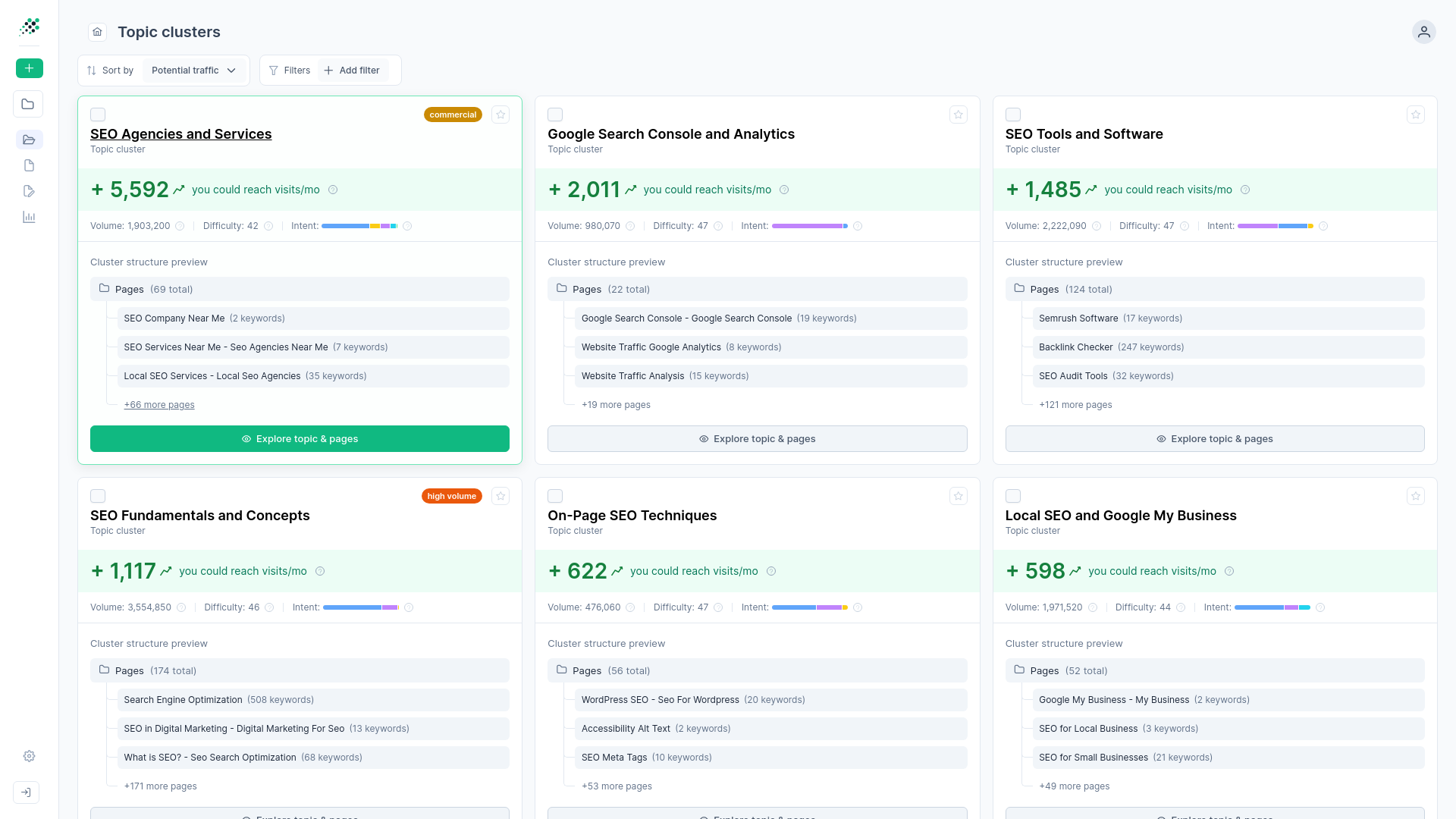
The shift from manual spreadsheet deduplication to automated semantic clustering changes how marketing teams operate. An e-commerce team managing 40,000 product pages switched to an AI-driven intent grouping workflow. That single move reduced a task that previously took two analysts four days of manual spreadsheet work every month down to just three hours of total setup time. Intent-based grouping ensures you target highly related concepts together, rather than relying on simple word matching. This intent-based structure reduces internal cannibalization and eliminates the tedious manual sorting that causes severe workflow bottlenecks.
Balancing cost with enterprise capabilities
Software budgets often reveal a stark divide in the industry.
An accurate SEO pricing comparison depends on identifying which features actually function in the base tiers versus which ones require an expensive add-on. Entry-level tools lack execution depth, while massive enterprise suites start well over a hundred dollars a month, forcing a difficult compromise. Mid-market platforms provide reliable flat-rate access, whereas legacy all-in-one suites frequently implement strict usage caps on lower tiers. To evaluate the cost-to-value ratio, map which features your team uses weekly and avoid platforms that charge a premium for modules that will simply sit dormant in the background.

Feature comparison of leading SpyFu alternative platforms
| Platform | Starting Price | Primary Focus | Top Advantage | Main Limitation |
|---|---|---|---|---|
| SpyFu | $39/month | Competitor history tracking | 13 billion keyword database | Manual spreadsheet workflows |
| RankDots | Contact for pricing | AI-driven content execution | Automated semantic topic clustering | Competitor module in beta |
| Semrush | $139.95/month | All-in-one marketing suite | 27.8 billion keyword database | Hard historical data caps |
| Ahrefs | $29/month | Deep backlink intelligence | 15-minute backlink refresh | Aggressive credit consumption |
| Similarweb | $125/month | Multi-channel market intelligence | Traffic source breakdown | Inaccurate for small domains |
| SE Ranking | $103.20/month | Modular daily tracking | AI-assisted Content Editor | Smaller keyword database |
| Rankfender | $89/month | Answer Engine Optimization | AI brand visibility scanning | Strict prompt tracking limits |
| Serpstat | $59/month | Budget-friendly SEO platform | Daily local rank tracking | Slow interface load times |
| Ubersuggest | $12/month | Cost-effective basic SEO | Real-time SERP extension | No API access |
| SEO PowerSuite | $349/year | Unlimited desktop tracking | TF-IDF semantic analysis | Requires local desktop installation |
Semrush
Enterprise platforms stand out for their sheer volume of available metrics. They act as powerful data silos for teams that require deep market intelligence across multiple channels.
The all-in-one marketing suite
Semrush is a comprehensive digital marketing suite covering SEO, PPC, content marketing, and social media management in one unified platform. Its database contains over 27.8 billion keywords to support global keyword discovery. The platform provides a highly capable Keyword Magic Tool for comprehensive research and detailed search intent filtering to help marketers parse massive lists of opportunities. It also includes a Site Audit tool that crawls pages to find technical errors and metadata issues, along with a Backlink Gap tool to compare competitor link profiles and identify missing referring domains.
Workflow capabilities and learning curve
Users frequently find the extensive number of features and metrics creates a steep learning curve for beginners. When migrating to an expansive suite, users frequently encounter feature bloat and pay for social media trackers or local listing managers they may never actually deploy. We've noticed this pattern across large marketing departments: they purchase the platform for organic tracking but get overwhelmed by the sheer density of the reporting dashboards. This software fits agency professionals and enterprise intelligence teams with the dedicated headcount required to extract value from every available module.
Pricing and historical data caps
Pricing for the platform starts at $139.95 per month for the base Pro plan. The entry tier offers substantial current data access. However, the system restricts historical data and places hard usage caps on lower-tier plans. Teams running extensive weekly site crawls or managing dozens of concurrent client projects often find themselves forced into higher subscription tiers just to bypass these arbitrary lookup limits and maintain their operational momentum.
Ahrefs
Certain platforms differentiate themselves through specialized technical infrastructure rather than trying to cover every conceivable marketing channel.
Deep backlink intelligence
Ahrefs has one of the most active commercial backlink databases in the search industry. The Site Explorer provides deep competitive link profile analysis and domain metrics. The system refreshes its backlink index every 15 minutes to offer near real-time visibility into new referring domains and lost citations. This 15-minute update cadence fits technical SEOs and dedicated link builders who need to monitor digital PR campaigns and outreach efforts as they happen.
Keyword research across engines
Beyond off-page metrics, the platform provides a versatile Keywords Explorer for researching global search queries across multiple distinct search engines, including YouTube and Amazon. This expanded scope helps digital teams looking to optimize their video content or e-commerce listings outside of standard Google search results. The software also includes a dedicated Site Audit tool designed to identify technical issues and track overall website health over time. This setup ensures foundational structural elements remain intact as the site grows.
Credit consumption and pricing
The platform's billing structure requires users to consume credits for daily usage, which can quickly deplete for heavy data queries. Every report you open, filter you apply, or fresh data pull you request subtracts from the monthly allowance. Pricing starts at $29 per month for the highly restricted Starter plan, or $129 per month for the standard Lite tier. It doesn't offer a free trial. You need a paid subscription just to test its core suite. For large teams running constant SERP analyses, the credit limits frequently create operational friction.
Similarweb
To understand a rival's complete digital footprint, you have to look beyond organic search performance to see their entire acquisition strategy across the web.
Multi-channel market intelligence
Similarweb delivers multi-channel market intelligence aggregated from diverse global internet panels. It estimates total website visits, user engagement metrics, and geographic traffic distribution for competitor domains. The system analyzes traffic sources to break down user acquisition by direct, organic, paid, and referral channels. When tasked with evaluating a rival's commercial strategy, knowing exactly which channels drive their conversions prevents marketing teams from wasting budget on poorly converting informational terms.
Limitations for smaller domains
The platform produces less accurate traffic estimates for smaller or niche websites with under 500,000 monthly visits. Because the data methodology relies heavily on panel tracking and statistical sampling, lower-traffic domains often show incomplete or highly volatile reporting metrics. The software also lacks classic SEO features like backlink auditing or granular keyword rank tracking. It is primarily a macro-level competitive analysis tool rather than a microscopic page optimization utility.
Enterprise intelligence applications
Pricing starts at $125 per month when billed annually, or $199 per month on a standard month-to-month basis. It provides an extensive API for programmatic access to traffic metrics, so large organizations can feed behavioral data into custom internal dashboards. This solution fits market researchers, competitive intelligence analysts, and enterprise marketing directors who need broad strategic overviews of industry trends rather than specific on-page content recommendations.
SE Ranking
You look at the spreadsheet of software budgets and realize you're trapped between two extremes. The entry-level tools barely scratch the surface, while the enterprise suites demand hundreds of dollars a month for features your team never opens. The middle ground is where SE Ranking positions itself. It combines a flexible, modular platform with generous daily tracking limits at a budget-friendly entry price.
Modular architecture and tracking limits
The platform tracks keyword positions daily across both global and local search regions. Pricing starts at $103.20 per month when billed annually. Instead of forcing you into a single monolithic package, the modular structure lets you adjust how often data refreshes. You pay for the frequency you need. The trade-off is navigation. Users report the interface becomes confusing when switching between different modules, which breaks the flow of a fast-paced work session.
Content execution and auditing capabilities
Beyond position tracking, the system includes a Website Audit feature to scan for technical issues and on-page optimization errors. It also provides an AI-assisted Content Editor to help generate and optimize copy against target keywords. These execution features are helpful, but they operate in separate silos. For a zero-manual-step pipeline that moves from research straight to a fact-verified first draft, an integrated platform like RankDots usually fits better.
Database trade-offs and the ideal user
The main compromise here is sheer scale. Data suggests the platform maintains a smaller keyword and backlink database compared to premium enterprise alternatives. If you need historical link data spanning a decade, this isn't the tool. Looking across the market, we'd lean toward this setup for agencies and mid-market teams that need to optimize their software budgets without entirely sacrificing daily position tracking.
Rankfender
Search behavior is fracturing rapidly. People ask ChatGPT and Claude for recommendations instead of scrolling through ten blue links. Rankfender focuses specifically on Answer Engine Optimization (AEO) and lets you scan for brand visibility within these large language models. Instead of just tracking standard Google SERPs, the AI system monitors how often your brand surfaces when users prompt conversational interfaces.
Ecosystem integrations and content pipelines
The platform connects with major CMS environments and includes active integrations for Shopify, Wix, and WordPress. It also includes an AI Content Engine built on an eight-stage pipeline. The goal is to generate and format information exactly how LLMs prefer to ingest and cite it. This pushes past standard keyword insertion.
Usage constraints and entry costs
The pricing structure starts at $89 per month for the Essential plan. The catch lies in the tracking volume. The entry plans impose strict limitations on tracked prompts and enforce limited reporting frequency. You cannot run continuous, real-time pulse checks without upgrading to a much higher tier. Our take: this platform makes the most sense for brands that already dominate traditional search and want to optimize strictly for AI chat interfaces.
Serpstat
Tasked with evaluating a competitor's commercial strategy, you need to know exactly what they pay for a click. Third-party approximations often lead to wasting your marketing budget on low-converting informational terms. Serpstat provides specific keyword research metrics, including search volume, difficulty scores, and cost-per-click data. It tracks daily keyword rankings across local and global search regions to monitor how those commercial terms fluctuate over time.
API access for programmatic teams
The platform's standout advantage is its data accessibility. It provides extensive flat-rate API access without the per-seat charges that typically inflate agency plans. For technical marketers and programmatic SEO builders who prefer to pull raw data into their own custom dashboards rather than working inside a third-party interface, this structure is highly attractive. Pricing starts at $59 per month for the base Individual plan.
Performance friction and database size
The trade-offs here are speed and scale. Data suggests the system maintains a significantly smaller backlink and keyword index compared to leading enterprise suites. It includes a Site Audit tool to discover broken links, missing metadata, and indexing issues, but users report the platform suffers from slow interface load times and slow reporting generation. The tool works. The interface lags. If your team relies on rapid ad-hoc query adjustments during live meetings, the loading delays become a noticeable bottleneck.
Ubersuggest
Most keyword platforms require you to leave the search engine to do your research. Ubersuggest flips that workflow by relying heavily on its Chrome extension for real-time SERP insights. You get search volume, cost-per-click data, and basic competition metrics alongside Google search results. The platform also handles standard keyword research, rank tracking, and site auditing for on-page SEO errors.
The lifetime payment model
The pricing structure is the defining characteristic here. The tool offers a cost-effective one-time lifetime payment option, which completely avoids the recurring monthly fees that drain freelance budgets. You can subscribe for $12 per month or pay a $120 one-time fee. For solo consultants or beginner-level marketers operating with almost zero overhead, that single payment structure is the main draw.
Scaling limitations for advanced users
You get exactly what you pay for. The platform enforces strict daily search and lookup limits, which caps how much research you can do in a single session. It also lacks an API or any modern AI workflow integrations. If you want to feed data into a programmatic pipeline or use AI to cluster topics automatically, you hit a wall immediately. This is strictly for freelancers and beginners who just need surface-level metrics without the enterprise price tag.
SEO PowerSuite
Almost the entire search software market has moved to the cloud, but SEO PowerSuite is a downloadable suite of four desktop applications. It bypasses ongoing monthly subscriptions in favor of an annual license. The platform includes advanced on-page features like TF-IDF analysis for semantic optimization to help you understand which related terms top-ranking pages use to build topical relevance.
Uncapped tracking constraints
Cloud platforms charge you for server processing, which is why they cap how many keywords you can track. Because this software uses your local computer's IP and processing power to scrape search engines, it offers unlimited keyword and project tracking. For individual consultants managing large client portfolios with thousands of target terms, removing those arbitrary tracking limits changes the profitability of a project.
Local installation and reporting limits
The desktop requirement is a double-edged sword. You must have a dedicated local machine running the software to execute scheduled tasks. Pricing reportedly starts at $349 per year for the Professional plan, alongside a limited free version. Keep in mind that the base paid tier lacks white-label reporting capabilities. If you need to send branded PDF updates to clients automatically, you have to upgrade to the highest tier. The pattern is clear: it serves individual technical consultants perfectly, but fails distributed teams who need instant cloud-based collaboration.
Frequently asked questions
What features should I look for in a SpyFu alternative?
Why are businesses looking for SpyFu competitors?
Is there a tool that automates semantic topic clustering?
How much do premium competitor analysis tools cost?
Final verdict on upgrading your SEO toolkit
Your choice of spyfu alternative usually comes down to deciding whether you need a deep data repository or a streamlined execution pipeline.
Many legacy competitor tracking tools stop at the data dump stage and leave teams to build the strategy manually. If your primary goal is monitoring global macro trends, an enterprise database makes sense. But for most in-house teams, it's better to prioritize actionable insights over inflated metric volumes. A vast database offers very little value if the generic difficulty scores treat every domain identically. Finding your competitive edge requires evaluating search results relative to your specific site's backlink profile. This reveals realistic weak spots you can actually displace.
The real bottleneck often hits right after the research phase. You finally isolate a strong semantic topic cluster. You're ready to brief your writers and start drafting. Suddenly you find yourself exporting a spreadsheet, loading it into a separate brief generator, and fighting with an AI tool that confidently fabricates industry statistics. That fragmented toolchain disrupts your momentum.
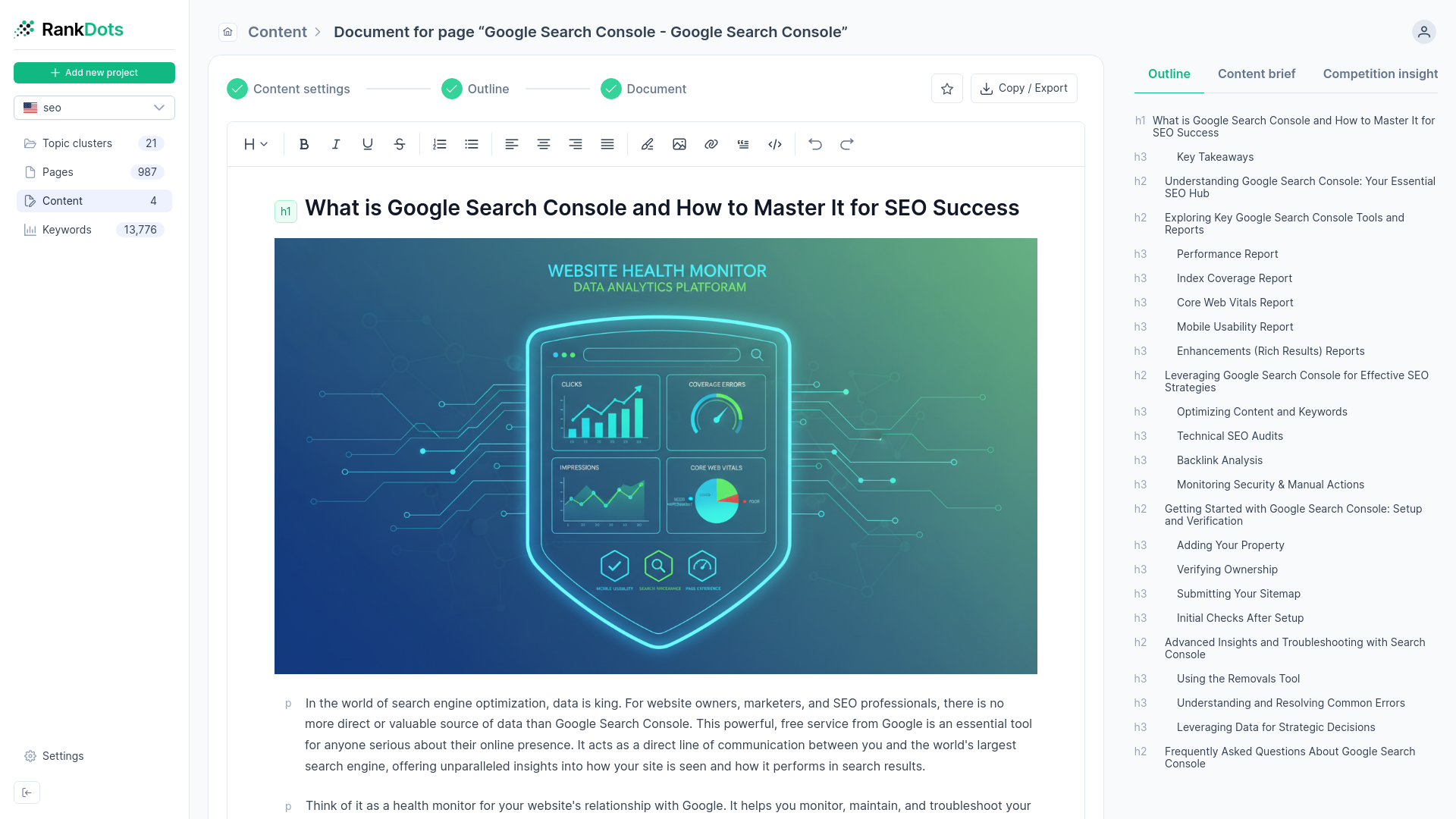
Consolidating the pipeline is generally recommended. Moving directly from data to deliverable changes the entire production rhythm. Platforms like RankDots keep the workflow unified so you can move from keyword discovery to fact-verified content generation without ever switching tabs. Stop paying for raw data dumps. Invest in the workflow that actually helps you hit publish.
Stop sorting spreadsheets and start publishing high-ranking content.
A reliable SpyFu alternative should eliminate manual keyword grouping. Automated intent clustering lets you skip tedious manual analysis and move straight into production. Don't pay for disjointed data exports when you can consolidate your entire content pipeline today.