Real Estate SEO: A Hyper-Local Strategy for Independent Agents

Real estate businesses face an uphill battle online, often watching massive property portals dominate their local neighborhood search results. By building a targeted real estate SEO strategy around hyper-local neighborhood keywords, you can attract high-intent property buyers and sellers without relying on expensive, shared leads from mega-portals.
Between 93% and 97% of home buyers start their search for property information online. Yet, when reviewing their monthly marketing budgets, many independent agents realize they are spending thousands on leads that are cold, unready, or being fiercely worked by three other local competitors simultaneously. The resentment of watching aggregators eat into your commission is real. But there is a better way.
This guide details a complete six-part framework for building a hyper-local search strategy that drives exclusive buyer and seller leads.
Quick Takeaways
- Real estate SEO is the strategic process of optimizing your digital presence to capture high-intent property buyers and sellers through hyper-local search visibility, bypassing the trap of expensive shared leads.
- Stop wasting budget competing for broad city-level search terms; shifting your focus to street-level neighborhood dynamics allows you to outmaneuver massive national property portals.
- Discover how to identify exact search phrases that trigger local commercial intent and pinpoint specific weaknesses in search results where independent agents can easily rank.
- Transform your map pack visibility by optimizing your local profile and coaching clients to leave highly specific, localized reviews that act as powerful semantic sales copy.
- Learn how to organize your website using a topic-first architecture, building comprehensive neighborhood hubs that smoothly transition readers from casual research to actively browsing your property listings.
- Uncover the critical technical fixes required to stop generic property feeds from creating massive duplicate content issues that actively throttle your organic search traffic.
What is real estate SEO and why it matters
The trap of the mega-portal lead cycle
The standard playbook for finding clients usually involves buying visibility. There are over 360,000 real estate brokerages in the US, and most of them are fighting over the exact same purchased contacts.
Market data tracks this heavy saturation and shows exactly why competing for shared portal leads is a significant drain on resources. The average cost per lead on aggregator platforms typically runs between $20 and $60 in standard markets, while highly competitive metropolitan areas often see lead costs between $139 and $223. You pay that premium just for the chance to pitch an unvetted contact alongside three other agents.
In contrast, organic search leads close at a rate of around 14.6%, compared to a dismal 1.7% for outbound efforts. Earning your own traffic builds a permanent asset; renting it simply drains your operating margins.
Why broad city-level terms are a dead end
Ambitious agents write comprehensive guides about buying a home in their major metropolitan city, only to see them generate zero traffic weeks later. They lack the technical context to realize they are competing directly against national websites like Zillow and Redfin that hold massive domain authority.
Those platforms dominate broad terms because they offer total price displays, portable application profiles, and automated algorithmic valuations. Trying to outrank them for a generic term like "Chicago homes for sale" is a guaranteed path to frustration. You can't beat a multi-billion dollar engineering team at their own broad-market game.
The hyper-local advantage
The pivot that works focuses on hyper-local visibility. Major portals are built to categorize data at the city and zip code level, but they lack the nuance to speak to street-level neighborhood dynamics. When you shift your target from broad geography to hyper-local authority, you bypass the aggregators entirely. You become the definitive answer for specific condo buildings, school district boundaries, and hyper-specific property constraints that generic valuation algorithms can't capture.
Keyword research and search intent for real estate
Identifying buyer intent in local searches
What does a user typing "best neighborhoods for young families" want? Probably an informational guide covering school ratings, crime statistics, and park access. Someone typing "3 bedroom homes near Oak Creek Elementary" has a highly specific commercial intent. When we miss that distinction, pages sometimes rank but fail to convert.
The gap between ranking and closing a deal is almost always an intent-mapping failure, not a content quality issue. You have to identify exactly what local buyers are typing when looking for niche properties, without guessing based on your own internal MLS jargon.
Proper real estate keyword research removes the guesswork entirely and shows you the exact phrases that trigger local commercial intent.
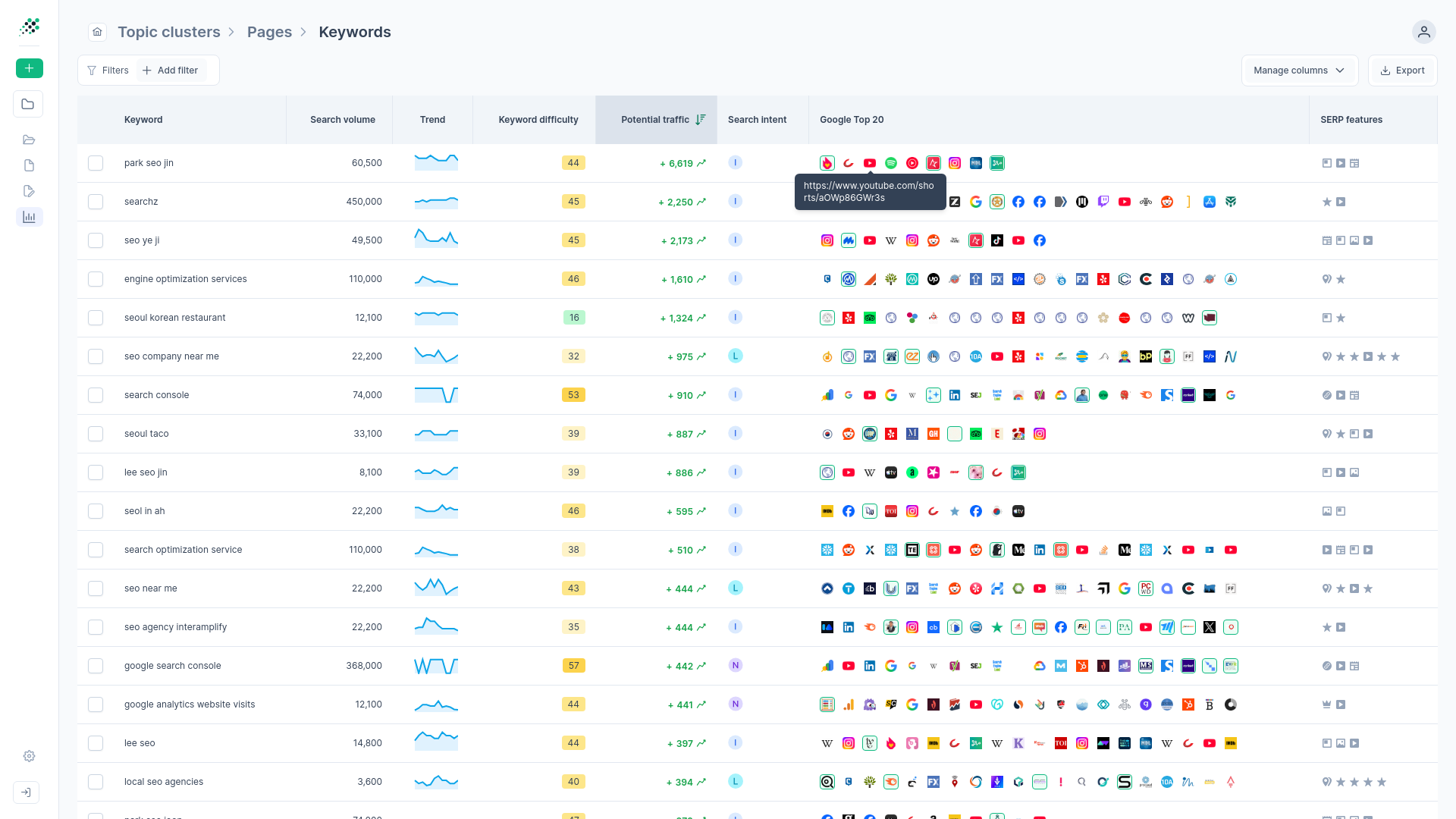
We rely on tools that categorize this automatically. RankDots, for example, filters search intent into five distinct types, including a dedicated "Local" intent. That filter instantly separates the broad informational researchers from the high-intent buyers physically looking to tour a property in your farm area.
Finding the easy-to-rank spots
You can't brute-force your way past national portals, so you have to find the gaps they miss. Stop chasing raw search volume and look for weaknesses in the search engine results pages (SERPs) instead.
We'd lean toward ignoring any keyword where the entire first page is dominated by national banks, Zillow, and government census data. Instead, you want to identify specific keywords where you can realistically displace competitors through content quality alone.
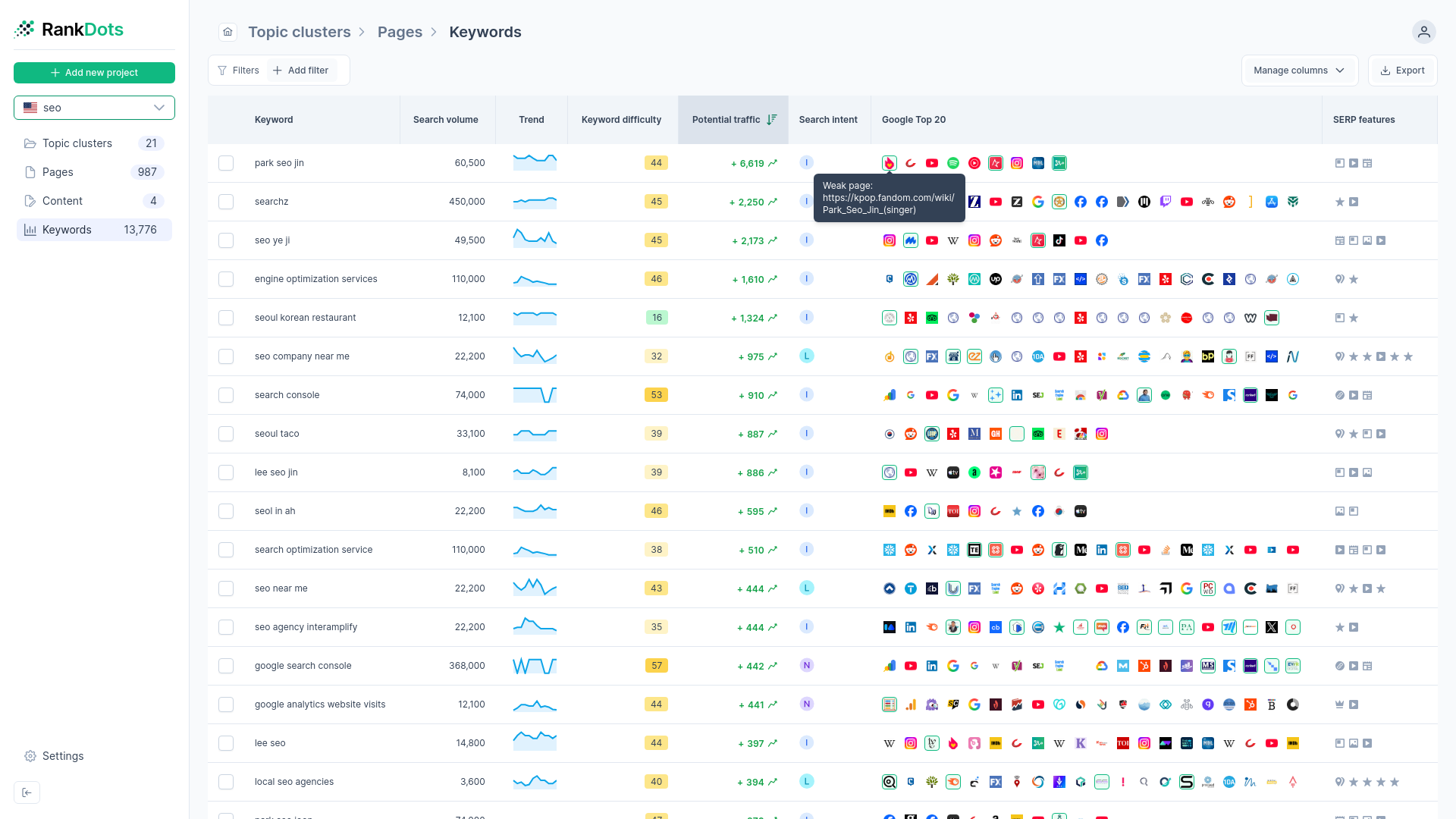
The Easy-to-Rank Spots metric inside RankDots handles this mechanically. It analyzes the live top 20 Google results and counts how many positions are currently held by domains weaker than yours. The metric highlights the hyper-local terms major portals ignore and gives you a clear roadmap of winnable battles. If a small lifestyle blog or an outdated local directory is ranking in position four, that is your target.
Mapping features to specific constraints
Once you find those winnable keywords, map your property features directly to buyer constraints. If a search term focuses on "condos with EV charging in downtown," your page needs to address that specific constraint immediately.
Do not pad the page with generic neighborhood history. Address the exact limitation the buyer is trying to solve. Detail the specific buildings that offer deeded parking with charging stations, the average HOA fees covering that electricity, and the availability of street-level charging nearby.
This semantic alignment is exactly why a highly targeted local page from a small brokerage routinely outranks a generic listing page from a massive aggregator. You're answering the unstated question behind the query, while the portal is just serving a grid of unrelated properties.
Local SEO and Google Business Profiles
Winning the map pack
Traditional organic results only tell part of the story. The Google Local 3-Pack is the great equalizer. It's the one place where semantic local relevance bypasses the domain authority of national portals. The 3-Pack captures roughly 44% of clicks during local searches, significantly outpacing traditional organic results which receive only about 29%. Getting into that top three is a mandatory step for any independent agency trying to win a specific zip code.
A dedicated strategy for local SEO for realtors bypasses national portals and puts your business directly in front of buyers standing in your target market.
Your Google Business Profile is the foundational platform for this visibility. It dictates your appearance in maps, controls your operating hours, and is the primary trust signal for local buyers.
Follow this checklist to optimize the core elements of your profile:
- Verify your exact business name without adding spammy keyword modifiers (do not name your business "John Smith Real Estate Agent Miami").
- Select the most precise primary category available, such as "Real Estate Agency" or "Real Estate Consultant", rather than just "Business".
- Fill out all operational hours, ensuring you include holiday exceptions and weekend availability.
- Upload high-quality exterior and interior photos of your office, plus localized photos of the neighborhoods you serve.
- List your exact farm areas in the service area settings, capping it at a realistic drive time.
Managing localized client reviews
A beautifully optimized profile remains invisible without a sustained stream of reviews. Imagine receiving an inbound phone call from a pre-approved buyer who found your profile on the first page of Google, read three detailed reviews about your local negotiation skills, and decided you were the only agent they wanted to work with. That happens when your reviews become localized sales copy.
Prompt your clients to include the neighborhood name and property type in their feedback. A review stating "Helped us navigate a multiple-offer situation on a 4-bedroom house in Oakwood" provides massive semantic value to search algorithms. A generic "Great agent!" review does almost nothing to help you rank for local terms.
Retaining map pack traffic
Once users click from the map pack to your website, the technical performance of your site determines if they stay. The standard page load speed benchmark is 2 seconds or under. Slowing load times from 1 to 3 seconds increases the bounce rate by 32%, and a delay from 2 to 5 seconds can cause bounce rates to spike up to 38%.
Page speed is particularly critical for real estate websites, where property listing pages already see an average bounce rate of 42% to 55%. If your map pack listing links to a heavy, bloated IDX feed that takes six seconds to load, you're wasting the local visibility you just earned.
The role of secondary directories
Search algorithms don't trust the information you provide in a vacuum. They cross-reference your profile against secondary directories across the web. If your Name, Address, and Phone number (NAP) data is inconsistent across minor business listings, the algorithm loses confidence in your location data and drops you from the map pack. Ensure your exact details match perfectly on every platform, from the local chamber of commerce to industry-specific directories like Realtor.com and local brokerage aggregators.
Topic clustering for neighborhood pages
Moving from keywords to a topic-first architecture
Looking at a massive spreadsheet of 300 property-related search phrases is overwhelming. Agents often freeze at this stage, completely unsure which phrases deserve their own standalone pages and which should just be bullet points in a weekly blog post.
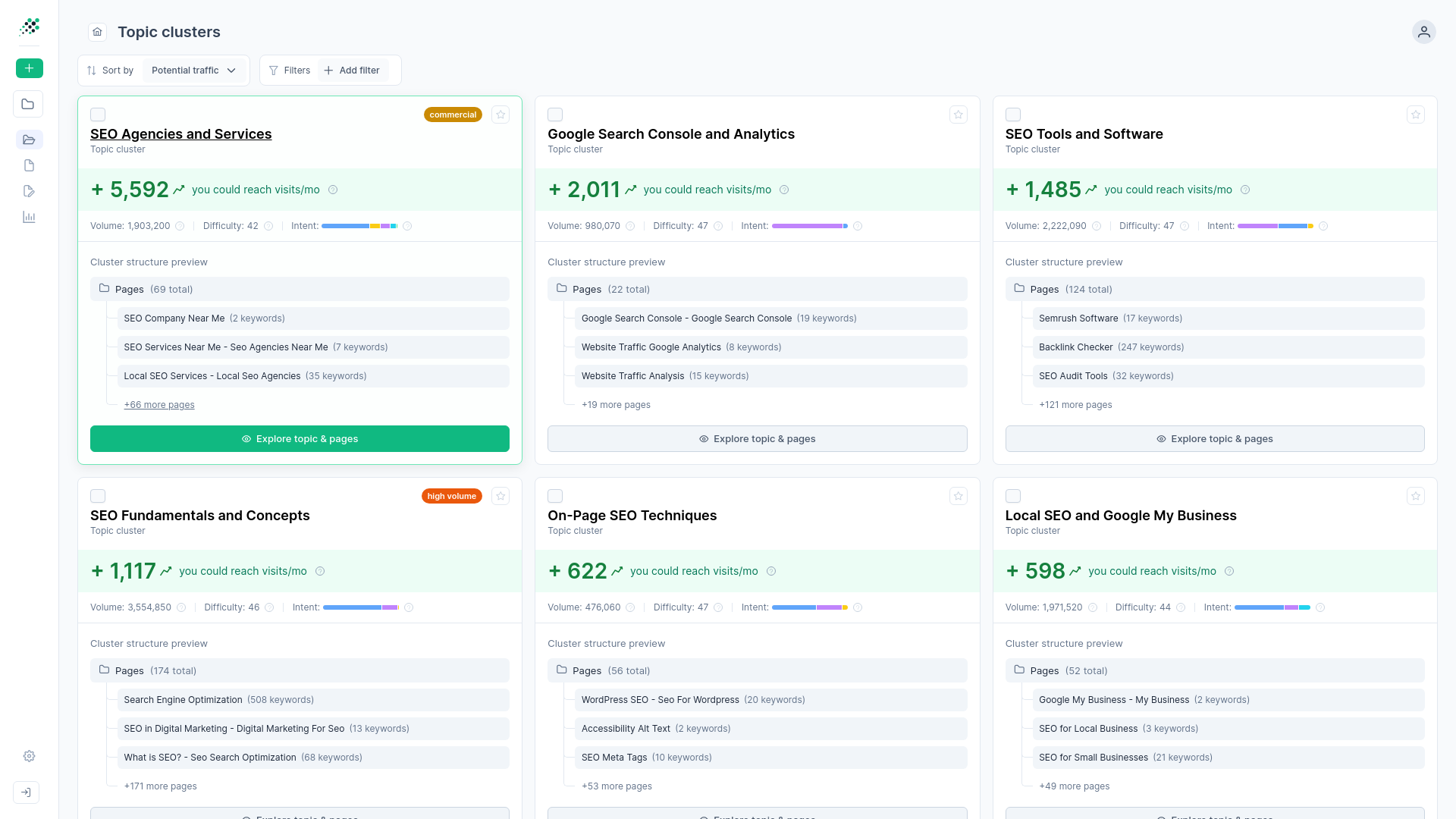
Traditional SEO tools group terms superficially based on shared words, which creates disjointed site structures. The modern solution is a Topic-First Architecture. RankDots uses AI-powered semantic grouping to build hierarchical clusters and replace the old one-keyword-per-page approach. It knows that "affordable starter homes" and "cheap entry-level houses" belong in the same cluster despite sharing zero words.
For real estate, this means automatically building parent pillars for broad themes (like a main city guide) and mapping specific subtopics (like property taxes or school districts) to supporting pages.
This approach to real estate topic clustering ensures search engines view your site as a complete library of local knowledge rather than a random collection of disjointed blog posts. This workflow replaces manual spreadsheet anxiety with a ready-to-build, structured taxonomy.
Structuring guides around buyer reality
When agents sit down to draft a neighborhood guide, they often instinctively write it like a property listing. They focus heavily on their own recent sales history, block out a few paragraphs about how "charming" the area is, and drop in a generic IDX widget.
That instinct creates a page that looks exactly like a generic Redfin listing and fails to capture the lived reality of the neighborhood.
Actual buyers looking for neighborhood information want details on school district boundaries, typical commute times, and local amenities. They're trying to figure out what living there actually feels like on a Tuesday morning. A parent neighborhood page should be a comprehensive hub.
The foundation of neighborhood page SEO is treating this hub as a master directory that answers broad questions before funneling users to specific subtopics. It provides an overview of the area and then links out to dedicated subtopic guides.
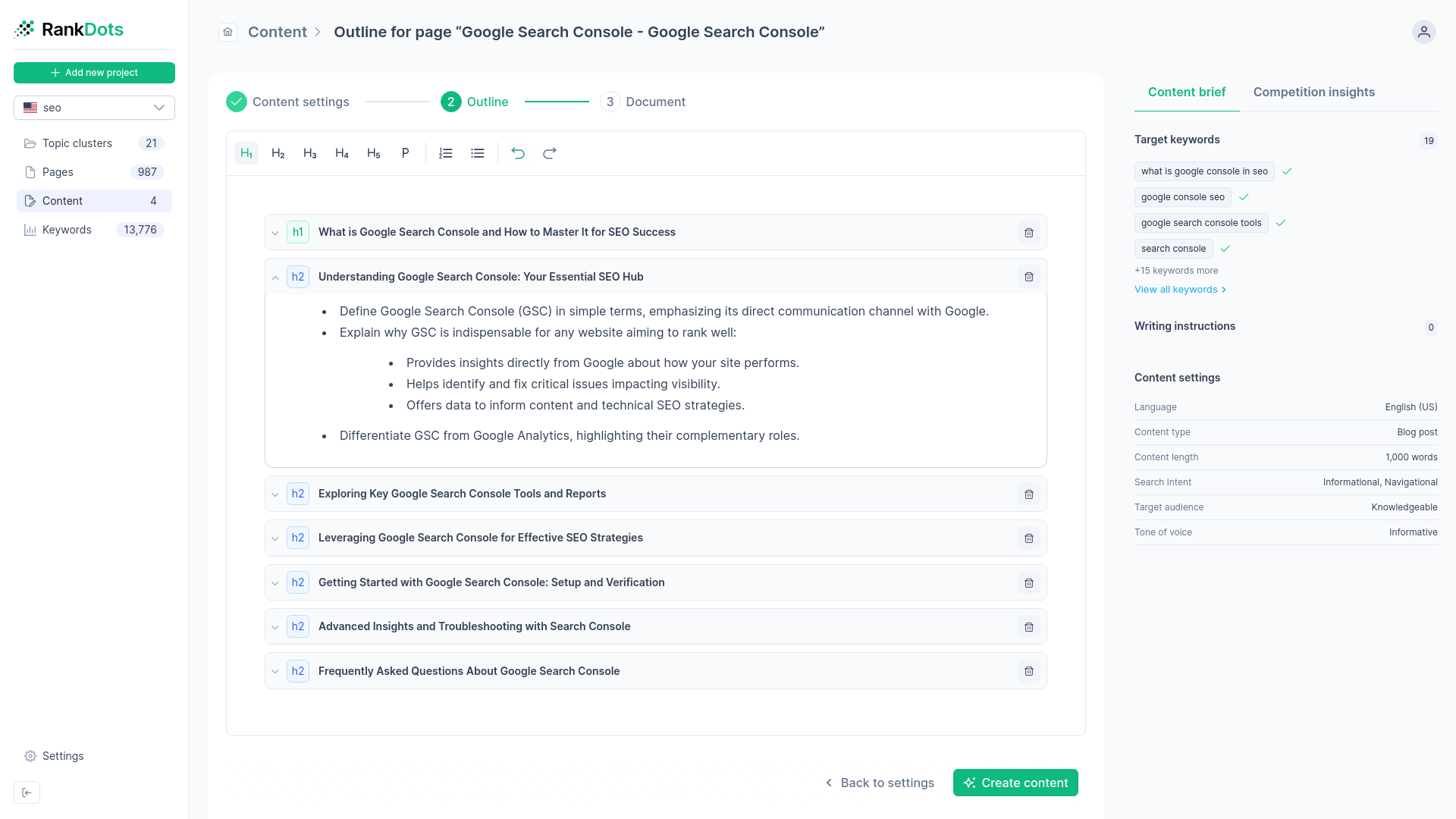
If a buyer wants to know about the local elementary school, they click through to that specific deep-dive. You serve the informational intent perfectly without cluttering the main page with unrelated, highly specific details that most readers will just scroll past.
Internal linking between listings and guides
Your informational guides must connect directly to your active commercial inventory. When someone finishes reading about the best parks and commute times in a specific zip code, the logical next step is viewing properties near those exact amenities.
Build internal links that connect your educational subtopic pages to your active property listings, and vice versa. If you have a listing in a specific subdivision, link that listing description back to your deep-dive guide on that subdivision's HOA rules and community pool.
This interconnected structure keeps users on your site longer and signals undeniable topical authority to search engines. It smoothly transitions readers from casually researching an area to actively shopping for a home, entirely within your owned digital ecosystem.
Technical and on-page optimization
Real estate websites are inherently heavy. They pull in massive databases of property listings and rely entirely on high-resolution photography. If you ignore how your website's technical foundation handles that load, search algorithms will time out before ever indexing your content.
Taming the IDX duplicate content problem
Every agent in your market pulls from the exact same MLS feed. That means hundreds of local websites display the exact same property descriptions, photos, and formatting. Search algorithms hate duplicate content. When they see identical pages across fifty different domains, they usually default to ranking the largest national portals and ignore the rest. We've seen this exact technical issue throttle organic traffic on beautiful, expensive custom agency websites.
You have to actively manage what the search engine is allowed to read using canonical tags and index controls. A canonical tag tells the crawler which version of a page is the master copy. For standard MLS listings that you don't exclusively own, it's often better to apply a "noindex" tag to the individual property pages. That tag instructs the crawler to skip the thousands of generic listing pages that eat up your crawl budget. Instead, it forces the algorithm to focus entirely on indexing your unique, hyper-local neighborhood guides and your exclusive listings.
Managing load speed on image-heavy listings
Buyers demand massive, high-definition photos of kitchens and backyards. Browsers struggle to load them. When your property pages load slowly, your Core Web Vitals scores collapse. These vitals are specific metrics Google uses to measure how fast a page becomes visible and interactive. A slow site frustrates users, drives up your bounce rate, and directly damages your local map pack retention.
Look inside Google Search Console. The platform provides a dedicated report showing exactly which URLs fail the speed threshold. Fixing this usually requires implementing lazy loading, where images only render as the user scrolls down the page, and compressing large media files to modern web formats before they hit your server.
Translating your business for search engines with schema
Search algorithms process text; they don't possess inherent local context. They don't automatically know that the text string in your website footer represents a physical brokerage open for business. You have to translate that geographic reality into machine-readable code using schema markup.
You can explicitly define your business entities to search engines using hidden code called schema markup. Adding "LocalBusiness" and "RealEstateAgent" schema maps your exact geographic coordinates, operating hours, and founder details in a structured format the algorithm digests instantly. The schema directly feeds the geographic relevance required to rank in local searches. It removes all ambiguity about where you operate and what services you provide.
Link building and off-page SEO
Most link building advice sounds like a digital grift. Ignore the cold-email outreach templates entirely. For an independent agent, building off-page authority is just digital community networking. You want links from organizations that actually exist in your specific zip code to signal to search engines that you're an embedded local entity.
Earning links through community sponsorships
You likely already sponsor local events. Youth sports teams, charity 5Ks, and neighborhood block parties are standard real estate marketing expenses. The mistake is treating them purely as offline brand awareness.
If you donate to a local high school athletic program, you get eyes in the bleachers. If you ensure that sponsorship includes a hyperlink from the school's official website back to your neighborhood guide, you get permanent digital authority. Those highly localized, community-based domains carry strong trust because national aggregators can't easily acquire them.
Whenever you write a check for a local sponsorship, follow this workflow:
- Ask if the organization has a sponsor or partner page on their website.
- Provide them with your exact logo and the specific URL you want them to link to (prefer your local neighborhood guide over your homepage).
- Follow up a week later to verify the link is live and clicking through correctly.
Turning MLS data into digital PR
Major property portals publish national housing trends. They can't tell a local journalist why inventory in a specific three-block subdivision just dried up overnight. You have the raw data and the on-the-ground context to answer that question.
Run a simple quarterly analysis on your farm area. Package the findings into a short, localized market report that highlights shifts in days on market or seller concessions. Pitch that report directly to local business reporters and regional newsletter writers. They constantly need fresh, localized stories. When they use your insights, they'll link back to your website as the primary data source.
Pitching regional lifestyle publications
Look beyond purely real estate-focused websites. Every major city has regional lifestyle magazines, community forums, and blogs dedicated to new residents. Reach out to the editors of these publications and offer to write a highly specific guest column.
Skip the generic guide on securing a mortgage. Pitch a detailed breakdown of how recent zoning changes affect property taxes in a historic district. Earning links from these locally relevant publications proves to search algorithms that you're a deeply knowledgeable authority in that specific geographic boundary.
Frequently asked questions
How long does real estate SEO take to generate leads?
Is SEO a better investment than paying for leads on real estate portals?
Can small independent real estate agencies rank on Google against mega-portals like Zillow?
Do real estate agents need blogs to succeed in SEO?
What specific types of keywords should real estate professionals focus on?
Conclusion and next steps
The math behind buying shared aggregator leads doesn't hold up long-term. When you pay for positioning on a mega-portal, your pipeline vanishes the second your credit card declines. Earning your own local search traffic requires upfront effort, but it builds a permanent, owned asset. An optimized local strategy attracts exclusive, high-intent buyers who already trust your localized expertise before they ever fill out a contact form.
Start with a single neighborhood cluster
Do not try to optimize your entire website in one weekend. We've watched agents attempt to build forty neighborhood pages at once and produce thin, useless content that ranks nowhere.
Consider picking a single, highly specific subdivision or zip code where you already do business. Write the definitive parent guide for that area. Build out three to four supporting subtopic pages that cover the local school boundaries, the commute realities, and the property tax nuances. Link them all together into a cohesive cluster. Prove you can rank in one neighborhood before expanding to the next.
From planning to execution
Strategy without implementation is just theory. Local search results are the one arena where an independent agent can still consistently outmaneuver a massive national platform. You just have to know exactly where to apply pressure.
Map out your first topic cluster today. Identify the easy-to-rank local terms where major portals show weakness. Fix your schema markup, clean up your map pack profile, and publish your first hyper-local guide. Stop renting your visibility and start owning your local market.
Stop buying shared leads and start earning exclusive buyers
Real estate SEO builds a permanent digital asset that attracts high-intent clients directly to your brokerage. Map your exact market coordinates and find the winnable neighborhood search terms mega-portals ignore. Outline your first neighborhood guide today to start capturing these unserved local searchers.