12 Best AI Tools for Content Creation to Build a Topic Strategy

The world doesn't need "more content"—it needs better content, produced faster, without sacrificing strategy or sounding like a robot. When evaluating AI tools for content creation, the best options go beyond basic chat interfaces. A strategic stack bridges keyword research, semantic clustering, and multimodal generation to build topical authority.
Teams are often under pressure to scale output and match competitor velocity. But trying to hit those benchmarks by jumping between a dozen disconnected text, video, and audio generators usually backfires. Nearly 82% of employees waste critical time acting as manual intermediaries between disjointed AI systems. About a quarter of workers lose seven or more hours per week just copying, pasting, and feeding context into fragmented workflows.
We need tools that solve this fragmentation, not add to it. Below is a comprehensive breakdown of 12 proven platforms across text, visual, and audio generation, plus the step-by-step workflow to connect them.
Quick Takeaways
- The most effective AI tools for content creation are unified platforms that bridge semantic research and multimodal generation, allowing teams to scale production and build topical authority without relying on fragmented workflows.
- Transition your strategy from isolated keyword lists to intent-based topic clusters to prevent self-cannibalization and significantly boost your organic traffic retention.
- Reverse-engineer live search engine results before generating a brief to ensure your output matches the exact content structures and topical depth that algorithms currently reward.
- Establish strict tone, brand voice, and audience expertise guardrails upfront to prevent generation engines from defaulting to generic, robotic text.
- Treat the generated structural outline as your final point of strategic control, manually verifying hierarchy and keyword distribution before initiating the full drafting process.
- Implement an end-to-end publishing pipeline that exports approved drafts directly to your CMS, eliminating the hours lost to manual copy-pasting and formatting errors.
Building an AI-driven content strategy
The fastest way to fail with generative tools is to feed them a scattered list of keywords and hope a coherent website emerges. Strategy has to happen before generation. We usually see teams stall out when they stare at an enormous, unorganized spreadsheet of search terms downloaded from a legacy tool. Sorting that data by shared words takes days of manual effort and almost always leads to cannibalizing your own rankings.
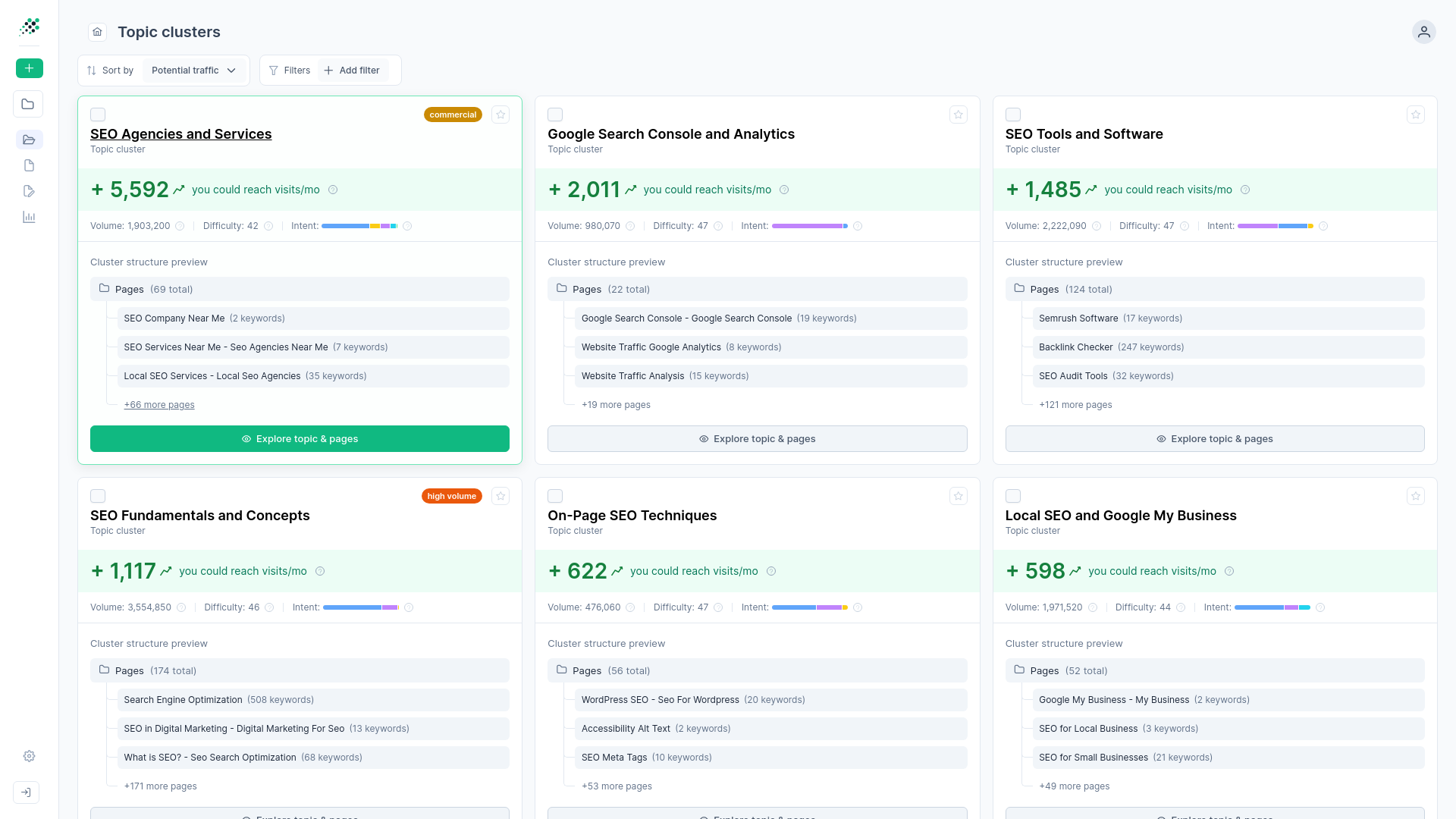
Moving from keywords to topic clusters
The fundamental shift in modern SEO is moving from a keyword-first approach to a topic-first architecture. Build hierarchical topic clusters rather than starting with a massive list of isolated phrases and trying to map them to individual blog posts. Grouping content into semantic topic clusters yields roughly 30% more organic traffic than publishing isolated articles. These clustered pages maintain their rankings 2.5 times longer.
Traditional tools group terms based on exact-match words. A semantic approach groups them by user intent. Searchers typing "affordable auto insurance" and "cheap car coverage" want the exact same thing, even though the queries share zero words. Websites using a structured topic cluster architecture experience an average 43% increase in organic traffic compared to sites without one.
Reverse-engineering the SERP
Search volume tells you how many people are looking. It tells you nothing about what they actually want to read.
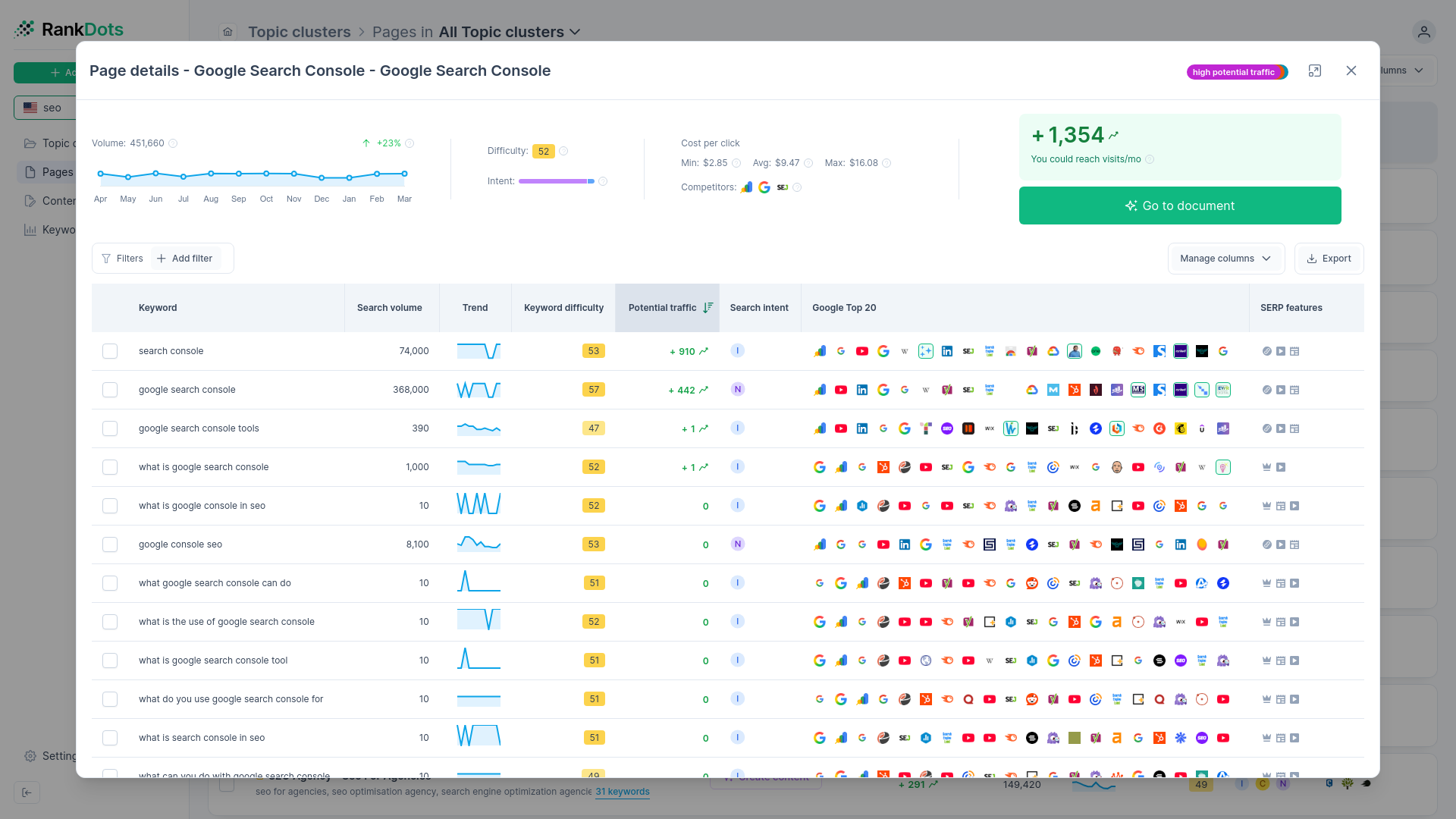
Before generating a brief, analyze the live ranking patterns for your target cluster. We rely on RankDots because it reverse-engineers Google's algorithms to show exactly what is being rewarded. Review page types, content structures, topical depth, and required word counts to identify the structural gaps in your calendar. If the top results are all comparison tables and your tool generates a 2,000-word narrative essay, you won't rank.
Mapping the content calendar
Once intent and structure are clear, map those disjointed terms into a cohesive calendar. Parent topics become your broad pillar pages. Specific subtopics become your supporting blog posts. A platform with a continuous keyword pipeline will update these clusters based on emerging search trends, preventing keyword exhaustion and keeping the strategy anchored in search behavior.
Step-by-step AI content creation workflows
Most teams drop the ball when transitioning from planning to execution. Copy-pasting text from a chat interface into a document editor, reformatting the outline, and manually uploading to a CMS breaks focus and introduces formatting errors. A connected pipeline changes the math.
Defining tone and audience parameters
Generic text happens when tools lack boundaries. Before drafting the first heading, define the guardrails.
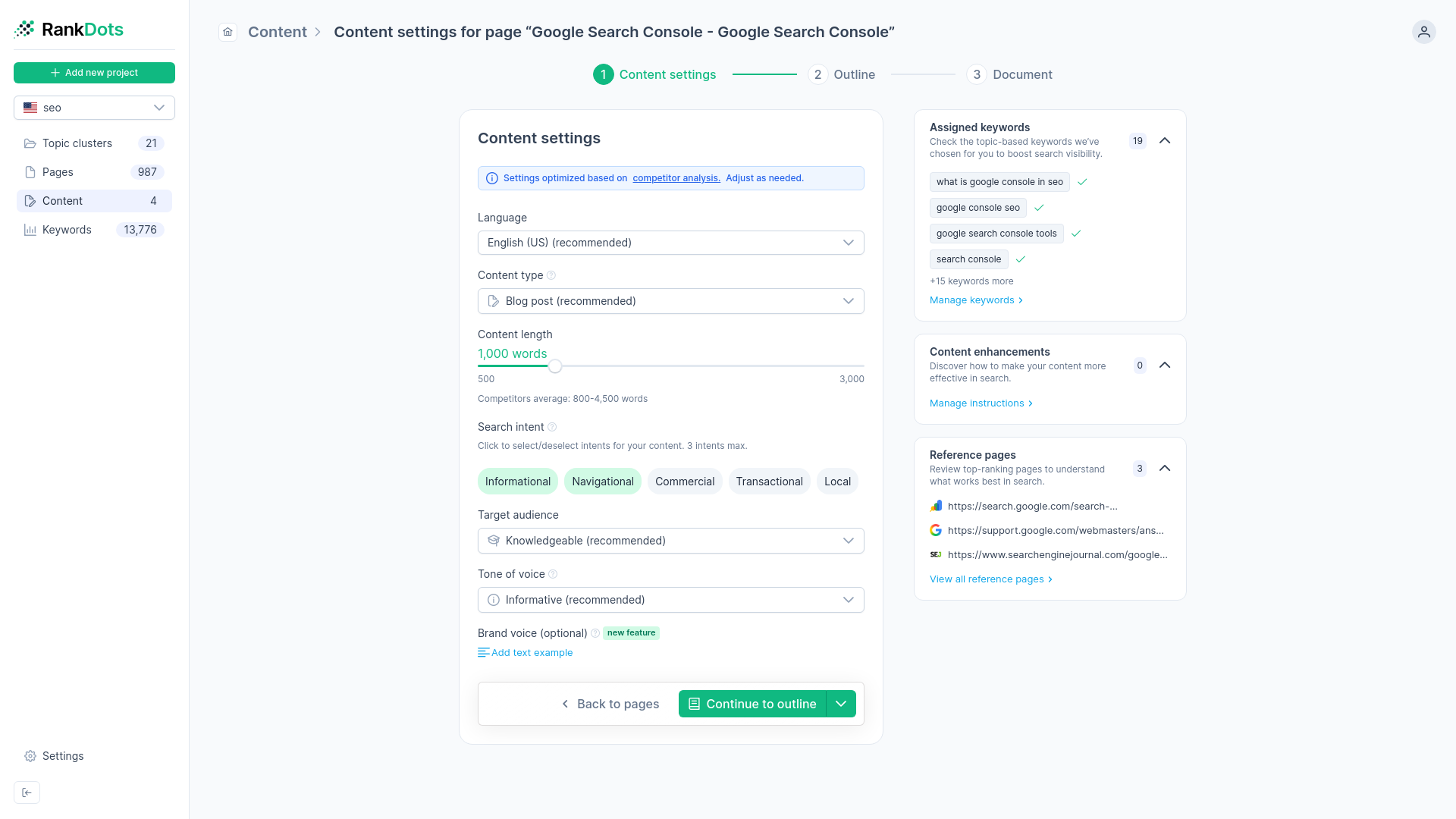
The 3-Step Content Wizard in RankDots forces you to set these parameters upfront. You define the primary topic, select target keywords, and adjust selectors for tone and audience expertise level. The platform can even detect your specific brand voice from existing pages and adapt its output to match. These early constraints prevent the AI from defaulting to its standard, overly enthusiastic robotic tone.
Reviewing structured outlines
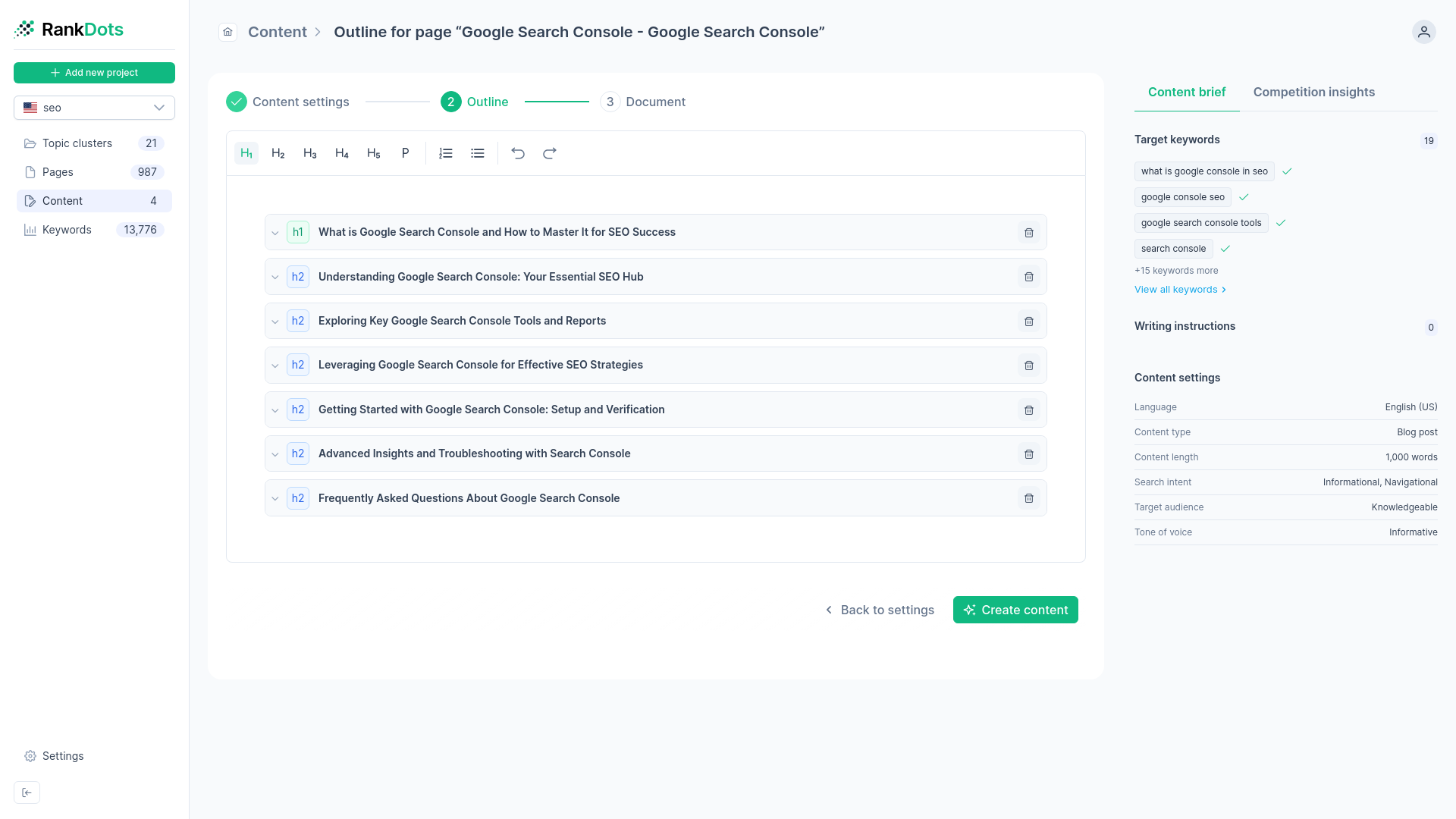
Never let a model write a full draft blind. The outline is your last point of strategic control.
- Generate a structured HTML outline based on your initial parameters.
- Verify that top keywords by search volume are distributed naturally across subheadings.
- Adjust the hierarchy, add specific internal links, and remove any fluff sections the tool inferred.
This brief review step ensures the architecture is sound. RankDots purposefully pauses at its topic management dashboard, prompting you to review the brief before the heavy generation begins. You can edit this structure or export it as a standalone deliverable if you prefer using human writers for certain pieces.
The pipeline to publication
Once the outline is approved, initiate the full draft generation. Because the parameters and structure were locked in advance, the resulting document requires far less line-editing.
The final bottleneck is usually distribution. Direct exports to Google Docs allow for quick team collaboration and compliance reviews. From there, publish straight to WordPress or your chosen CMS to bypass the final copy-paste hurdle. You end up with clean markup, optimized headings, and zero manual data entry.
AI Tools for Content Creation Feature Comparison
| Platform | Key Capability | Notable Constraint | Starting Paid Tier |
|---|---|---|---|
| RankDots | SERP reverse-engineering and topic clustering | N/A | Contact for pricing |
| ChatGPT | Multimodal processing and web browsing | Occasional hallucinations | $20/month (Plus) |
| Claude | 1 million token context window | Strict usage limits | $20/month (Pro) |
| Jasper | Jasper IQ brand governance | Enterprise-focused complexity | $59/month (Pro) |
| Copy.ai | GTM workflow automation | Lacks native multimodal generation | $49/month (Pro) |
| Midjourney | High-resolution image generation | Discord-based interface | $10/month (Basic) |
| Adobe Firefly | Generative Fill in Adobe Photoshop | Video generation outputs are duration-limited | Included with Creative Cloud |
| Canva | Magic Studio AI tools | Limited advanced vector editing | $15/month (Pro) |
| Runway | Gen-4 video and Act-Two motion capture | No native audio generation | $12/month (Paid) |
| Synthesia | AI avatar video generation | Strict minute limitations | $18/month (Paid) |
| HeyGen | Video translation with lip-sync | Credit-based consumption model | $29/month (Creator) |
| Descript | Text-based video and audio editing | Cloud processing dependency | $16/month (Paid) |
| ElevenLabs | Instant and Professional Voice Cloning | Requires high-quality source audio | $6/month (Starter) |
ChatGPT
Most teams start their generative journey here, and for good reason. ChatGPT offers a highly versatile conversational interface with advanced reasoning capabilities and deep multimodal integration.
General-purpose power
The platform's ability to process text, analyze uploaded datasets, and browse the web for deep research makes it a powerful generalist tool. You can feed it a 50-page PDF report and ask it to extract specific statistics, or have it generate python scripts to clean your raw data.
However, this broad utility comes with structural trade-offs. Because it's an open-ended conversational agent, it lacks a dedicated marketing pipeline. You have to build and enforce your own workflows, prompt chains, and brand voice guidelines every single time you log in.
Pricing and constraints
Occasional hallucinations remain a factor, requiring tight editorial oversight on factual claims. The platform enforces usage caps on its most advanced reasoning models, which can bottleneck production during heavy editorial sprints. A free tier is available, while the Plus plan starts at $20/month, with expanded Pro and Business options for heavier enterprise use. We'd lean toward this for ideation and general research, but it requires significant manual wrangling to operate as a scaled production engine.
Claude
If your strategy involves digesting massive amounts of proprietary data before writing, Claude is where you should spend your time. It differentiates itself through an exceptionally large context window and advanced reasoning capabilities.
The context advantage
The defining feature is the 1-million token context window. You can upload entire brand guideline manuals, years of historical blog posts, and multiple competitor transcripts in a single prompt. The platform excels at complex document parsing and maintaining consistent logic across massive inputs. When we need a model to perfectly mimic a highly specific, nuanced brand voice based on dozens of source examples, this is typically the most reliable engine.
Fidelity over volume
It handles complex multimodal input processing cleanly, though it doesn't natively generate images or audio like some competitors. The trade-off for this high-fidelity output is access. Strict usage limits apply even on paid tiers, meaning you can't rely on it for thoughtless, high-volume batch generation.
A free tier is available, with the Pro plan starting at $20/month. The tool is best deployed as a senior strategic assistant for your most complex, high-stakes written assets rather than a bulk content spinner.
Jasper
Picture reviewing a batch of drafts generated by a basic AI writing assistant. The text reads as entirely robotic and generic, failing to capture your company's distinct tone. The heavy manual rewriting required essentially negates any time saved, creating frustration when tools that promise efficiency just end up damaging brand credibility. Jasper solves this specific enterprise bottleneck by operating as a tightly controlled production engine.
Enterprise production pipelines
The platform operates as a comprehensive marketing operating system rather than a simple, isolated chat box. End-to-end content pipelines connect entire campaigns, linking long-form blog posts directly to the required email sequences and social media updates. The standout capability here is the Jasper IQ brand governance feature, which enforces strict voice controls across every generated asset. It analyzes your corporate style guides, competitor positioning, and product documentation, ensuring the output sounds like it belongs to your organization before a single draft is finalized.
Governance and pricing
That level of precise control comes with a distinct trade-off. We typically see casual users struggle with the enterprise-focused complexity. The interface assumes you are running multi-channel campaigns with numerous stakeholders and strict compliance needs. Pricing excludes casual users entirely, reflecting this heavy corporate focus. Following a 7-day free trial, the Pro plan starts at $59/month billed annually, and custom Business tiers scale up quickly to match organizational requirements. We recommend this strictly for enterprise teams needing brand governance.
Copy.ai
Sales and go-to-market teams operate with an entirely different set of requirements than editorial publishers. Copy.ai leans heavily into that distinction, focusing deeply on automation capabilities for specialized GTM workflows. While it struggles to produce sprawling, long-form narratives or comprehensive educational hubs, it excels at scaling out repetitive, conversion-focused assets like outbound email sequences, ad variants, and targeted landing page copy.
Go-to-market automation
Marketing consistency remains the top priority for revenue teams. The platform offers detailed brand voice customization targeted at maintaining a unified tone, ensuring that a cold outreach email sounds exactly like the LinkedIn ad that originally prompted the prospect's signup. You feed the system your core value propositions, and it maps those specific messages across high-volume sales copy efficiently.
Domain constraints
The trade-offs regarding its narrow domain focus become obvious if you try to use it for general multimedia campaigns. It lacks native multimodal generation, meaning you'll need a separate dedicated tool to produce accompanying visuals or audio assets. The pricing structure includes a free tier, while the Pro plan jumps to $49/month. We recommend this platform specifically for revenue teams pushing high-volume outbound campaigns, rather than generalist marketers looking for an all-in-one AI tools for content creation solution.
Midjourney
Visual production requires its own dedicated pipeline, and Midjourney remains the industry standard for sheer aesthetic quality. The platform delivers high-resolution image generation emphasizing artistic and cinematic fidelity. When a blog header, hero image, or social asset needs to look like a premium digital painting or a high-end macro photograph rather than a flat vector graphic, this engine consistently produces the most impressive results.
Unmatched visual fidelity
The technical depth beneath the surface is substantial. Advanced parameter controls let you adjust aspect ratios, stylization weights, lighting conditions, and specific rendering engines with granular precision. Recent updates introduced image-to-video animation features, so you can add subtle, controlled motion to generated assets directly within the same prompting environment.
Interface friction
However, the workflow friction caused by its Discord-based interface requirement remains a significant hurdle for corporate adoption. You can't log into a clean, dedicated web dashboard; prompting happens through chat commands in a public or private messaging server. The interface can feel chaotic for teams used to traditional software applications. The platform requires a paid subscription, with the basic plan starting at $10/month and no permanent free trial available. The aesthetic quality justifies it.
Adobe Firefly
Enterprise design teams often hesitate to use generative imagery because of copyright uncertainty and potential legal exposure. Adobe Firefly addresses that exact risk directly with commercial safety assurances. Because the underlying models are trained exclusively on content cleared for commercial use, teams can deploy the generated assets in high-visibility campaigns without worrying about unexpected intellectual property disputes.
Native design integration
The advantage is where the tool actually lives. Direct integration of Generative Fill natively within Adobe Photoshop means professional designers don't have to disrupt their established creative processes. You can extend backgrounds, remove unwanted objects, or generate entirely new structural elements without ever leaving the primary canvas. It also features Precision Flow and AI Markup tools for refined image editing, and even allows organizations to train custom generative AI models on their own proprietary product assets.
Output constraints
Heavy corporate users will eventually run into usage limits. The platform imposes generative credit limits across all plans, which can slow down high-volume ideation sprints when multiple variations are required. Video generation outputs currently face strict duration caps. While a free tier exists, premium access is bundled directly with Creative Cloud subscriptions. This platform remains the safest choice for teams prioritizing commercial safety.
Canva
Not every marketing team has dedicated professional design resources available for daily visual requests. Canva embeds its Magic Studio AI tools directly into a familiar drag-and-drop interface, making visual production accessible for everyone. Everyday users can generate images, remove backgrounds, or instantly resize layouts for different social platforms with a single click, bypassing complex prompt engineering entirely.
Accessible visual scaling
You need strict guardrails to scale visual content safely. The platform's brand management kits support rapid visual scaling; administrators can lock in exact corporate colors, typography, and logo placements. When junior team members use basic text generation features or create event graphics, the output remains constrained by those pre-defined corporate guidelines.
Structural limitations
When compared to dedicated professional design software, Canva's limitations regarding advanced vector editing become clear. You can't manipulate complex bezier curves, execute intricate layer-masking techniques, or build highly detailed custom illustrations from scratch. The platform includes a free tier, with Canva Pro, Business, and Enterprise plans available for broader feature access. It works best as a rapid production engine for social teams and content marketers, handling the bulk of daily visual needs.
Runway
Consider an enterprise team building a content cluster. They need bespoke video assets to anchor their pillar pages, but hiring a dedicated production crew isn't feasible. Runway provides a professional-grade suite built specifically for advanced content teams and filmmakers. The platform recently rolled out Gen-4 video generation alongside its Aleph in-video editor, giving you granular control over elements within the frame. You can dictate the motion of a subject without breaking the background context.
For teams mapping specific movements to generated characters, the Act-Two motion capture feature changes how you storyboard. You drive the action directly rather than hoping a text prompt generates the right physical performance.
The trade-offs are structural. Video generation outputs currently face strict duration caps, so you'll have to stitch shorter clips together in an external timeline for longer narratives. It also lacks native audio generation. If you need a cinematic landscape to anchor a blog post, it excels. If you need a fully narrated explainer video, you'll have to pipe the visual output into another tool.
A free tier gives you 125 one-time credits to test the waters, while paid plans start at $12/month. We'd lean toward this for high-end B-roll and precise visual hooks, but you'll need a separate workflow for your sound design.
Synthesia
Your team is tasked with scaling multimedia content for a global marketing campaign without increasing the production budget. Hiring local actors and translators across different regions is too expensive and slow, usually bottlenecking the rollout before it even starts. Synthesia solves this specific localization hurdle.
The platform lets you generate high-quality talking-head videos using lifelike AI avatars without ever setting up a camera. Because it features multilingual text-to-speech capabilities, you can take a single core brief from your topic cluster and instantly version it for global markets. You can even build custom avatars based on your internal subject matter experts.
The main friction point comes down to volume constraints. The platform relies on strict minute limitations per subscription plan rather than an open-ended generation model. You'll need to be strategic about which pages in your cluster warrant a video asset. A free plan is available, with paid tiers starting at $18/month billed annually. It's a highly effective engine for globalizing content, provided you carefully budget your allotted generation time.
HeyGen
For teams pushing localization even further, HeyGen focuses heavily on the fidelity of its translation features. The platform produces photorealistic AI avatars with precise lip-syncing, matching the generated mouth movements to the exact pacing of the audio.
You can generate videos in a choice of 70+ languages and 175+ dialects. When your marketing team needs to adapt a product announcement for regional nuances rather than just broad language categories, this engine handles the localized dialects beautifully. The resulting videos avoid that disconnected, uncanny valley effect that plagues older avatar tools.
You manage output through a credit-based consumption model. High-volume video pipelines require careful oversight here, as re-generating a clip to fix a minor script error still costs credits. You have to lock down your translated scripts completely before hitting generate. If your strategy relies on churning out dozens of talking-head tutorials a week for a localized knowledge base, you'll need to map your credit burn rate accurately to avoid mid-month production stalls.
Descript
Once you've generated the raw video and audio files for your campaign, you still have to cut them together. Editing timelines usually intimidate marketers who are used to working purely in text documents. Descript changes the editing process. It treats media files exactly like text.
Modify an auto-generated text transcript to edit your video and audio. If a speaker rambles, you just highlight the offending paragraph and hit delete. The video cuts itself to match. The platform also includes Overdub voice cloning. If someone misspeaks, just type the correct word into the transcript to fix the audio. The AI generates the new audio in the speaker's exact voice to patch the gap.
We generally recommend running all spoken-word audio through its Studio Sound enhancement feature, which automatically strips out background echo and room noise to create a clean audio polish.
The primary limitation is infrastructural. Because it relies on cloud processing to handle those real-time transcript edits and audio enhancements, the platform demands a highly reliable internet connection. If your connection drops, the application can stall. A free tier is available, while paid plans start at $16/month billed annually. It's the most accessible way for a text-first content team to take ownership of multimedia editing.
ElevenLabs
Audio is often the final layer required to complete a multimodal content cluster. ElevenLabs currently sets the benchmark for natural, human-sounding voice generation. The platform supports Text-to-Speech (TTS) models across over 70 languages, but its differentiator is the emotionally expressive synthesis. The voices pause naturally, inflect on questions, and carry a distinct cadence that avoids the robotic monotone typical of older TTS engines.
For development teams embedding voice directly into applications, it provides low-latency API models capable of real-time streaming integration. Most content marketers, however, will focus on its Instant and Professional Voice Cloning features. You can train the model on your own voice to narrate articles or ads automatically.
The catch is the input requirement. Effective voice cloning requires exceptionally high-quality source audio. If you upload a training file with background hum or heavy compression, the resulting clone will bake that noise into every generation. The credit system penalizes failed generation attempts, meaning you pay for the output even if you have to tweak the pacing and generate it again.
A free tier is available, with the paid Starter plan beginning at $6/month. When you need premium narration for a pillar page or a high-converting video ad, this is the most reliable engine for the job.
Frequently Asked Questions
How do you choose the best AI Tools for Content Creation - Ai For Content Creation?
Is AI-generated content good for SEO?
Can AI maintain a consistent brand voice?
Does RankDots continuously update content topics to prevent keyword exhaustion?
What are the copyright concerns of AI content creation?
Build topical authority faster with a structured content pipeline.
Stop wasting hours acting as a manual intermediary between disconnected platforms. Connect your keyword strategy directly to RankDots to generate structured, ready-to-publish drafts. You maintain strict editorial control while accelerating your production calendar.